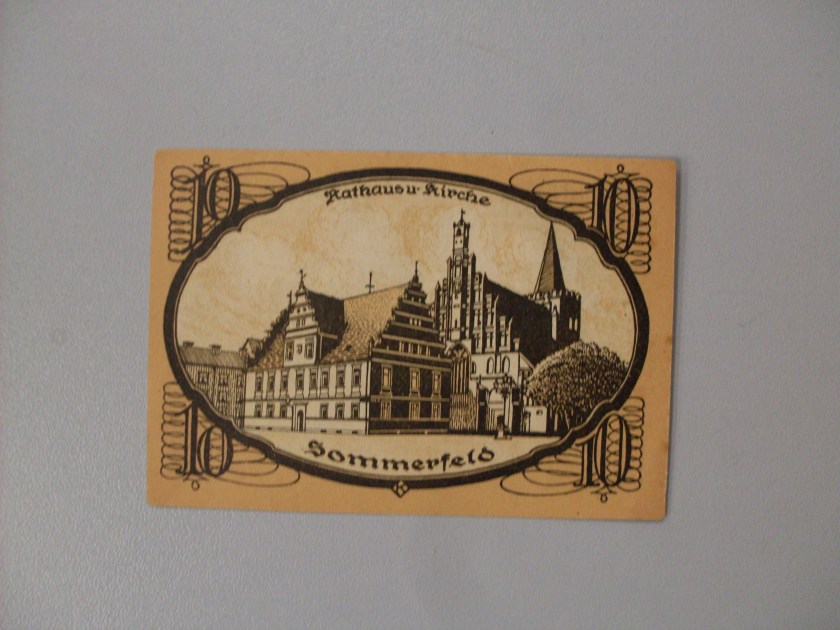
I mentioned in a previous blog post that I would focus a blog entry on Notgeld, and it is time to deliver on that promise. German notgeld has to be my personal favourite numismatic item to collect. The artwork and sometimes vibrant colours often put some of the more contemporary banknotes we have today to shame. It also allowed the individual issuing authority to show pride in their towns and cities, and display individuals and events particular to that region. Below is a very small selection of notgeld from my own personal collection to show the variety in the different pieces that were issued:


So what is Notgeld?
Notgeld is emergency money issued in both Austria and Germany from during WWI and the inter-war years prior to WWII. Issued during the economic crises and eventual global collapse post 1918, they were an attempt to bridge the void left by a failing economy provided by the central government at the time. They are not too dissimilar to token coinage issued in other countries throughout history, and other examples of such issues could be ‘Necessity money’ in both Belgium and France, the ‘Gun money’ issued in Ireland, ‘Company tokens’ issued by US mining companies, or the business tokens/’Condor tokens’ issued by businesses in Britain during the late 18th century.
Who issued the Notgeld?
Notgeld was often issued by a non licensed body in the separate towns and cities, usually a local savings bank or a local state/privately owned business. This limited the use of the notgeld to the town or area to which it was produced. Although this didn’t stop them from travelling from further afield. Each issuing body would often issue different series of notgeld for the local area. Often comprising sets of a common theme. With some of the more ambitious sets numbering around 7-8 notes. Some of these sets could show different landmarks in the area, or retelling of an important event which happened close by. Some of the sets even tell local tales and legends, with each banknote actually being numbered (with a letter) so the story can be placed in the correct order. Very similar to cigarette cards at the time.
What were they made from?
The main material notgeld was produced out of was from paper or card stock. Usually anything which was close to hand and in abundance. Coins were also minted in a fashion, from cheap base metals such as aluminium, or silk, linen, compressed coal, leather, clay and even re-purposed postage stamps. Some of the recycled materials also included playing cards, which are highly sought after by the collecting community.
How long were they issued for?
Although issued for most of the inter-war period, they were only produced in small batches for actual general use. So general periods can be 1914-18, 1922, and 1923. After the general need was met, some further production was carried out on the different series for the collectors of the different notes. Usually this demand was created by the various ‘sets’ the issuing bodies released. As with most things, there is always someone out there willing to collect it. This production of notgeld for collectors, has resulted in many examples surviving today still in mint condition, with those bearing the hallmarks of circulation being far outweighed by those that haven’t.
What was the issuing value of notgeld?
During the first issues of notgeld typical values never strayed higher than 1 Mark, with many being valued no more than 50 Pfennig. However, during the hyperinflation of the 1920’s, higher and higher denominations were being printed, with some reaching at the height of the crises, into the 10’s of millions of marks. This at the time when banknotes issued by the central government were reaching into the hundreds of millions. During this period, coal dust compressed notgeld became increasingly common. However, surviving examples are now extremely rare as they were often exchanged for actual coal, or even burned themselves for fuel.
When did notgeld stop being used as currency?
Notgeld ended it’s role as an emergency money after the collapse of the Weimar government in the early 1930’s. A move synonymous with the rise of the Nazi party and the chancellorship of Hitler, when the national currency was reformed and the Reichsmark came into force.
Below I have added some links to some good notgeld resources online. Usually with further links and lists to help identify any notgeld you may have:
 Numismatic Exploits
One thought on “Notgeld”