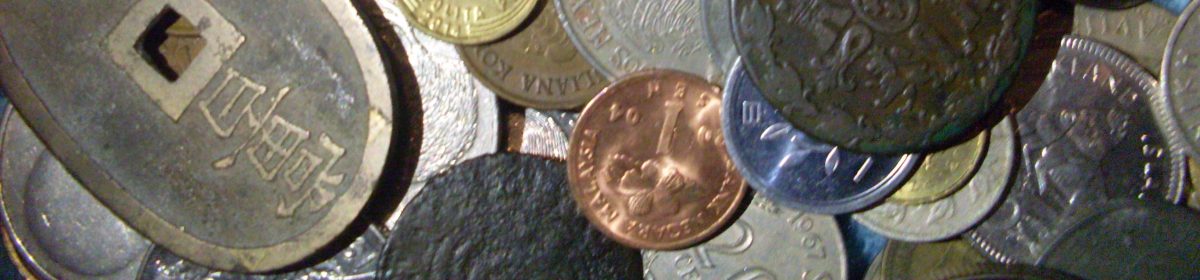
This time I have gotten some new coins with a different flavour for a change. As it is nice to step outside the bounds of Europe and N. America every so often!

All these coins originate from India (except the 5p of course haha) and are especially small in comparison to any other coin I have in my collection. They have a broad range of dates during India’s very long history. Dating from before colonial activity to British rule.
The first coin is a small silver 1 Chakram piece (top left) dating from 1860-1901. This is by far the smallest coin I have ever held in my hands, and now keep it in a small bag in case I ever drop it (which I have done and spent a furtive 20 minutes searching for it again). It hails from the Travancore region of India located at the very southern tip of the sub-continent. During the period of this coins minting, the kingdom of Travancore was under direct British rule. Travancore would exist as a kingdom until 1949 when it was merged with the kingdom of Cochin. It would later form a part of the state of Kerala in 1956, with the position of king being replaced by govenor (known as a Rajpramukh) being appointed by the president of the newly formed Indian state.
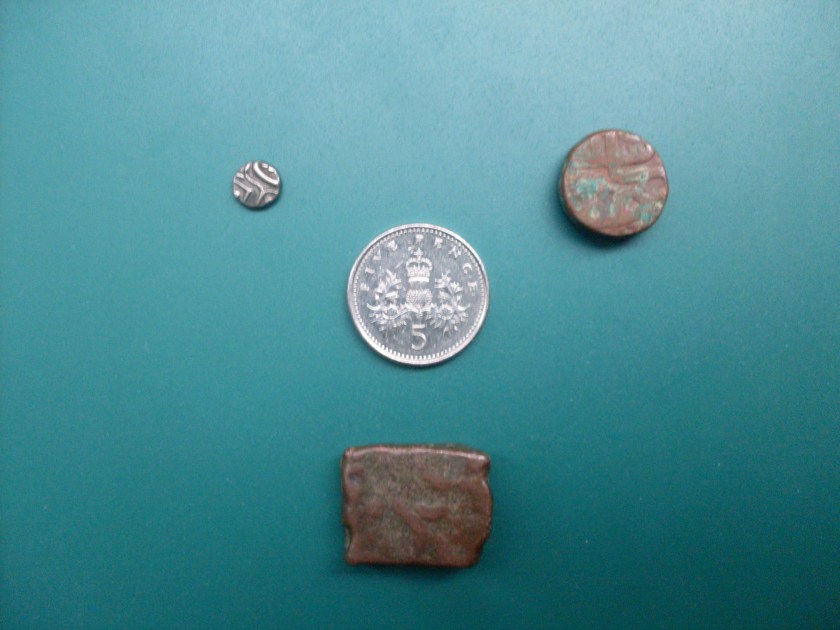
The next coin is a 1 paisa piece (bottom) from Hyderabad, located in the South central region of India. It dates from around 1763-1774, the period when the British East India Company was gradually exerting more control in the region creating presidencies and protectorates. Hyderabad wouldn’t come under the sphere of British influence until 1805 when the Maratha Empire loses in the second Anglo-Maratha war. Hyderabad itself gained it’s independence from the Mughal empire during the early 18th century when Mir Qamar-ud-Din Sidiqqi broke away from the empire and set up the Asaf Jah dynasty in control of the region. The ruler (known as the Nizam) would control Hyderabad until 1948 when he was deposed by the new Indian army in operation Polo to prevent a potentially large hostile state remaining in the middle of the newly formed country. The coin itself is rather worn, but a more detailed picture can be found here.
Finally, the last coin (top right) is a 1/2 Tonga from the Gujarat region of India, located in the far west of the country. It dates from 1512-1526. A period before any western colonial powers had an influence in the country. Much of northern India during this period was either in control or influenced by outisde muslim forces. Gujarat was no exception, and was attacked in the late 12th century, by Islamic forces from Eastern Iran. The invasion failed, but Muslim influences were transmitted peacefully due to close proximity of her neighbours. Gujarat would maintain close ties with Egypt, a powerful member of the Muslim world in the middle to late medieval period, which would later evolve to close ties with the Ottomans. Most notably in the form of working together to prevent Portuguese naval expansion in the Red Sea area. Gujarat would remain independent until it was conquered by the Mughal empire in 1572. This however would not diminish the region, as the port city of Surat would continue to flourish being the only major westward facing Indian port. This would cause the city to becoming a major trading hub on par with that of Beijing or Venice, eventually gaining the title of Bab al-Makkah (gate of Mecca).
 Numismatic Exploits