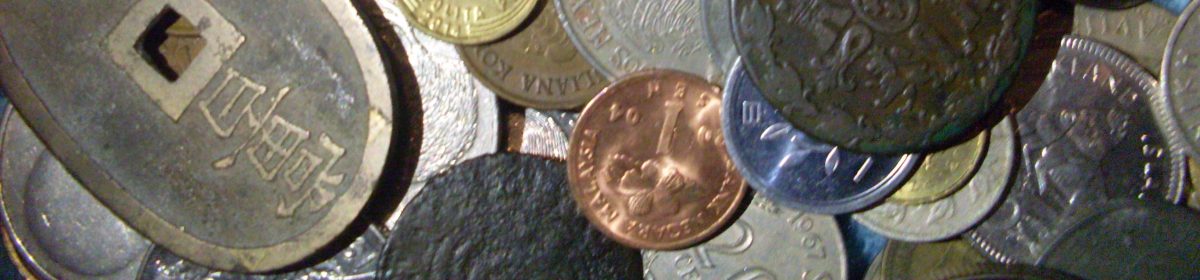
This month I am presenting the last installment of my Asia focus in regards to additions to my collection. It is safe to say that no foray into Asia would be complete without at least touching upon China. It dominates the region, and would be extremely hard not to at least acquire several coins from it’s extremely long history. I have also attained another Japanese copper coin (2 Sen, Meiji Era), as well as another silver Indian coin (1 Jital, 1210-1235) from the Dehli Sultanate.

I will start off with the rather worn and virdigrised coins on the piece of card. Both are clearly Chinese, and the one on the left dates from the year 7-14AD. It is a 1 Wu Shi coin from the ‘Emperor’ Wang Mang. I use the term emperor in quotes as Wang Mang was a court official during the Han dynasty who overthrew the Emperor of the Liu family and started the new Xin dynasty (which means ‘renewed’ in Chinese) under his control. Wang Mang was killed when the capital Chang’an (called Xi’an today) was attacked by forces loyal to the previous Han dynasty in 23AD. The Han dynasty was restored a few years later in 25AD and would continue to rule China until the start of the Three Kingdoms period in 220AD.
The coin on the right dates from 1094-98AD, and is a 1 cash coin from the Emperor Zhe Zong of the Song dynasty. Not much happened during Zhe Zong’s reign. He inherited the throne at the age of nine, and was under control of his grandmother until her death in 1093. He attempted reforms to gain further control on the empire, but due to political infighting amongst his courtiers, many of the reforms were not fully implemented. This would eventually lead to the collapse of the Song dynasty in the 12th century. Zhe Zong himself would die at the age of 24 in 1100.
The final two Chinese coins date from the early 20th century when China underwent massive political change and upheval. Following the turn of the 20th century, China was in the grips of the Boxer Rebellion (1899-1901), a movement which was anti-foreign, anti-colonial, and anti-Christian. A pro-nationalist movement which had risen up in response to meddling from foreign powers in Chinese affairs, and aggressive Christian missionaries infiltrating all aspects of Chinese life. Chinese government officials were split on how to deal with the movement as some held sympathies due to harsh demands and exploitation inflicted by the Western Colonial powers during the previous decades. The attitude of the Empress changed in favour of the Boxers in 1900, when international intervention was beaten back at the Battle of the Taku Forts. Eight different foreign powers sent troops to China to deal with the rebellion, and the now hostile Qing government. In 1901 the rebellion was quelled and ultimately the ruling dynasty’s control of the country. With defeat and the apparent weakness of the ruling Qing dynasty(not just in the Boxer Rebellion, but the previous Sino-Japanese war), many military officers, students and court officials advocated a change of government to that of a Republic. The Wuchang uprising sprung up in 1911. Several months later, other provinces in China followed suit after receiving appeals from rebel forces, and by March 1912 the Empress of the Qing dynasty abdicated, leaving China to become a Republic.
 Numismatic Exploits
One thought on “Collection Update Jan ’18”