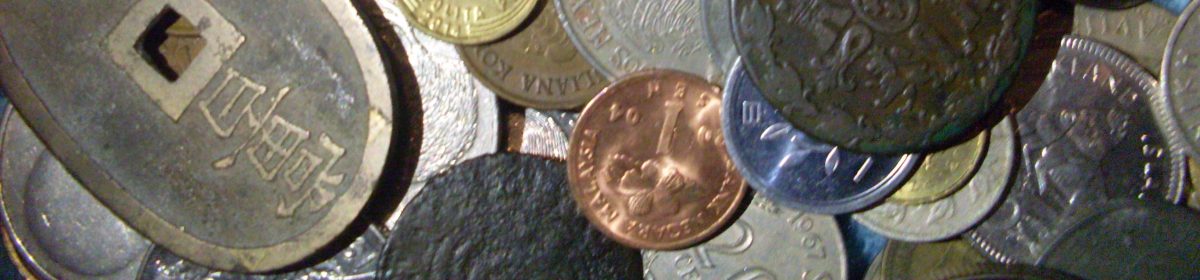
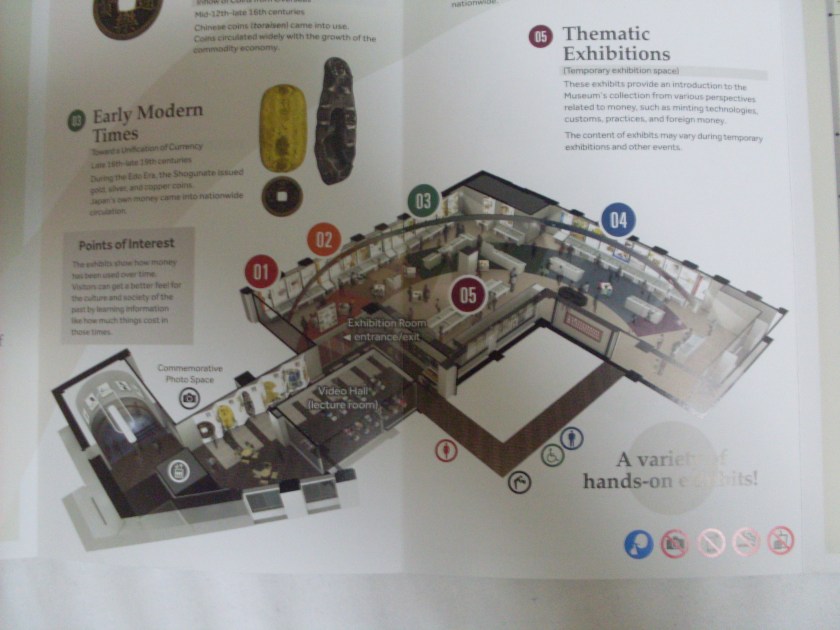
So I have finally had a chance to visit another numismatic venue. This time travelling to the other side of the world to Japan. Two things stood out when I first entered the museum. The first was the price, apart from the British museum, this is the only other museum which has a numismatic section to be completely free. Secondly, and more frustratingly (although understandable), photography was forbidden inside the building. So I had to make do with a picture of the sign outside and one showing the floor-plan from the pamphlet I got.

When entering the museum on the ground floor (the actual exhibition room is up a flight of stairs), you are greeted by a team of security guards and a metal detector. They are quite adamant that nothing stray enters the building, as I can attest there are some very valuable pieces on display which could easily be ‘acquired’ by the less discerning members of the public.
Another thing which happened during the check-in was when I was given a small bright red folder which had a brief translation and break-down of all the exhibition’s cases. The need for this became apparent when reaching the exhibition hall as everything was purely in Japanese.
The museum itself is not very large, but comparable in size to others I have been to. So that of itself was no big issue. It was definitely far better laid out than others though, with more space than the British museum, and some ordered progression throughout the room when compared to Vienna’s Kunsthistoriches Museum or Helsinki’s Kansallismuseo. The exhibit takes you through a certain route and journey through the history and evolution of Japan’s coinage. From the earliest coins copying those from China, to the more modern coins in circulation and the advent of paper money.
There were some well preserved and fantastic pieces on display throughout the exhibition. From basic copper coins, through silver to gold. It was sad that the guide I was reduced to using was only a summary, as not being a native Japanese speaker I missed out on a dearth of information provided on the individual pieces on display.
As well as Japanese pieces on display, other nations coins and banknotes were sprinkled throughout the exhibit helping to explain Japans economic history. Also being used as examples to explain design decisions the Japanese mint took when producing their own. Again, the quality of the pieces chosen were of prime condition. I was also amused to find a 9th century Anglo-Saxon coin mixed in amongst the collection. To think something that old from England had travelled so far tickled me.
The exhibit also had a section on how Japanese people have attempted to forge the currency, as well as the mints attempts to tackle counterfeits. I have only found one other museum to do this, again referring back to the British Museum in London. Although, compared to London, the Bank of Japan museum focuses mainly on endeavours in Japan rather than a more worldwide effort the British museum approaches.
The museum also contains many hands-on exhibits within the space. Visitors are able to touch 1 million yen in bills to see how large the stack would be (and the chance to feel that much money haha). They also had a heavily chained wooden case filled with enough pure gold ingots to allow visitors to feel the weight of several millions yens worth of pure gold. I just managed to get the case off the table.
Finally, my favourte part of the exhibit was tucked away in the corner at the back of the room. It was several electronic shelves built into the wall with an electric keypad locking system. Visitors were able to type in a code printed on the wall, and the shelves in the case would switch out and present different types of coins or banknotes with a specific theme in mind. I managed to see German Notgeld, Japanese occupation money from the Second World War, and medieval clan tokens before my control of the keypad was wrested unwillingly from me to a group of schoolgirls on a field trip.
In short, the Bank of Japan currency museum was certainly one of the more well thought out and well designed musems on the topic of numismatics I have gone to.
 Numismatic Exploits