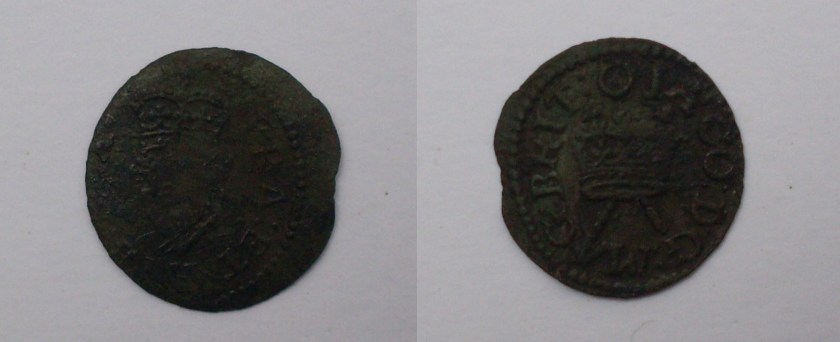
This month, I am going to talk about a small coin (about 16mm in diameter) from James I of England. This coin is known as a ‘Lennox’ farthing, taking it’s namesake from the man who minted them. Originally the patent to strike these coins was given to Lord Harrington by James I in 1613, due to their being an extreme shortage of small change in the country at the time (a problem which would persist until the late 18th century). Harrington died the following year in 1614, followed shortly by his son. The patent went to his wife who either sold it or gave it to Ludovic Stewart 2nd Duke of Lennox on June 28th 1614.
Ludovic would go on to mint five different variations of this coin. With only one of these actually being authorised to be circulated in Ireland. Despite a harp featuring prominently on the reverse of the coin, it was not until the fifth variation when it was allowed in Ireland. This fifth variation is markedly different from the others, as the flan was more oval shaped than round.
The coin shown in the picture above is the third variation minted sometime between 1622-24. This can be identified by the privy mark shown at 12 o’clock on the obverse side of the coin (above the crown and sceptres). The privy mark shown is called an ‘annulet’ (represented by a full circle), and with this third variation a total of 22 different privy marks were used. All in an attempt to stop forgeries.
The Duke of Lennox would die in 1624, a year before James I. The patent to strike the coin would pass on to his widow Frances Duchess of Richmond. The patent would be reaffirmed by James’ son Charles I, and the coins themselves would later be known as ‘Richmond’ farthings.
 Numismatic Exploits