I fear that this month’s update will be quite lengthy as I recently acquired a large number of German coins stretching through just over 200 years of history. During that time Germany went from a collection of individual states disguised as the Holy Roman Empire, to eventual unity. Two world wars, being split again, and another eventual reunification requires me to be very scant on details otherwise it would turn into a very lengthy essay!
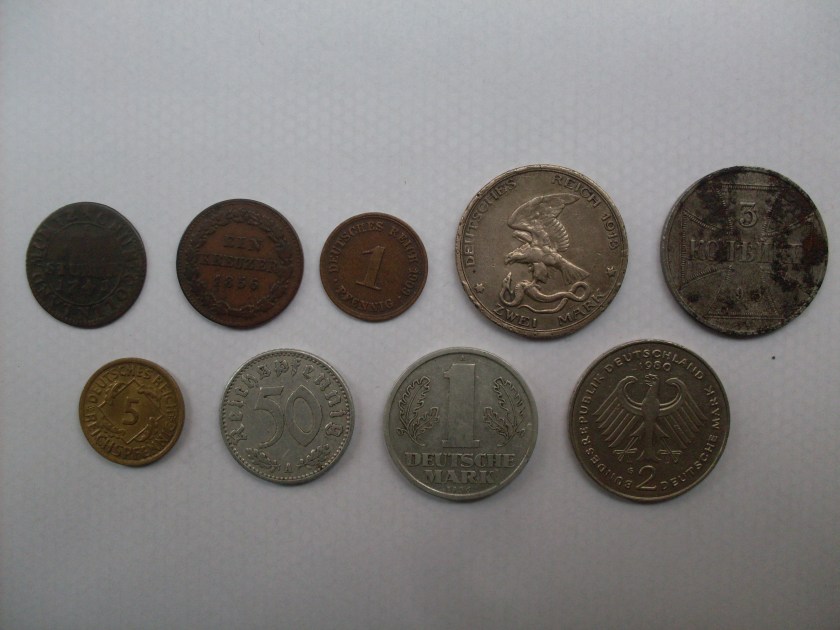
Our delve into Germany’s past starts with the first coin, which is a 1/4 Stuber from the German state of Cologne (dated 1741). Cologne at this time was an archbishopric and was issued under the name of Archbishop Clemens August (his stylised monogram taking up the obverse side of the coin).
The beginnings of the Holy Roman Empire are unsure, and many scholars cannot agree whether it was Charlemagne who became the first emperor in 800AD, or Otto I in 962AD. However, by the middle of the 18th century when the 1/4 Stuber was minted, the state of Prussia had come to dominate the Empire in it’s politics with the accession of Frederick I (the Great) to the throne of Prussia. Frederick would eventually spark the War of the Austrian Succession (1740-48) and more importantly the Seven Years Wars (1756-63) which would sow the seeds for the American Revolutionary War, and add further fuel to the fire which caused the French Revolution.
By the time of the minting of the next coin (1 Kreuzer, 1856, Duchy of Nassau), the Empire had been dissolved 50 years previously in 1806. This happened when Emperor Francis II’s armies were defeated by the French under Napoleon at the battle of Austerlitz. The Emperor abdicated after signing the Treaty of Pressburg, where many of the Empire’s western territories were organised into a French satellite state called The Confederation of the Rhine. After the end of the Napoleonic wars in 1815, the Confederation was replaced by the German confederation until 1866 when it became part of the North German Confederation founded by Prussia. A forerunner of the German Empire which would be formed under Prussian leadership in 1871.
The unification of Germany occurred under the leadership of the Iron Chancellor, Otto von Bismarck. The desire for a unified Germany was borne out of the revolutions which occurred in 1848-9, with the idea of pan-Germanism and the discontent felt with the traditional autocratic political structure of the current individual German states. Bismarck desired a unified Germany, but with Prussia at the helm, not Austria. So a series of wars were initiated to establish dominance. The first is known as the Second Schleswig War (1864), in which Prussia and Austria attacked Denmark. Achieving victory, both Austria and Prussia were ceded territory from Denmark, and the northern frontier of the future German Empire would be established. However, due to collusion with Austria, the outcome of this war led to the Austro-Prussian War (1866). The result of this war allowed Prussia to assert control over what would be the empires future southern provinces. It also ended the idea of forming a German empire which included Austria, as this would weaken any Prussian control.
Finally, in 1870, the French declared war on Prussia starting the Franco-Prussian War (1870-1). The French Emperor, Napoleon III, was worried about being encircled by two family members of the same house (A candidate of the Hohenzollerns was in line for the throne of Spain). Some clever politicking by Bismarck and the infamous Ems Dispatch caused conflict to be started. Prussia, with assistance from the Southern German states, easily defeated France. With the chief adversary to German unification being defeated, the new German empire was proclaimed in 1871 in the Hall of Mirrors in the Palace of Versailles with the Prussian King Wilhelm I becoming emperor.

The next few coins come from the German Empire, with the large 2 Mark (1913) being a special anniversary coin commemorating Prussia re-entering the Napoleonic Wars a century prior. The last in the top row is a 3 Kopeks (1916) made from solid iron. These would be issued by occupying German forces on the Eastern front in the Russian territories they had captured during WWI.
After Germany’s loss in WWI the Weimar republic was created in 1919. The first coin on the second row is a 5 Reichpfennig (1926) from the Republic. The Republic suffered many problems from it’s inception, ranging from hyperinflation during the Great Depression of 1929, political paramilitaries from both the Left and Right, and a contentious relationship with the victors of WWI, most notably France. The people of Germany blamed the Republic for the loss in WWI and the humiliating requirements of the Treaty of Versailles rather than the wartime government. This created the perfect condition for Hitler and the Nazi party to rise to power, which as everyone knows, led to WWII and the horrors committed within. The next coin is a 50 Reichpfennig from this period, dated 1940 below the eagle and swastika.
After Nazi Germany’s defeat in WWII, Germany was split in half between the Western Allies and Soviet Russia. The part controlled by the West was called the Federal Republic of Germany, whilst the part under Soviet control was called the German Democratic Republic. The last two coins each come from both parts of Germany. The 1 Deutsche Mark (1956) comes from East Germany, and it is testament to the conditions at the time under Soviet rule as the material the coin is made out of is aluminium. Compared to the 2 Mark (1979) coin from the West which is a much more solid cupro-nickel coin.
With the fall of the Berlin Wall in November 1989, it paved the way for Germany to be reunited again after 45 years of separation in October 1990 with the Treaty on the Final Settlement with Respect to Germany. This was further reinforced by the collapse of the Soviet Union the following year, and Germany was able to become fully sovereign in March 1991.
 Numismatic Exploits