Back in early 2018 I had a two week long trip to Japan. Whilst there I managed to pick up a wide variety of different types of coins and banknotes to add to my collection. Within the post I wrote at the time I mentioned that I added a unique Japanese banknote called a Hansatsu to my collection (the post can be found here). The Hansatsu I acquired back then it turns out was on the small side of what was produced in Japan at the time. This month I have managed to acquire another Hansatsu note, one which dwarfs the size of the ones I got during my trip.

The Hansatsu itself measures 19.5cm tall and 4.7cm wide. It dates from the mid 18th century and was made from thick card stock. The feel of it is very similar to rough cardboard. The value of the banknote is 1 silver momne, and was produced in Amagasaki Han which is now a part of modern day Hyogo Prefecture.
The Han system is the historical term for the estate of the Daimyo who were powerful Japanese feudal lords. Differing from Western style of feudalism, the Japanese feudal domain was based on projected annual income rather than geographical size. The value of the Han itself was based on the Kokuda system, which determined how much rice could be produced for one person for one year. This unit of measurement was called a ‘koku’ and would form the basis of taxation for each Han. The value obviously varied from Han to Han, with the richest Han in the Edo period being the Kanazawa Han owned by the Tokugawa Shogunate. The value of which was estimated to be just over 1 million koku in 1690.
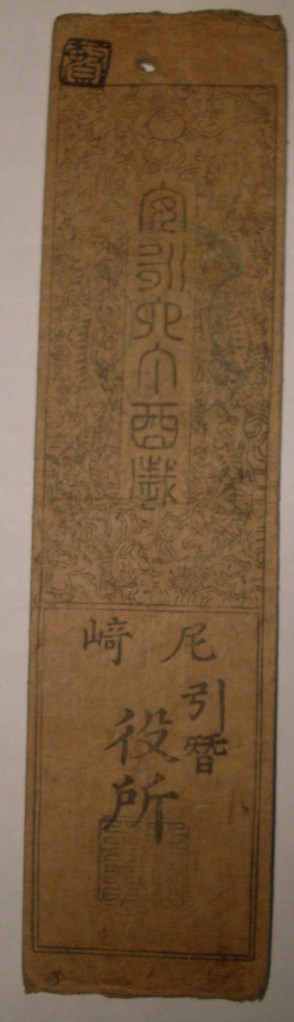
On the front of the Hansatsu, a large figure takes prominence at the top. This figure is the Japanese god Daikokuten, one of the seven Japanese gods of fortune within the Buddhist faith. As the value of much of Japan was tied to the production of rice, Daikokuten is often depicted on Hansatsu sat astride several rice bails. Furthermore, this is reinforced, as Daikokuten is also one of the deities tied to agriculture. As mentioned in my previous blog post, he is also tied to wealth, good fortune, and happiness, which has led him to be a popular God amongst the Japanese.
 Numismatic Exploits