A small and tiny coin enters my collection this month. Minted during a period of great political upheaval which resulted in a brief span of time which is seen as a small blip in the status quo of my country’s history.
This period from 1649-1660 is often referred to as the Commonwealth when a series of small civil wars broke out here in England leading to the trial and execution of the king and the appointment of a man to lead the country who is every bit as politically and historically controversial as Margaret Thatcher.

With the nominal value of 1 pence, this small silver coin is just 14mm in diameter and 1mm thick.
On the reverse of the coin are twin shields bearing the St George’s cross and Irish harp respectively, whilst above them is the roman numeral denoting the value of the coin. On the obverse is a single shield with the St George’s cross surrounded by a laurel wreath.
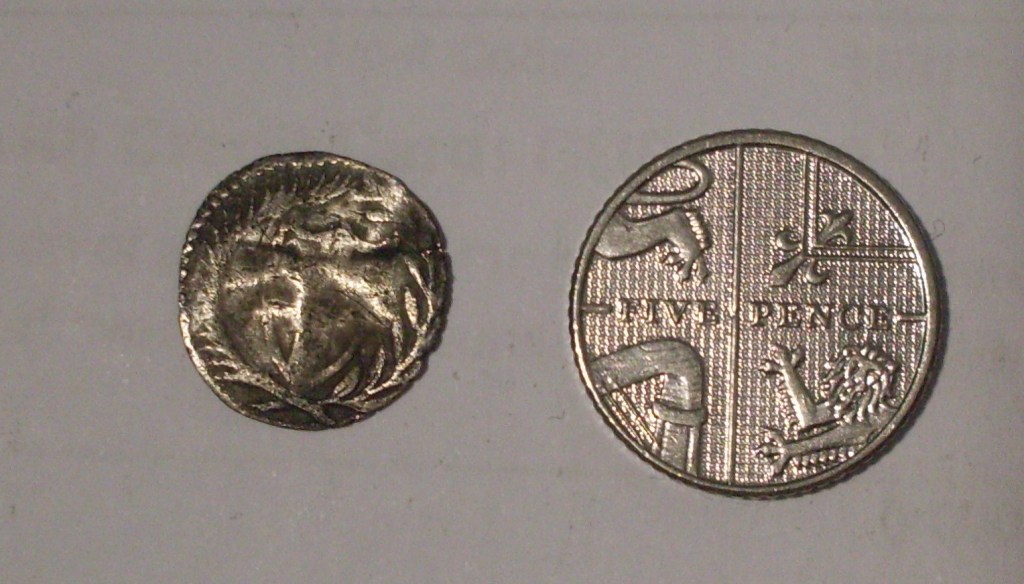
Breaking away with the more traditional designs this coin does not bear the royal coat of arms which was usual for English coinage at the time. A clear indication of the turmoil the country was going through when it was struck.
The Commonwealth was the political structure created by parliament in England and Wales after the execution of Charles I in 1649. Although the king was deposed, fighting would continue within the British Isles, most notably in Scotland and Ireland. This would continue until 1653 when Oliver Cromwell was pronounced Lord Protector of all four constituent nations after parliament was dissolved.
Cromwell’s place is severely contentious in the annals of history of these islands. Ranging as someone who would promote religious tolerance amongst the different Christian groups (Except Catholics) to a bloodthirsty warmonger who would carry out almost genocidal acts in Ireland.
Cromwell has been a figure of much debate by both contemporaries and historians alike. Some often portray him as an opportunistic hypocrite motivated by power, whilst others have described him as an “energetic campaigner for liberty of conscience.”
He would pursue an effective aggressive foreign policy which was aimed at trying to limit the economic powerhouse which was the Netherlands. With Jews finally being allowed to return to England after over 350 years of banishment by king Edward I. This was in hope that they would help speed up the economic recovery of the country after a decade of civil war.
Cromwell would also sign the Treaty of Paris in 1657, which would ally Britain with France against the Spanish. The terms would cede the ports of Mardyck and Dunkirk to Britain to help reduce the activity of corsairs and privateers which infested the Channel during this period.
Cromwell would be offered the crown of England in 1657, but he would stick to his principles and decline it due to being the arch-principle who brought down the previous king. However, the office would take on more of the trappings of the monarchy as time wore on, and it would be similar in all but name.
Cromwell would die of natural causes in 1658, and his son Richard would take over as Lord Protector. Richard was a poor substitute for his father and in 1660 would go into exile on the continent when the monarchy was restored that year under Charles II.
Cromwell has a very lasting legacy which is still felt amongst many who live here. The abolishment of the monarchy, although for a brief period of time, would allow more powers and freedoms to be granted to those outside of the system. When Charles II was crowned as king he would do so with much reduced powers than those enjoyed by his father, Charles I. Never again would parliament be dissolved at the whim of the monarch and the people of England (although still miniscule at this point in history) would gain a little say on how things would be run.
 Numismatic Exploits