Collection update August ’17

SDC12389

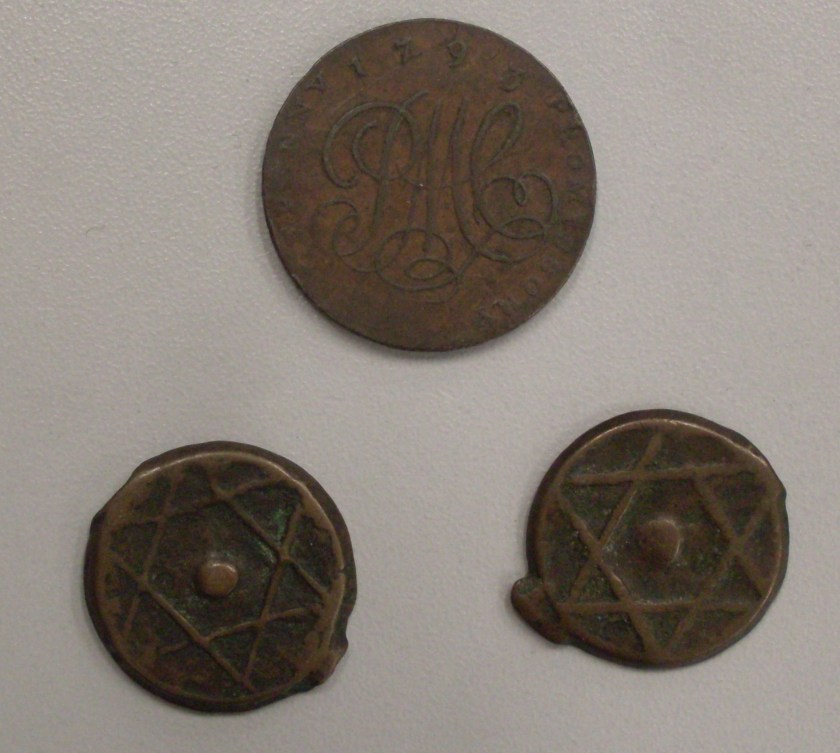
This month’s additions are a pair of bronze coins from Morocco and yet again another token.  I feel like I am getting more tokens these days than I am actual coins!  However, this token is a window into local Welsh history particular to Anglesey.

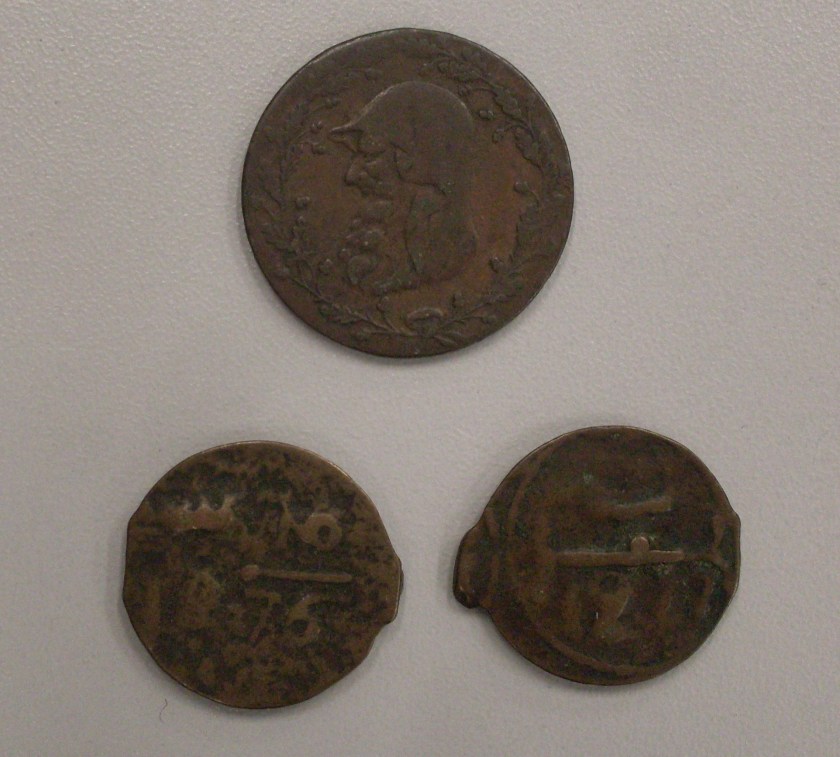
Now the story of this token references back to some of my previous blog posts, in particular, that during the late 18th century it was the practice of the British Royal Mint not to produce coinage of low numeric value as it was seen as to cheapen the name of currency.  This produced a lot of problems for the lower classes whose daily lives revolved around transactions involving small denomination coins.  As we can see, one of the outcomes was the evasion money I mentioned last month.  Another type of coinage which appeared was coins being minted by businesses and companies.  The token I acquired this month is known as the Anglesey Penny, or as it is more well known, the Druid Head Penny.  These coins were produced by the Parys Mountain Copper works to help facilitate the payment of it’s workers at it’s site in Amlwch, Anglesey.  This can be clearly seen by the PWC monogram on the reverse of the coin,  and although the picture is faded due to wear and time, a legend around the monogram promises to pay the bearer ‘one penny’ by the company itself.  The coins were first produced in 1787 and continued on until 1821 when it was made illegal to produce them.  During this time frame the idea became popular and a half-penny was minted as well, with production of these half-pennies starting in 1788 a year after the penny itself was introduced.  So why the druid motif?  This harkens back to ancient Anglesey history where the island was the spiritual home of the druidic order in Britain.  It therefore was the main focal point for the ancient Celtic religion until the druids were exterminated by the Romans in 77AD, which resultantly brought the celtic tribes under their control.
SDC12390

The other two coins which hail from Morocco are 2 bronze cast coins with the denomination of 2 Falus.  The dates are faded and worn and hard to discern, but both date from around 1275-1277 in the Arabic calendar (1858-1860).  At this time Morocco was ruled by Sultan Abd al-Rahman, who would die in 1859.  Morocco would continue to use cast bronze coins until machine milled coinage was introduced in 1882.  Apart from the cast bronze coins, Morocco also used silver and gold hammered coins for larger denominations.  Uniqely, there was no fixed exchange rate between the different denominations of coins Morocco produced, nor were the weights of the individual coins regulated.  Thus, it would be safe to assume that after haggling the price with the seller, you can further spend more happy hours haggling about the exchange rate.

Checking Change

The inspiration behind this entry came when receiving change from an automated machine in a local supermarket.  Whilst checking the coins to see if it came to the right amount I realised that one of the 2p pieces I was given was not actually a coin intended for use in the UK, but was minted for use in Gibraltar.  Not being bothered, because it was not a coin I had in my collection, it got me thinking about other coins I have received in my change which had a point of origin elsewhere.  This usually resulted in many destinations from British dominions such as the Falkland Islands, Gibraltar, Jersey, Guernsey and the Isle of Man.  However, the train of thought soon evolved into special minting of commemorative coins for general circulation.

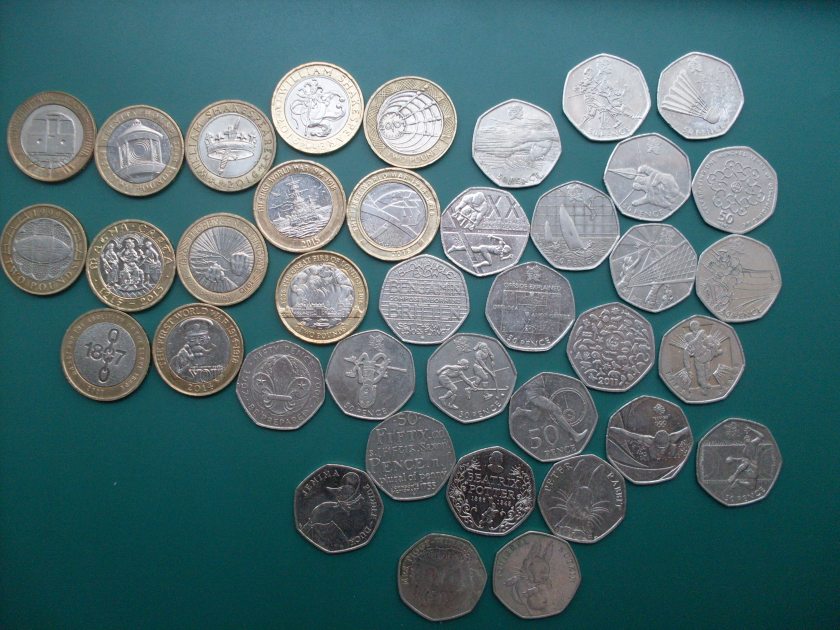
Now here in the UK we have many such coins in the form of 50p and £2 pieces.  Though scarce at first, the process has become rather endemic with many pieces being struck each year to commemorate people and events.  The latest run being the second release of 5 more 50p coins of Beatrix Potter characters.  Some of these coins though to a collector have value beyond what is struck on the face.  With some of the more notable examples being the Kew Gardens or the WWF 50p pieces.  This got me thinking further and I started scouring my collection for examples beyond the borders of the UK, and the picture below shows some of the examples I have dug out:

SDC12388

  1. Italy – (Going clockwise from far left) 200th anniversary of the council of state 200 Lira, World Food Day 1981 200 Lira, UN Food and Agriculture Organisation (FAO) 100 Lira, 100th anniversary of the birth of Marconi 100 Lira.
  2. India – Grow More Food coin from the UN FAO 50 Paise.
  3. New Zealand – 10th Commonwealth Games, Christchurch 1974 1 Dollar
  4. Spain – 1982 Football World Cup 25 and 50 Pesetas.
  5. Australia – 12th Commonwealth Games, Brisbane 1982 50 Cents.
  6. Argentina – 150th anniversary of the removal of the Spanish viceroy 1 Peso.
  7. Mexico – Centenary of the defense of Veracruz 20 Pesos.
  8. France – (Pre-Euro) 50th anniversary of the French Resistence 2 Francs
  9. Canada – (Clockwise from top) Confederation centenary 1 Cent, Year of Volunteers 10 Cents, Creation of the territory of Nunavut 1999 2 Dollars, Centenary of the Canadian Mounty 25 Cents.
  10. USA – (Left to right) Bicentennial of American independence 1 Dollar and 1 Quarter. (I haven’t included American state quarters in the photo due to the large number of them, and pure laziness on my part)
  11. Various – (From Left to right, top to bottom) Various 2 Euro coins collected during trips to Europe, the countries are as follows – Finland, Belgium, Germany, Austria (x2), and France.
  12. Algeria – Two 5 Dirham coins

Finally, as an aside, the photo below shows the various number of 50p’s and £2 coins I have managed to collect by getting them in my pocket change.  As a final note, I guess it is a good practice to check your change for more than to see if it is the right amount.  Sometimes you find something a little bit more special and unexpected.

SDC12387

Collection Update July ’17

This month’s additions to my collection is a small handfull of British copper coinage, and a single silver coin from the reign of Charles II.

Much of the earlier coins are severely worn, with the most prominent of the copper coins seeing less wear dating from 1901.  Much of the coins are copper pennies with various monarchs represented.  The earliest date is from the reign of George II, and although one of the coins exhibits a somewhat clear view of his bust on the obverse, much of the reverse showing Britannia is severely worn making it very difficult to date.

The small group of three coins in the bottome centre of the pictures however are the most interesting.  Shown here is an Irish half-penny, the exact same design as the penny shown in my collection update of last month.  It unfortunately shows the same amount of wear as it’s counterpart, although the bust of George III is more defined.

The silver coin is from the reign of Charles II, and I got it as part of this group in a bulk purchase.  It hasn’t weathered the years well, as it is slightly bent, with a hole punched through it.  It dates from 1679, 19 years after the restoration of the monarchy in the UK.  Charles’ father, Charles I was executed (and the only English monarch to have been so) by parliament after losing the Civil War to forces led by Oliver Cromwell.  Cromwell ruled the country in the role as Lord Protector until his death.  This is the only time when England has not been a monarchy, but a Commonwealth.

When Cromwell died in 1659, his son Richard was not well liked by the newly formed army, and was seen in general as a man incapable of continuing his father’s policies.  After a small coup enacted by the army, a new parliament was installed.  After much deliberation and politicking, Charles II issued the Declaration of Breda which acknowledged his acceptance of the conditions proposed to him on accepting the English crown.  The monarchy was restored in May 1660, and Charles II was crowned in April of the following year.

Finally, the only other coin of note is the modern 2p coin.  It is significant because it dates from 1971, the year that the UK decimalised it’s currency, ending the old system of pounds, shillings, and pence.  A system which is often ascribed to being the longest running monetary system globally, dating back to the Roman occupation of the British Isles.  This 2p coin however, is also of note, as instead of showing the later inscription of the value in letters above the number on the reverse, it instead uses the phrase ‘New Pence’.  A feature on the coin until 1982.  Also of note, there was a mistake in the minting of 2p coins in 1983, and some bearing the old legend of New Pence has become somewhat rare.  So remember to check your change, you may have a nice night out in the form of a copper coin!

Evading the law!

Another talk about token coinage again this time.  Today I would like to focus on a British token coinage issued during the late 18th century called ‘evasion tokens’.

imgonline-com-ua-twotoone-chQoJCLLAU

Now the picture above (although blurry, and the token itself quite worn), shows one of the many different types of evasion tokens which were minted during this period.  So why do these things exist?

During the late 18th century in Britain counterfeiting was rampant, with some reports saying that only 2/5th’s of the coins in general circulation were actually genuine.  These figures come from around 1753, by 1771 it was getting out of control, and magistrates were applying more and more pressure to find the counterfeiters and destroy the minting machines.  It was then that the counterfeiters found a loophole in the law which allowed them to continue making the fake coinage.

The laws at the time stated that only ‘Regal’ coinage was covered by the counterfeiting laws.  Thus, if a coin was not an ‘exact’ copy of one issued by the government, then the law is technically not being broken, and thus any punishment is evaded.  They were not coins, but tokens.  Hence the name ‘evasion tokens’.  Most of these tokens were thus changed to suit the work-around in the law.  So a large number of figures replaced King George, such as Isaac Newton, William Shakespeare, and even George Washington (the example in the photo shows Pope Gregory II).  George III wasn’t completely removed either, with his facing changed, or the legend around his bust altered.  The legends themselves were often nonesense or humourous in nature.  With some saying ‘Brittania Rules’, ‘These Bonny Isles’, ‘Bonny Girls’ and so on.  There were some instances of company names being included on the reverse of some tokens too.  Speaking of the reverse, these were also a target for changes, with Britannia being slightly altered, or replaced with the Irish harp entirely.  The legend was also subject to change, with similar epithets to those placed on the obverse, often more outlandish with examples of ‘Englands Glory’ and ‘Hilarias’ being used.

The tokens themselves were often widely accepted by the populace at the time for a couple of reasons.  First and foremost, there was a dire need of small change at the time, due to indifference by the government towards a copper coinage.  It was a widely held belief that copper was not a fit enough metal to strike a ‘regal’ coinage, and thus striking copper coins was not an especially important activity for the Royal Mint to pursue.  Secondly, many of the native provincial Britons were illiterate and if the ‘coin’ on offer looked somewhat genuine and something they were used to, they were happy to accept it.

The earliest examples of evasion tokens date from the mid-1770’s, but the majority seem to come from between 1795 and 1800.  There are thousands of different designs out there, and were first started to be catalogued in 1892 by Atkins, which then wasn’t updated until in 1987 by Cobwright, with a further revision in 1993 (A walk in the Monkolokian Forest in search of the Spiny Fubbaduck – yes, that is the title of the work by Cobwright).


Collection update June ’17

SDC12365

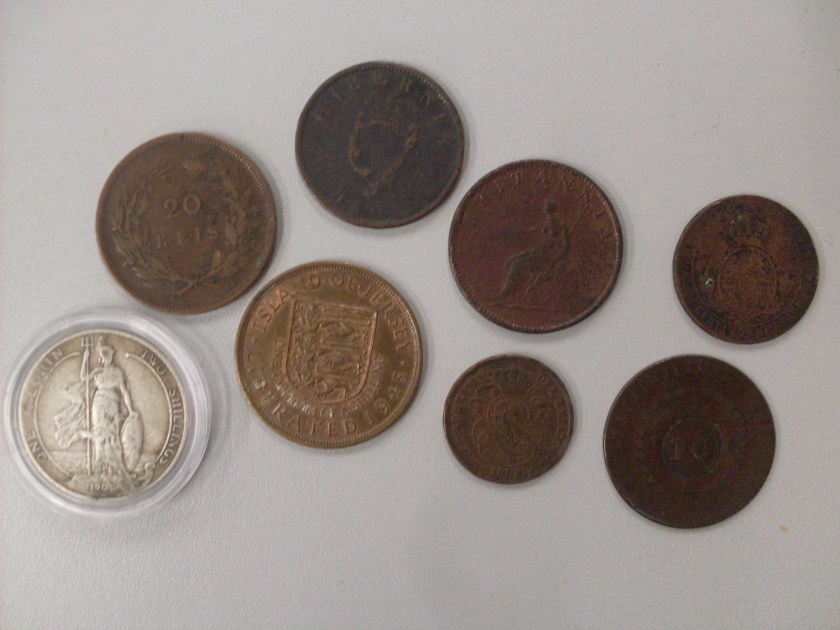
This month I managed to acquire a small smattering of 19th and early 20th century copper coins, with one silver 1904 florin.  The florin itself is interesting due to the fact it is the first design change of how Britannia was depicted on the coinage of Britain.  The usual design choice is with Britannia seated facing left, with her shield and trident by her side.  A image which can easily trace it’s roots back to Roman provincial strikes during their ~300 year occupation (The Royal Mint has a small page detailing more information about Britannia and the Romans.).  On the Florin of Edward VII we can clearly see she is standing facing right, with her customary trident and shield in hand.  This design was used until 1911 when it was changed to a pattern of crossed sceptres and shields depicting the coat of arms of the four constituant countries of the UK.

Keeping within the UK for a moment more we also have a bronze coin from the island of Jersey dated 1945, commemorating the liberation of the island from occupying German forces at the end of WWII.  Along with Guernsey and Alderney, the Channel Islands were the only part of the British Isles to be occupied by German forces during the war.  They were held from June 1940 till their peaceful liberation in May 1945.

SDC12366

To the top centre of the pictures there is a Hibernian penny dated 1805.  Unfortunately, the coin is badly worn, and the inscription, especially the portrait, of George III on the obverse is barely visible.  Hibernian coins were minted for the sole use in Ireland, and were minted after a 20 year gap due to the Napoleonic wars and the American War of Independence.  Minted in Soho, these coins were the first official issue of Irish coins in a base metal.  Most official coins being minted in precious metals such as silver.  This therefore caused a shortage of change (which was not just endemic to Ireland, but the UK as a whole at the time) leading to many ‘tokens’ being minted by locals throughout the country to fit this need.  These tokens were known as Evasion Tokens, and will be the topic of my next blog entry.

Finally, the last coin worth talking about, is the Brazillian 20 reis coin which has been counterstamped in the bottom right corner of the pictures.  Even though it is severely worn, the coin dates from the mid-1830’s when the Empire of Brazil was suffering from a series of revolts, uprisings and civil unrest.  Brazil at this time was under the control of Pedro II, the son of Pedro I who returned to Portugal to install his daughter on the throne.  Brazil was therefore ruled by a weak regency council as Pedro II was underageat the time.  The unrest began due to several wars with neighbours, but the straw which broke the camels back in regards to the currency could either have been the Cabanagem or the Malê Revolt.  Regardless, the currency was devalued in an attempt to save the country’s finances, and to save costs by not reissuing a new currency, the government simply cut the value of the coins in half.  So a 20 reis coin became a 10, and a 40 reis coin became a 20 and so on.  The new value of the coin was the counterstamp clearly seen in the middle of the reverse over the original value.  I do own several Brazillian coins with these counterstamps, but there are surviving types of this coin which do not bear the counterstamp, unfortunately I have only had the privilege of seeing them in pictures only.

Collection update May ’17

This month I will be talking about two small coins which I got as part of a small group of silver coins mainly from Denmark.  The Danish coins themselves date from the early 20th century, and like most Scandinavian coins of that era, their design, in my own personal opinion are something to be desired.  Generally sporting the value of the coin itself whilst displaying the monogram of the current monarch.  A bit lacklustre.  The second coin I want to talk about can easily fit into this category, as the design on the reverse is nothing to write home about, but the bust of the monarch is rather interesting to say the least.  However, I will move on to the first coin, as it has a bit more history attached to it.

imgonline-com-ua-twotoone-jkFhueRz2vhIj

Now above is a small silver coin from the city of Hamburg dated 1738.  It is about 17mm in diameter and about 1mm thick.  On the obverse we see the three towered castle which is the coat of arms of the city, whilst on the reverse is the date and value between some branches.  Sadly, sometime during it’s life the coin has been pierced to be worn as jewellery, thankfully it hasn’t marred much of the designs on both sides of the coin.  Even if it does leave a large ugly hole staring glaringly at you.
Hamburg itself is in a unique position within Germany, occupying an area in the north of Germany at the southern point of the Jutland peninsular. The full name of the city is the ‘Free and Hanseatic City of Hamburg’, tipping its hat to it’s medieval past and links to the Hanseatic trade league that it was a member of.  For much of Hamburgs existance it was a free city within the Holy Roman Empire, and later German Empire, being a state in it’s own right.  During the middle ages, Hamburg was one of the improtant ports within Europe due to it’s location near the North and Baltic seas, as well as being on the confluence of the rivers Elbe, Alster and Bille.  This was further strengthed by it’s status as a free city.  It was not, in fact, until after the Second World War that Hamburg lost it’s total independence from Germany itself as it was subsumed into the administration of Western Germany during British Occupation in 1949.  Where to this day it has grown to be the second largest city in Germany.

The second coin I mentioned is a silver threepence from the UK from 1819.  Now as I mentioned previously, the design of the coin itself is rather dull, but really I want to talk about the bust of George III displayed.

SDC12314

Now although the coin itself is very worn, and suffering from deep scratches on the face, a clear outline of the bust can be seen.  This bust design is known to collectors as the ‘bull-headed George’.  This was due to the engraver at the time, the Italian Benedetto Pistrucci, being unable to engrave a proper portrait from life due to George being very much insane. This portrait was thus put into use for several years between 1816-1820, and was met with much public hostility from all sectors of society.  One high ranking official in the Houses of Parliament has even been noted to have said ‘send the lot to the provinces so no-one has to see them’.  By this he meant the anywhere that wasn’t London or the south of England.  A view which is still often in use today.  Eventually the design was withdrawn from use, and the mint reverted back to the older ‘Young head’ design of the late 18th century, much to many peoples relief.  George was succeeded by his son George IV in 1820.

Notgeld

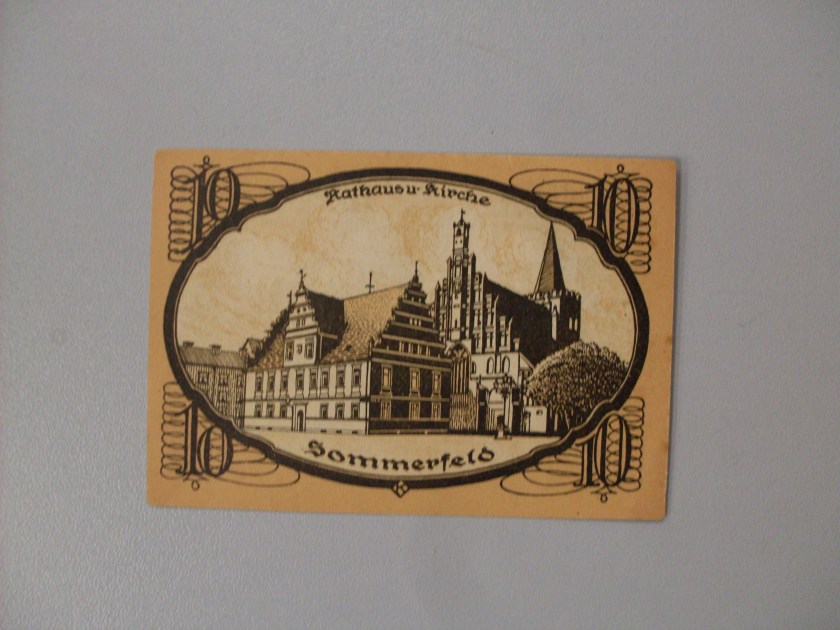
I mentioned in a previous blog post that I would focus a blog entry on Notgeld, and it is time to deliver on that promise.  German notgeld has to be my personal favourite numismatic item to collect.  The artwork and sometimes vibrant colours often put some of the more contemporary banknotes we have today to shame.  It also allowed the individual issuing authority to show pride in their towns and cities, and display individuals and events particular to that region.  Below is a very small selection of notgeld from my own personal collection to show the variety in the different pieces that were issued:

So what is Notgeld?

Notgeld is emergency money issued in both Austria and Germany from during WWI and the inter-war years prior to WWII.  Issued during the economic crises and eventual global collapse post 1918, they were an attempt to bridge the void left by a failing economy provided by the central government at the time.  They are not too dissimilar to token coinage issued in other countries throughout history, and other examples of such issues could be ‘Necessity money’ in both Belgium and France, the ‘Gun money’ issued in Ireland, ‘Company tokens’ issued by US mining companies, or the business tokens/’Condor tokens’ issued by businesses in Britain during the late 18th century.

Who issued the Notgeld?

 Notgeld was often issued by a non licensed body in the separate towns and cities, usually a local savings bank or a local state/privately owned business.  This limited the use of the notgeld to the town or area to which it was produced.  Although this didn’t stop them from travelling from further afield.  Each issuing body would often issue different series of notgeld for the local area.  Often comprising sets of a common theme.  With some of the more ambitious sets numbering around 7-8 notes.  Some of these sets could show different landmarks in the area, or retelling of an important event which happened close by.  Some of the sets even tell local tales and legends, with each banknote actually being numbered (with a letter) so the story can be placed in the correct order.  Very similar to cigarette cards at the time.

What were they made from?

 The main material notgeld was produced out of was from paper or card stock.  Usually anything which was close to hand and in abundance.  Coins were also minted in a fashion, from cheap base metals such as aluminium, or silk, linen, compressed coal, leather, clay and even re-purposed postage stamps.  Some of the recycled materials also included playing cards, which are highly sought after by the collecting community.

How long were they issued for?

Although issued for most of the inter-war period, they were only produced in small batches for actual general use.  So general periods can be 1914-18, 1922, and 1923.  After the general need was met, some further production was carried out on the different series for the collectors of the different notes.  Usually this demand was created by the various ‘sets’ the issuing bodies released.  As with most things, there is always someone out there willing to collect it.  This production of notgeld for collectors, has resulted in many examples surviving today still in mint condition, with those bearing the hallmarks of circulation being far outweighed by those that haven’t.

SDC12311

What was the issuing value of notgeld?

During the first issues of notgeld typical values never strayed higher than 1 Mark, with many being valued no more than 50 Pfennig.  However, during the hyperinflation of the 1920’s, higher and higher denominations were being printed, with some reaching at the height of the crises, into the 10’s of millions of marks.  This at the time when banknotes issued by the central government were reaching into the hundreds of millions.  During this period, coal dust compressed notgeld became increasingly common.  However, surviving examples are now extremely rare as they were often exchanged for actual coal, or even burned themselves for fuel.

When did notgeld stop being used as currency?

Notgeld ended it’s role as an emergency money after the collapse of the Weimar government in the early 1930’s.  A move synonymous with the rise of the Nazi party and the chancellorship of Hitler, when the national currency was reformed and the Reichsmark came into force.


Below I have added some links to some good notgeld resources online.  Usually with further links and lists to help identify any notgeld you may have:

https://notgeld.com/

http://germannotgeld.com/

https://www.notgeldmarket.com/

Collection update April ’17

This month I will be showing off some 17th and 18th century coins I managed to acquire at an extremely good price.  These coins hail from the Polish-Lithuanian Commonwealth which dominated Eastern Europe for much of the 16th and 17th centuries, until it’s decline in the mid to late 1600’s and eventually being partitioned in three stages by the Russian Empire (1772), the kingdom of Prussia (1793), and finally the Habsburg monarchy (1795).  Poland and Lithuania would then not be independent states again until 1918.

SDC12305

Now the picture above shows various coins throughout the life of the Commonwealth, with the 5p piece being shown as an example of the size of these coins.  All of them are hammered copper, as milled coins were still in it’s infancy during this period throughout many countries during this period.  Although some headway was being made in the process throughout France and Britain at this time.

The four coins on the left date from the mid-1660’s during the reign of John II Casimir Vasa.  They sport both emblems which are featured as the coat of arms of both nations which give the name sake of the Commonwealth.  There is the armoured horseman of Lithuanian and the argent eagle of Poland.  These coins come from a period when the Commonwealth is starting it’s century long period of decline.  During the two decades prior to these coins being struck, the Commonwealth had just lost a war against Russia, being forced to concede several parts of the Ukraine.  Poland also suffered an invasion from Sweden, known colloquially as ‘The Deluge’.  During this invasion Poland suffered heavily from the Swedes, with around 188 cities being sacked, and the population of many of them being severely destroyed (90% population destruction reported in Warsaw alone).  Some historians have argued that the destruction caused by the Swedish invasion was more costly to Poland than what the country suffered during WWII.  A figure estimated at 4 billion Zlotys (£750 million, $990 million) in 2012.

The coins on the right date from the mid-1750’s, from the reign of Augustus III.  During his reign he saw much upheaval and disorder by many of his subjects.  Augustus III and his predecessor Augustus II were relatively weak kings during the Commonwealths history.  More interested on their hold of the Electoral seat of Saxony in the Holy Roman Empire, they used the Commonwealth as a vehicle to increase their standing with the German provinces.  This caused the ferment of unrest as mentioned previously causing many reform movements to me founded.  Consequently, this led to the rise of the Polish Enlightenment.  The most interesting thing about the Polish Enlightenment is the key strata of society which spurred the movements.  In Western Europe, many of the Enlightenment movements were started by the lower classes in the bid for more freedom, tolerance and equality in society.  In Poland, it was the nobility (a mere 10% of the population at the time) which started the trend.

Finally, the coin at the bottom of the group, dates from the reign of Stanislaw II, the successor of Augustus III.  Also the last king of the united Polish-Lithuanian Commonwealth.  His reign saw the final collapse and destruction of the Commonwealth.  With the final blows starting with the first partition of Poland in 1772.  His successful attempt at a constitutional reform in May 1791 came too late however, and the Commonwealth ceased to exist as a political entity after the third partition in 1795.  The constitution set up by Stanislaw is unique in that it is the first constitution of the modern period in Europe, second worldwide after the US constitution of 1787.

Tied in with the coins above, I also acquired one more coin from the Kingdom of Prussia.  Dating from 1795, it coincides with the final year of the Polish-Lithuanian Commonwealth, with Frederick William II being one of the chief overseers of the Commonwealths death throws.

imgonline-com-ua-twotoone-XTF9hD6lPQaw

As well as overseeing the final partition of the Commonwealth, Frederick was keen in wars across much of Europe.  Particularly fighting against the French in attempts to keep (which was seen at the time), poisonous pervading influences of the French Revolution from tainting other European countries.  However, poor finances and promises to coalition partners caused much of his efforts to be stunted, a situation further exacerbated by the newly acquired Polish territories in 1795.

The new £1 coin

Now although it has been nearly a month since its general release, I have finally managed to acquire one of the new pound coins that doesn’t look like it has been dragged through a muddy field (I mean it has just been under a month…how do people manage to get them so dirty so quickly?).  So anyway, the design on the reverse is of the principle ‘flowers’ which represent each principle country of the UK.  You have the rose for England, the thistle for Scotland, the leek for Wales, and the shamrock for N. Ireland.  A winning design picked from a group selected by the Royal Mint.  I did hear on the grapevine somewhere that one of the chief entries for consideration for the new coin was to put something iconic of Britain on there, and someone came up with a full English breakfast.  The fact this was seriously considered did not fill my heart with confidence.  Thankfully they chose something a bit more sensible, if somewhat boring.

imgonline-com-ua-twotoone-tAjtp21G7SEl

So the new pound is radically different to the old ones.  It is somewhat larger, thinner and sports a new shape reminiscent of the old three pence piece the UK had prior to decimalisation in 1971.  It is also made up of two contrasting metals with a nickel-brass outer ring and a cupro-nickel core, making it very similar to the current circulating £2 coin, and a slight imitation to the 1 euro coin.  So the big question is, why the radical change? Why now, after the last major change to the UK currency was back in the late 90’s with the introduction of the £2 coin.

The simple answer is… just to combat fraud.  The pound coin is one of the most forged coins in British circulation, with the Royal Mint estimating that 1 in every 8 pound coins is fake.  So with the radical change in the coins composition and design other security features have also been added.  As well as the new shape, the usual ridged edge has also been included in the design.  As well as a semi-holographic area underneath the Queen’s portrait on the front (which I am told is also the 6th current portrait of her, and the new pound is the first coin to utilise it) which switches between the number one and the pound symbol.  Along the edges in fine writing there is script, which I didn’t notice until I inspected the coin with a jewellers loupe.  I personally thought it was just random bumps as decoration.  Either way, on the obverse the small script says the value of the coin, whilst on the back it shows the date.  There is a final hidden security feature which hasn’t been told to the general public (I am sure we will all find out sooner or later), which allows any authority to instantly check to see if the coin is legitimate or not.

As for my own personal opinion I am still a bit ambivalent about the coin.  As a collector I love seeing new stuff and witnessing big changes in a country’s coinage.  However, I feel a little bit sad as the old design will be phased out by the end of the year and it is something I have always known and grown up with.  I guess right now I am going through what everyone does when something new comes along and changes things.  I am sure the new pound will grow on me, and I will continue looking forward to the revealing of new designs on future strikes.  As long as it’s not a bloody full English breakfast…

Collection update March ’17

This months additions to my collection are items I purchased on my trip to Austria.  The prices of items there were a tad bit expensive (read: very), so the amount of pieces I obtained were few.  I did however manage to procure something I have been trying to get a hold of for a long time.  So I think I will start off with that!

imgonline-com-ua-twotoone-3Mpx2AzZ1LcD

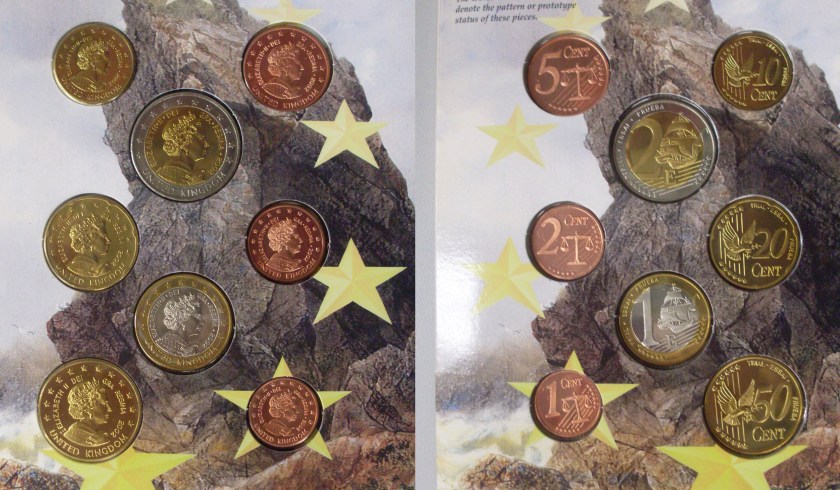
As you can see in the picture, these are prototype Euro coins for the UK.  Now obviously as we all know the UK did not adopt the Euro, and with Brexit, we can safely say any chance of that happening in the future is infinitesimally small.   These sets were created in 2002 by the International Numismatic Agency to showcase what British Euro coinage would look like, and another set was produced in 2004 with a Scottish theme to it.  This set, being the 2002 one without the 5 euro coin, is only one of 20,000 made.  Apart from showing Queen Elizabeth on the front (Golden Jubilee design), the designs on the reverse were picked to symbolise Peace, Commerce and Justice.  Now the UK was not the only EU member country who do not use the Euro.  Others such as Poland, Denmark, Sweden, the Czech Republic et al also have prototype sets like this floating around in collectors circles.  I did see the set for Denmark, but due to the price was unable to acquire it.  To be quite honest, it was secondary on my personal agenda over this one regardless.  This set being more desirable to me now now that the UK has voted to leave the EU.  A fact which renders a lot of the bumf on the back of the sleeve mute.

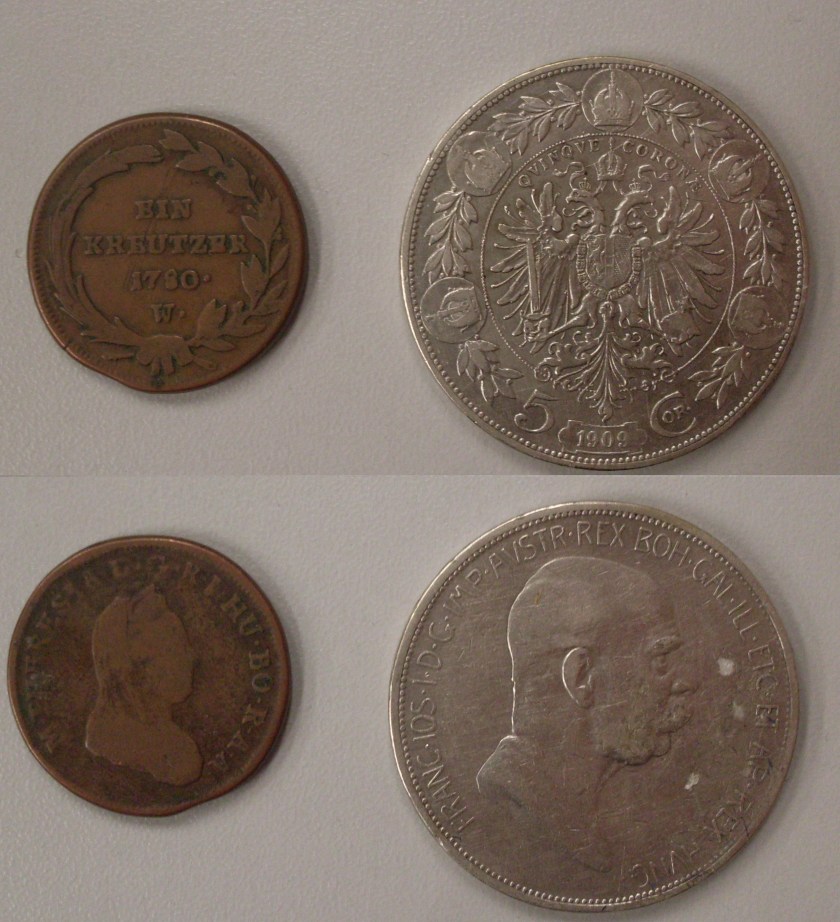
The next two items I purchase were two Austrian coins from the reigns of Maria Theresa and Franz Joseph I.

imgonline-com-ua-twotoone-PSRobNktePmh

The coins themselves are nothing spectacular, both showing signs of wear and tear.  With the 5 Corona coin of Franz Joseph being almost solid silver (which explained the 30 euro price tag on it).  So why did I purchase these coins?  More for the historical significance of the people represented on them than anything else.

Maria Theresa is important as being the only female ruler of Habsburg line, being the leading ruler of vast swathes of 18th century Europe, stretching from Italy in the South, to the Netherlands in the North, as well as numerous regions/countries/lands in central Europe as far East to central Romania.  She enacted many financial and educational reforms which strengthened Austrian control in the region as well as try and bring it kicking and screaming into modernity.  Something which she laid the foundations for, but wouldn’t bear fruit well until the late 19th century when it was implemented properly.

Franz Joseph I bears the title as Austria’s longest reigning monarch, as well as the second longest in Europe (missing out on the top spot to King Louis XIV of France by 4 years).  During his reign he witnessed the oncoming of the industrial revolution, the formation of both Germany and Italy as countries, and the outbreak of the First World War.  Surviving an assassination attempt in 1853 by a Hungarian nationalist he enacted a stance of harsher controls over Hungary and the other Balkan states under the Austrian crown.  This fermented further dissent in the local populaces who were being ground under the chafing strap of Austrian authority, which eventually led to the assassination of Archduke Franz Ferdinand in 1914 and the events which transpired afterwards.  Franz Joseph died in 1916, and his successor Charles I saw the abolition of the Austro-Hungarian empire, and with it the monarchy itself.