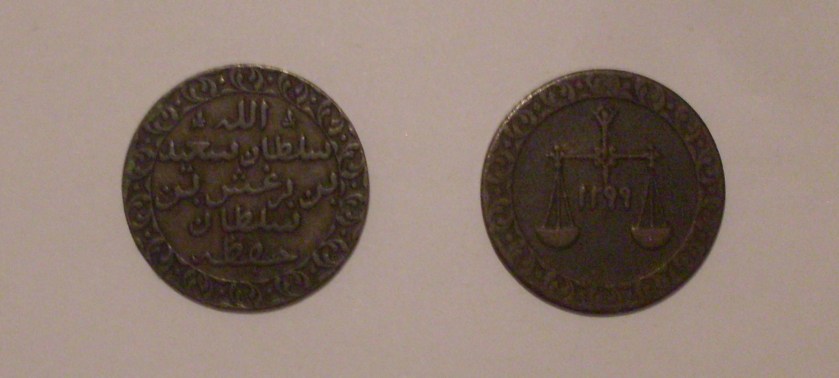
This month I have two small copper coins from the island of Zanzibar to talk about.
Minted in 1882 (1299 in the Arabic calendar) in Belgium, these two coins are from the small island of Zanzibar, now a part of Tanzania, off the coast of East Africa. The script on the front of the coin in Arabic translates to ‘Sultan Sa’id ibn Barghash ibn
May Allah save him.” The coin itself, is about the size of a British 10p coin, or a US quarter, with roughly the same thickness too. The denomination is 1 pysa.
Vasco da Gama’s visit to the island in 1498 started the period of European influence on the island. Prior to this, Zanzibar had been a small trading hub between Arabic and Indian traders in the east Indian Ocean. Portuguese settlers would found several settlements on the island, with the main city of Stone Town being expanded. However, Portuguese influence was very limited, much preferring to leave administrative control of the area to local leaders. This would come to an end in 1631, when the local Sultan massacred the Portuguese inhabitants. Direct control would occur until 1698 when Zanzibar would come under the control of the Sultan of Oman, who was invited by the local Swahili elites to remove the European presence.
Up until the late 19th century, Zanzibar would remain as a trading hub throughout the region, with many valuable goods, such as spices and ivory passing through. It was also a major hub area for the slave trade, with as many as 50,000 slaves passing through the port each year.
This proliferation of the slave trade in Zanzibar was the root cause of British involvement on the island. During the early 19th century, several treaties were signed between the Sultan of Zanzibar and the British to limit and eventually stop all slave trading ships passing through the territorial waters. The Sultan, losing a key source of revenue, decided to make Zanzibar itself the centre of the slave trade in the region instead. Finding it difficult to capture slave trading ships in the area during the 1850’s and 60’s, Britain informed the Sultanate in 1873 that a formal blockade of the island would occur unless the practice was stopped. The pressure caused the Sultan to relent, and the Anglo-Zanzibari treaty was signed stopping the slave trade, banning slave markets and protecting the rights of freed slaves.
Eventually in 1890, Zanzibar became a protectorate of Britain. Apart from a brief 38 minute war in 1896, the protectorate would last until 1963 when Britain passed the Zanzibar Act which ended the system. Zanzibar did not gain independence as Britain did not officially have sovereignty over the island, but citizens of the island until that point had the right to be British citizens. One of the most famous of these would be Freddie Mercury, who was born in Stone Town in 1946.
 Numismatic Exploits