Ave Maria

A look at a coin this month which is a well known icon amongst those who collect. First minted in 1741, it is still minted today with the date of the ruler’s death in 1780. Minted not just in the it’s original country of origin, but would be minted throughout the world until 1962. I am of course talking about the Maria Theresa thaler.

A typical Crown sized coin, the thaler measures 42mm in diameter with just a thickness of 2.5mm. Weighing a smidge over 28g, the coin is made of .833 silver. On the obverse of the coin we can see a depiction of Empress Maria Theresa, whilst on the reverse is Maria’s Habsburg coat of arms, a double crowned double-headed eagle holding a shield divided into four fields representing Hungary, Bohemia, Burgundy, and Burgau. Within this larger shield is a smaller crowned shield in the centre representing the coat of arms of Austria.

The thaler was originally struck in Austria between the years 1741-1780. Being the circulating currency of the Holy Roman Empire and it’s dominions it quickly became a important trade currency, with much of it’s popularity stemming from it’s use in the Arabic world and near East.
Maria’s successor, Joseph II, would allow the continued use of the 1780 dies after her death as the thaler would become the only silver coin the traders in the Arabian world would trust. This would set a precedent whereby all future strikings of the coin would use the 1780 date.
The popularity and success of the thaler would see it’s use and spread to areas of Africa and Asia which would adopt it as a sort of unofficial currency until after WWII. On the 19th September 1857, the thaler was declared an official trade coinage, and whilst little over a year later it would lose it’s status as an official currency in Austria, it would see a increase in production globally.
Mints around the world would begin to produce their own copies of the thaler, with notable examples coming from Birmingham, Bombay, Brussels, London, Paris, Rome, and Utrecht.
Although minting of the thaler outside of Austria would end in 1962 when the UK government formally agreed to stop production, the Austrian mint still produces them to this day, with proof and uncirculated versions being available to order from their mint.

It is estimated that, up until the year 2000, 389,000,000 thalers have been minted since their first inception in 1741.
Collection update March ’17

This months additions to my collection are items I purchased on my trip to Austria.  The prices of items there were a tad bit expensive (read: very), so the amount of pieces I obtained were few.  I did however manage to procure something I have been trying to get a hold of for a long time.  So I think I will start off with that!

imgonline-com-ua-twotoone-3Mpx2AzZ1LcD

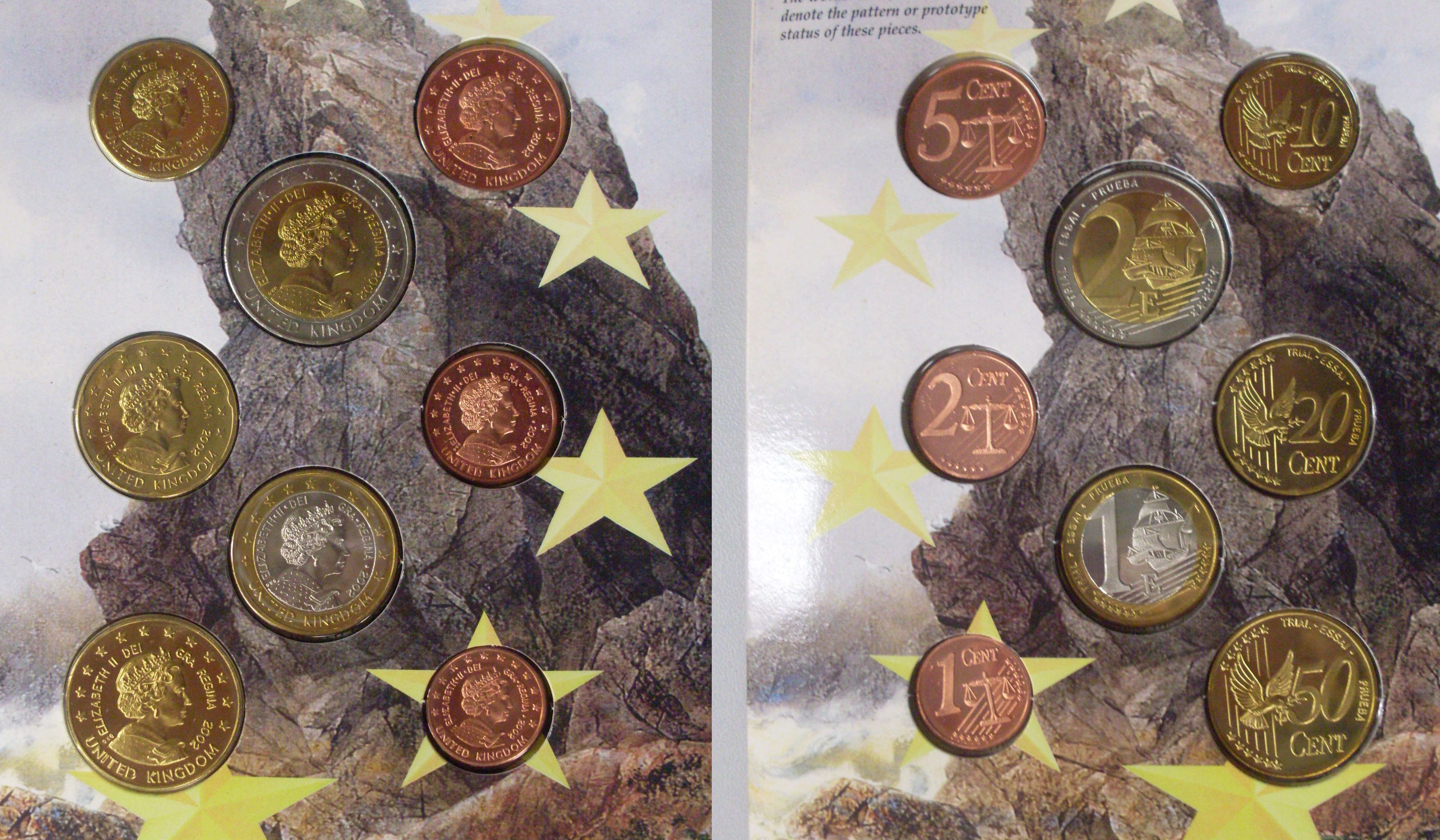
As you can see in the picture, these are prototype Euro coins for the UK.  Now obviously as we all know the UK did not adopt the Euro, and with Brexit, we can safely say any chance of that happening in the future is infinitesimally small.   These sets were created in 2002 by the International Numismatic Agency to showcase what British Euro coinage would look like, and another set was produced in 2004 with a Scottish theme to it.  This set, being the 2002 one without the 5 euro coin, is only one of 20,000 made.  Apart from showing Queen Elizabeth on the front (Golden Jubilee design), the designs on the reverse were picked to symbolise Peace, Commerce and Justice.  Now the UK was not the only EU member country who do not use the Euro.  Others such as Poland, Denmark, Sweden, the Czech Republic et al also have prototype sets like this floating around in collectors circles.  I did see the set for Denmark, but due to the price was unable to acquire it.  To be quite honest, it was secondary on my personal agenda over this one regardless.  This set being more desirable to me now now that the UK has voted to leave the EU.  A fact which renders a lot of the bumf on the back of the sleeve mute.

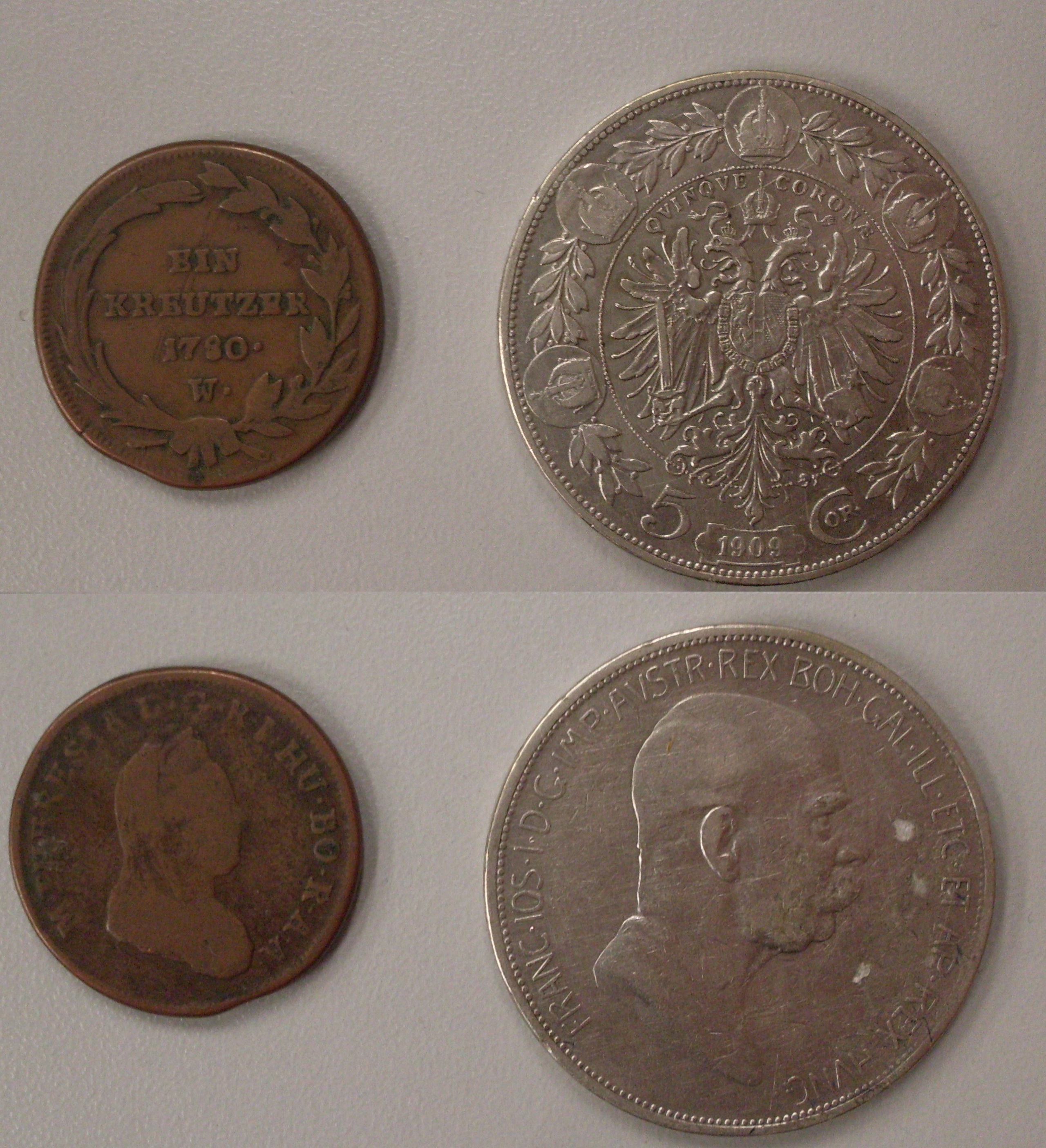
The next two items I purchase were two Austrian coins from the reigns of Maria Theresa and Franz Joseph I.

imgonline-com-ua-twotoone-PSRobNktePmh

The coins themselves are nothing spectacular, both showing signs of wear and tear.  With the 5 Corona coin of Franz Joseph being almost solid silver (which explained the 30 euro price tag on it).  So why did I purchase these coins?  More for the historical significance of the people represented on them than anything else.

Maria Theresa is important as being the only female ruler of Habsburg line, being the leading ruler of vast swathes of 18th century Europe, stretching from Italy in the South, to the Netherlands in the North, as well as numerous regions/countries/lands in central Europe as far East to central Romania.  She enacted many financial and educational reforms which strengthened Austrian control in the region as well as try and bring it kicking and screaming into modernity.  Something which she laid the foundations for, but wouldn’t bear fruit well until the late 19th century when it was implemented properly.

Franz Joseph I bears the title as Austria’s longest reigning monarch, as well as the second longest in Europe (missing out on the top spot to King Louis XIV of France by 4 years).  During his reign he witnessed the oncoming of the industrial revolution, the formation of both Germany and Italy as countries, and the outbreak of the First World War.  Surviving an assassination attempt in 1853 by a Hungarian nationalist he enacted a stance of harsher controls over Hungary and the other Balkan states under the Austrian crown.  This fermented further dissent in the local populaces who were being ground under the chafing strap of Austrian authority, which eventually led to the assassination of Archduke Franz Ferdinand in 1914 and the events which transpired afterwards.  Franz Joseph died in 1916, and his successor Charles I saw the abolition of the Austro-Hungarian empire, and with it the monarchy itself.