Day 12

Half way through the calendar and we are arriving back in Asia, fully rounding out the number of coins from each continent (except Antartica) to two each. This time we are heading to Macao.
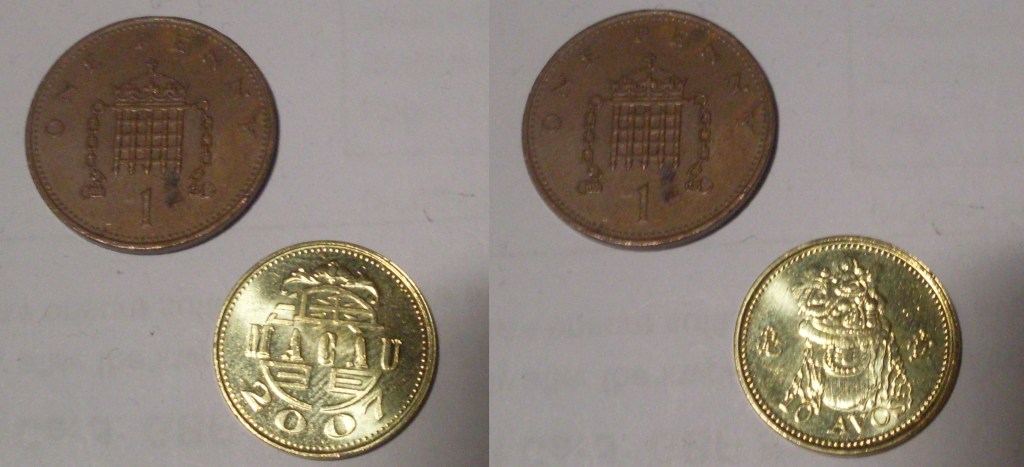
Dating from 2007 and made out of brass, on the obverse of the coin is the name of the territory in Portuguese with the date below it. The Portuguese name is surrounded by Chinese characters which spell out Macao in Chinese. The design of the Chinese characters are positioned in such a way that they also symbolise “shou” or longevity in Chinese. Finally, at the top, is a bat with it’s wings stretched out in flight. In Chinese customs bats are the harbingers of 5 blessings: Life, Wealth, Health, Love of virtue, and death after achieving one’s destiny.

On the reverse of the coin is a depiction of a lion headdress often used in the traditional lion dance throughout China. The lion dance is often performed at Chinese New Year as well as other important Chinese festivals and celebrations. The lion dance is distinguishable from the well known dragon dance due to the fact it is operated by just two dancers compared to teams of people holding poles representing the snaking body of the dragon.

Cash in hand

Back in January during my usual aims for the year I mentioned that I would like to pursue attaining more Asian coins for my collection.  Well this month I have finally achieved what I set myself.  Grabbing myself 12 Chinese cash coins to add to my growing hoard.

SDC13425SDC13426

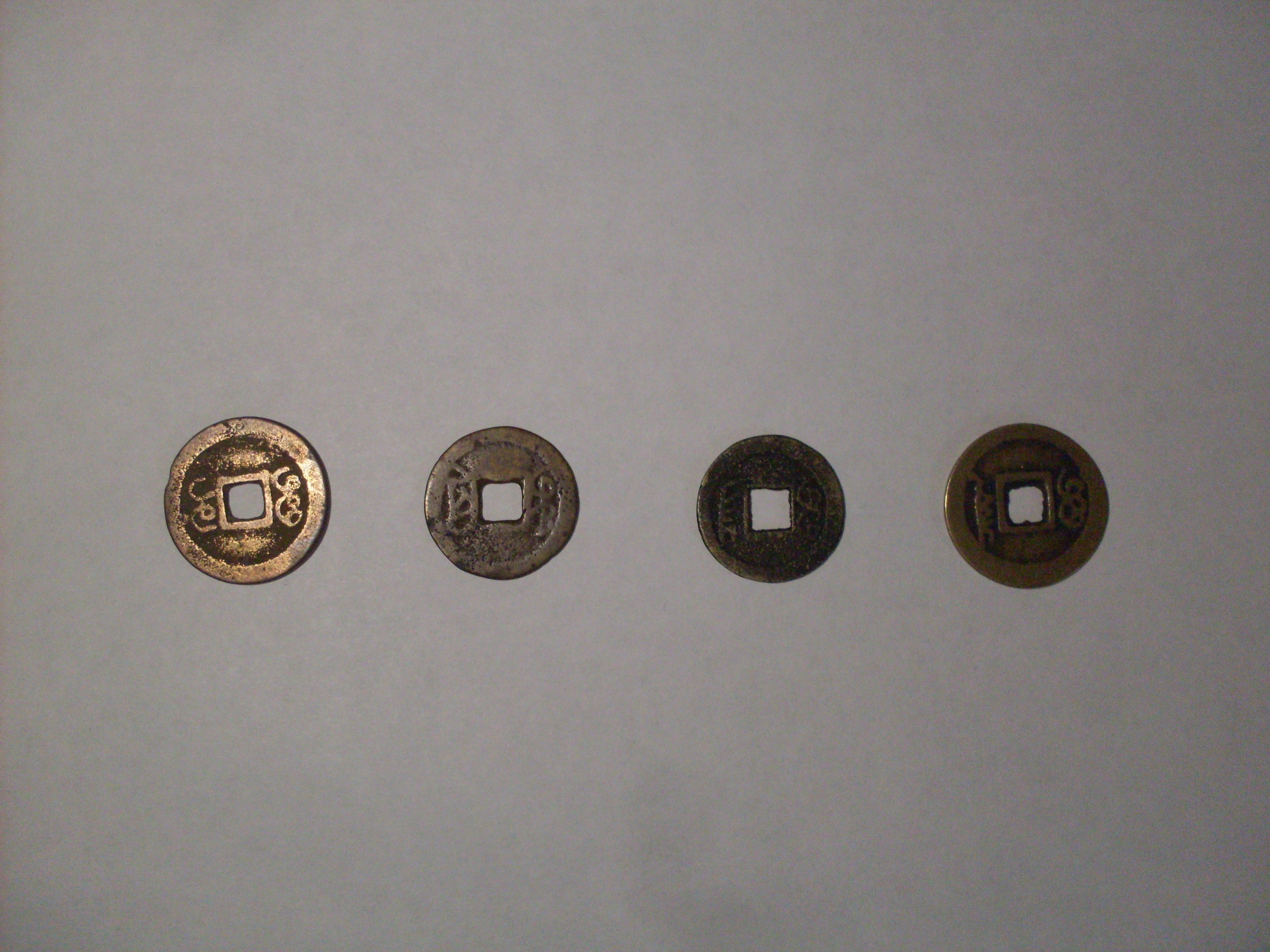
The first four coins from the group I have were identified by the person I purchased them from.  From the pictures, going from left to right, they are in date order.

1st – Dating from the Emperor Jiaqing of the Qing dynasty, this coin was cast from between 1796-1820.

2nd – Another coin from the Emperor Jiaqing, and dating from the same period as the first.  This coin however is known as a Boo Jin.

3rd – From the Emperor Daoguang of the Qing dynasty, this coin was cast between 1821-45

4th – From the Emperor Puyi (also known as Xuantong) who was the last emperor of China.  This coin was struck around 1908-09.

The other coins I acquired sadly are difficult to identify.  Mainly because I have no idea how to translate the Chinese characters on the coins themselves.

SDC13427SDC13428

I did however learn a few new things about Chinese cash coins during my attempts at researching them.  They were first made during the 4th century BC, and were in use continuously until their final casting in the first year of the Republic of China in 1912.  During this period the design remained pretty much the same, with the round shape and square hole most of us known them for.  This meant that many coins which had been struck during the Northern Song Dynasty (AD960-1279) were equally valid and in circulation up until the early 20th century!

Finally, despite the majority of the cash coins being manufactured through the process of casting.  During the latter periods of the Chinese Empire, it was also known for several of the coins to be machine milled similar to most coins are today.  Two of which can be seen in the bottom row of the last set of pictures above.  You can easily tell them apart from the ones which have been created via casting due to the crisper edges and lettering.

Collection Update Feb ’19

We are heading back to Asia this month for my latest addition to my collection.  China more specifically.

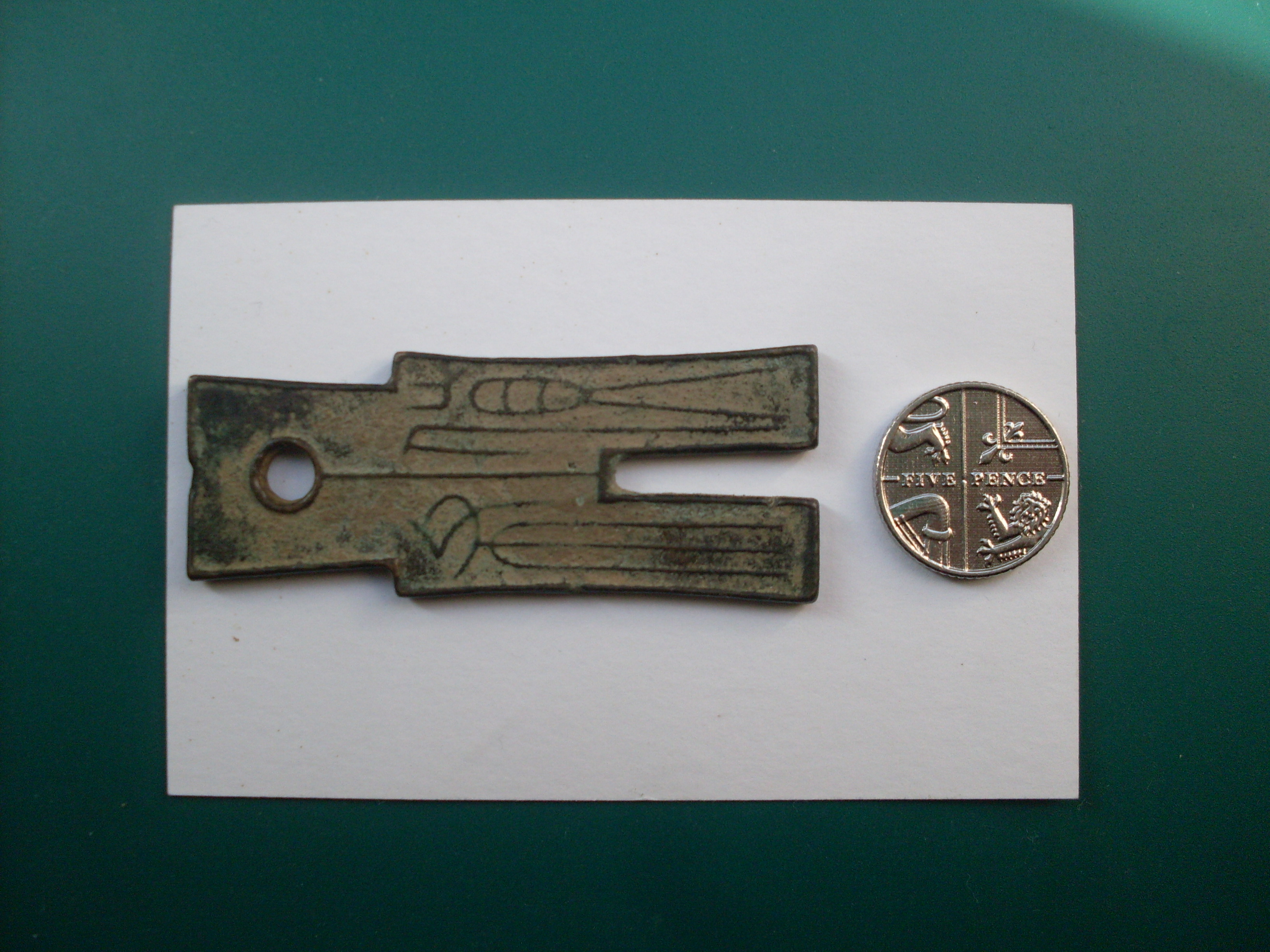
The piece I got this month is something I have only ever managed to see in museums or in books.  However, I got lucky and through some of my contacts found someone willing to sell on an example from their own collection.

SDC12846

From the picture above you can see a Huo Bu (money spade) from the reign of the emperor Wang Mang (9-23AD).  Now, this is not the first time I have acquired a coin from this Chinese emperor, and I have written briefly about his reign in a previous blog post back in January last year (Here).  So I won’t regurgitate anything in this post.  So I would like to explore spade coins in general.

Chinese spade coins were first made during the Zhou dynasty (~1045 – 256 BC) and resembled a small spade or weeding tool often used by the people as an alternative form of currency.  The original spade coins would have a hollow handle at the top of the coin, representative of the wooden handle you would insert.

Towards the later period of the Zhou dynasty, the legs would be less pointed and early forms of Chinese characters would start to appear on the coins.  Further changes would happen during the warring states period (475- 221 BC).  Each of the individual states would start producing their own spade coins, and they would become much smaller and would no longer have the hollow handle at the top.  Different shapes would also begin to be produced, with examples known to exist including arched feet, rounded feet, and coins with three holes (Pictures and examples of which cane be found here).

After Emperor Qin Shi Huang has conquered the warring states in 221 BC he replaced spade coins with the titular round coins with square holes many of us are familiar with and associate with in regards to ancient Chinese coins.  This would continue until we reach our reoccurring blog favourite, Wang Mang.  When he became emperor he reissued spade coins, in an attempt to impose some legitimacy to his dynasty after he usurped the throne and forge a link with previous dynasties.  The spade coins by this time had proven to be unpopular however despite several different types being cast and issued.  Round coins were ultimately reintroduced shortly afterwards, and the spade coin was resigned to it’s place in Chinese numismatic history.

SDC12847

Collection Update Jan ’18

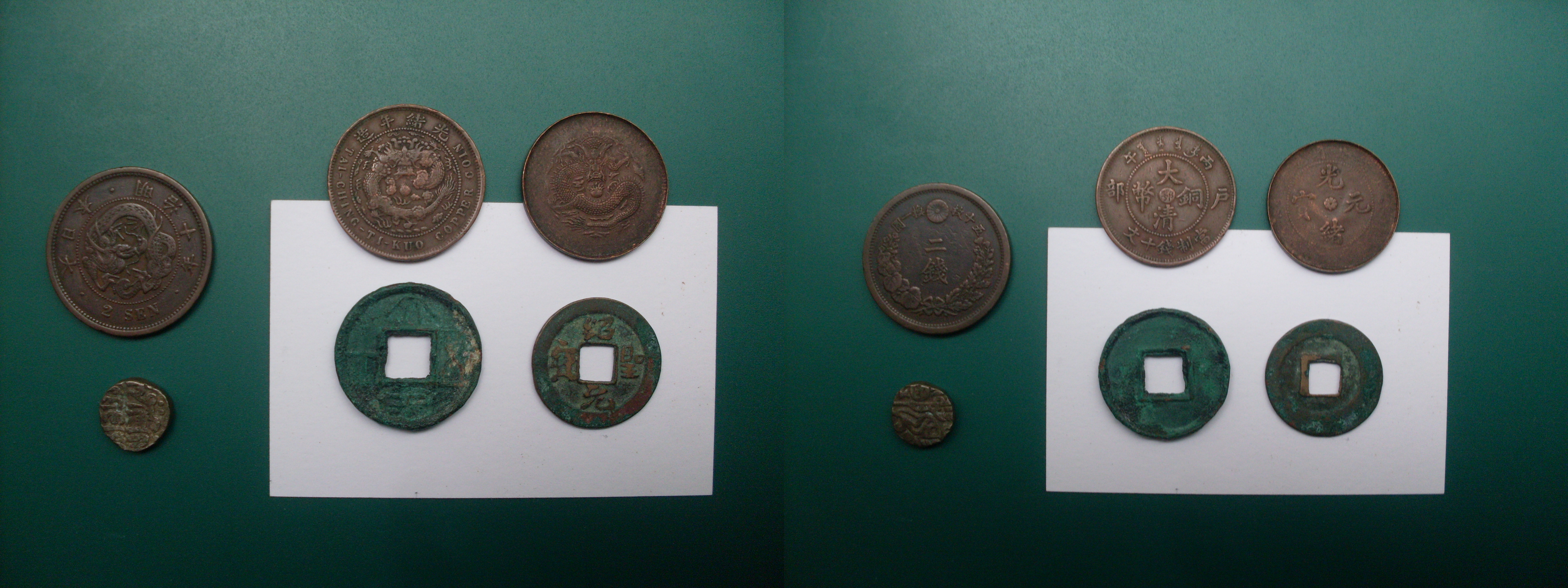
This month I am presenting the last installment of my Asia focus in regards to additions to my collection.  It is safe to say that no foray into Asia would be complete without at least touching upon China.  It dominates the region, and would be extremely hard not to at least acquire several coins from it’s extremely long history.  I have also attained another Japanese copper coin (2 Sen, Meiji Era), as well as another silver Indian coin (1 Jital, 1210-1235) from the Dehli Sultanate.

imgonline-com-ua-twotoone-ZmFusHpunV

I will start off with the rather worn and virdigrised coins on the piece of card.  Both are clearly Chinese, and the one on the left dates from the year 7-14AD.  It is a 1 Wu Shi coin from the ‘Emperor’ Wang Mang.  I use the term emperor in quotes as Wang Mang was a court official during the Han dynasty who overthrew the Emperor of the Liu family and started the new Xin dynasty (which means ‘renewed’ in Chinese) under his control.  Wang Mang was killed when the capital Chang’an (called Xi’an today) was attacked by forces loyal to the previous Han dynasty in 23AD.  The Han dynasty was restored a few years later in 25AD and would continue to rule China until the start of the Three Kingdoms period in 220AD.

The coin on the right dates from 1094-98AD, and is a 1 cash coin from the Emperor Zhe Zong of the Song dynasty.  Not much happened during Zhe Zong’s reign.  He inherited the throne at the age of nine, and was under control of his grandmother until her death in 1093.  He attempted reforms to gain further control on the empire, but due to political infighting amongst his courtiers, many of the reforms were not fully implemented.  This would eventually lead to the collapse of the Song dynasty in the 12th century.  Zhe Zong himself would die at the age of 24 in 1100.

The final two Chinese coins date from the early 20th century when China underwent massive political change and upheval.  Following the turn of the 20th century, China was in the grips of the Boxer Rebellion (1899-1901), a movement which was anti-foreign, anti-colonial, and anti-Christian.  A pro-nationalist movement which had risen up in response to meddling from foreign powers in Chinese affairs, and aggressive Christian missionaries infiltrating all aspects of Chinese life.  Chinese government officials were split on how to deal with the movement as some held sympathies due to harsh demands and exploitation inflicted by the Western Colonial powers during the previous decades.  The attitude of the Empress changed in favour of the Boxers in 1900, when international intervention was beaten back at the Battle of the Taku Forts. Eight different foreign powers sent troops to China to deal with the rebellion, and the now hostile Qing government. In 1901 the rebellion was quelled and ultimately the ruling dynasty’s control of the country.  With defeat and the apparent weakness of the ruling Qing dynasty(not just in the Boxer Rebellion, but the previous Sino-Japanese war), many military officers, students and court officials advocated a change of government to that of a Republic.  The Wuchang uprising sprung up in 1911.  Several months later, other provinces in China followed suit after receiving appeals from rebel forces, and by March 1912 the Empress of the Qing dynasty abdicated, leaving China to become a Republic.