It has been a couple of months since I have added anything new to my collection. Fairly recently I managed to spend a few days away in sunny Germany where ironically I bought some interesting items from France.
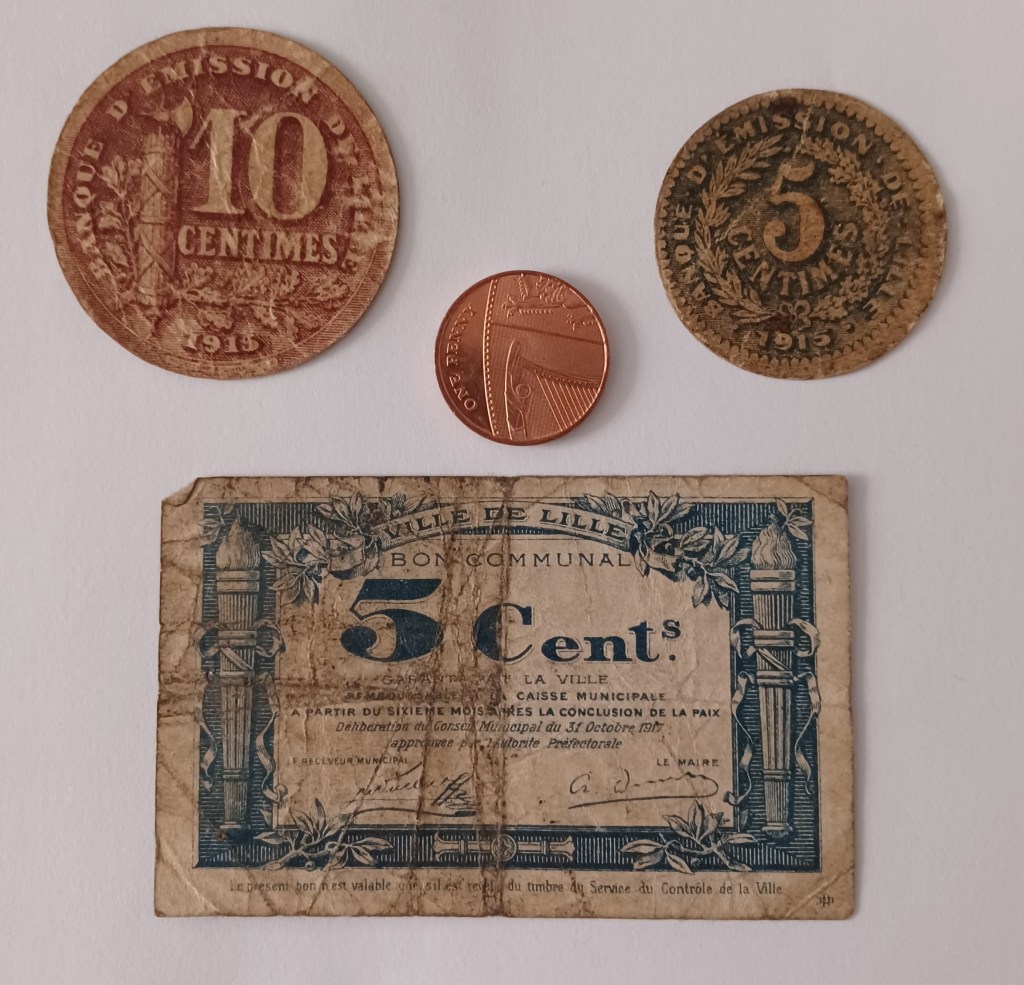
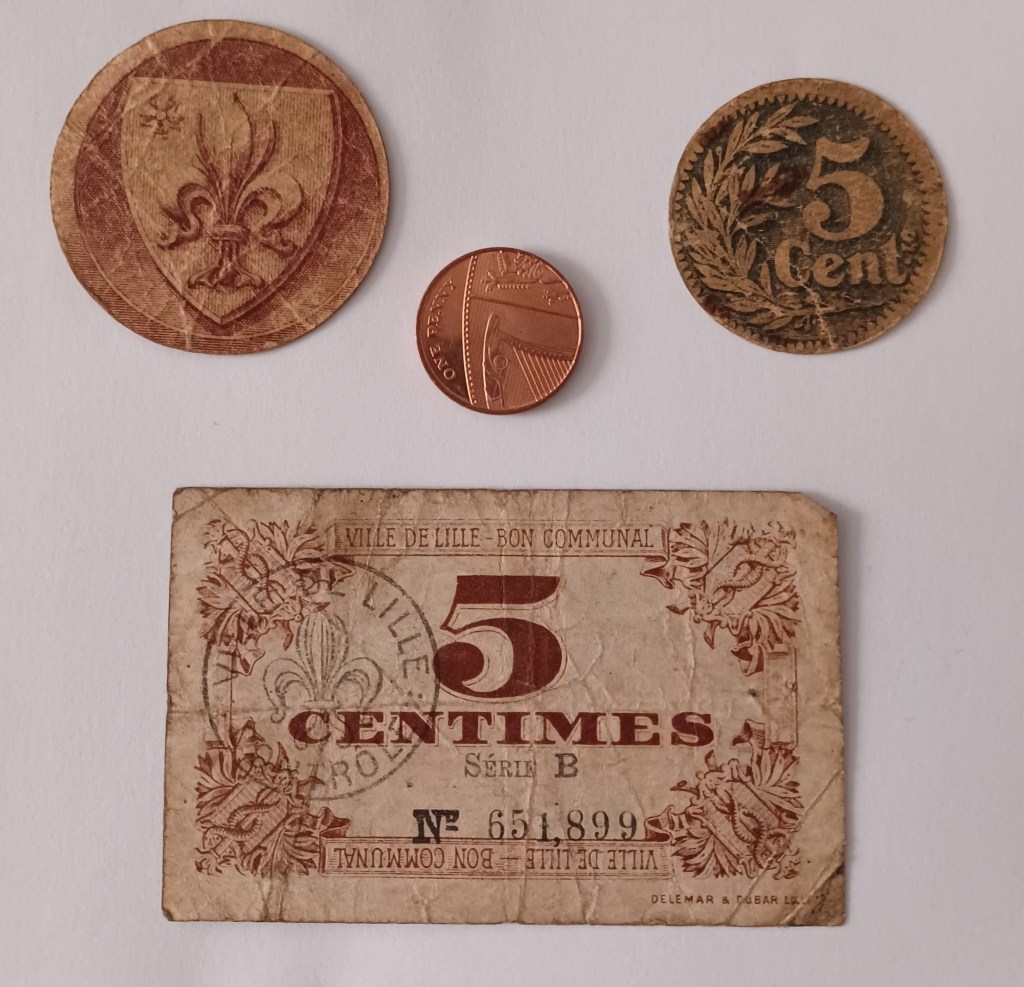
Dating from WWI these notes are the Gallic equivalent of those issued by Germany during the same period. Although not known locally as Notgeld, this necessity money functioned much in the same way.
Issued by local towns and villages it sought to fill the vacuum left by the central government during the unprecedented conflict at the time. These necessity money were a plan to keep local economies going during a time of great upheaval.
During the outbreak of the war in 1914 the central bank of France suspended the use of gold coins and any conversion of banknotes into gold. As a result rampant inflation begin to occur with many hoarding any coins with gold or silver content. Merchants, unable to process small transaction due to a lack of small coinage, began to issue bonds in small amounts to get around the problem. In August of 1914 the Chamber of Commerce of Paris was authorised to issue these small denomination bonds on behalf of the state as legal tender for any merchants who agreed to use them. These small bonds were backed with an equivalent amount of cash on deposit with the Banque de France.
Soon thereafter other Chambers of Commerce around France would begin to issue bonds in a similar manner to the one in Paris. The specimens added to my collection hailing from the town of Lille which sits close to the Belgian border.
The bonds would be issued for 5 years after which they would be swapped to more durable materials, such as bronze plated aluminium, as paper was not able to withstand the constant handling of day to day life. The last paper issues were phased out in most of France by 1921.
A look at a coin this month which is a well known icon amongst those who collect. First minted in 1741, it is still minted today with the date of the ruler’s death in 1780. Minted not just in the it’s original country of origin, but would be minted throughout the world until 1962. I am of course talking about the Maria Theresa thaler.
A typical Crown sized coin, the thaler measures 42mm in diameter with just a thickness of 2.5mm. Weighing a smidge over 28g, the coin is made of .833 silver. On the obverse of the coin we can see a depiction of Empress Maria Theresa, whilst on the reverse is Maria’s Habsburg coat of arms, a double crowned double-headed eagle holding a shield divided into four fields representing Hungary, Bohemia, Burgundy, and Burgau. Within this larger shield is a smaller crowned shield in the centre representing the coat of arms of Austria.
The thaler was originally struck in Austria between the years 1741-1780. Being the circulating currency of the Holy Roman Empire and it’s dominions it quickly became a important trade currency, with much of it’s popularity stemming from it’s use in the Arabic world and near East. Maria’s successor, Joseph II, would allow the continued use of the 1780 dies after her death as the thaler would become the only silver coin the traders in the Arabian world would trust. This would set a precedent whereby all future strikings of the coin would use the 1780 date. The popularity and success of the thaler would see it’s use and spread to areas of Africa and Asia which would adopt it as a sort of unofficial currency until after WWII. On the 19th September 1857, the thaler was declared an official trade coinage, and whilst little over a year later it would lose it’s status as an official currency in Austria, it would see a increase in production globally. Mints around the world would begin to produce their own copies of the thaler, with notable examples coming from Birmingham, Bombay, Brussels, London, Paris, Rome, and Utrecht. Although minting of the thaler outside of Austria would end in 1962 when the UK government formally agreed to stop production, the Austrian mint still produces them to this day, with proof and uncirculated versions being available to order from their mint.
It is estimated that, up until the year 2000, 389,000,000 thalers have been minted since their first inception in 1741.
A little delayed update with the April addition to my collection.
Another small coin enters the fold this month as I discuss an early medieval coin from Afghanistan.
Dating from the 9th or 10th century AD we have a small silver jital issued by the Shahi kings of Afghanistan.
Measuring about 10mm in diameter and only 1mm thick it has a silver content of roughly 70%, although the later strikes grew more and more debased as the were pushed further from the Kabul valley region by invading Islamic forces from Persia.
On the obverse of the coin is a symbol of a reclining bull with an inscription in Nagari above it. I unfortunately cannot translate the inscription on the piece I have due to wear. However, from other examples it is clear this is a inscription of the name of the ruler.
The reverse of the coin shows a relief of a horseman holding a flag.
The Hindu Shahis ruled over regions in northern India, Pakistan, and Afghanistan ranging from the Kabul valleys to Gandhara and the western Punjab.
Much of the information we have about this dynasty comes pieced together from coins, inscriptions, and chronicles left by other peoples as there is no written evidence provided by the dynasty itself. They ruled through much of this area at a time when Islamic expansion into Afghanistan was in full swing. Starting in Persia during the mid 7th century. Muslim forces moved into what is modern Afghanistan, with a Arab governor being put in charge of Herat after it’s capture in 652 AD. Stiff resistance to the Arab invasion would continue for the next two centuries as the majority population of the region followed Indian Buddhism. However, by the early 9th century Kabul would start to be attacked by Arabic forces as resistance was slowly worn down. The king of Kabul would be captured by the Caliph Al-Ma’mun (813-833AD) and would be made to convert to Islam. Resistance to Arabic rule however would persist longer and it would not be until Mahmud of Ghazni (998-1030AD) that the last Hindu Shahi king would be defeated.
A small and tiny coin enters my collection this month. Minted during a period of great political upheaval which resulted in a brief span of time which is seen as a small blip in the status quo of my country’s history.
This period from 1649-1660 is often referred to as the Commonwealth when a series of small civil wars broke out here in England leading to the trial and execution of the king and the appointment of a man to lead the country who is every bit as politically and historically controversial as Margaret Thatcher.
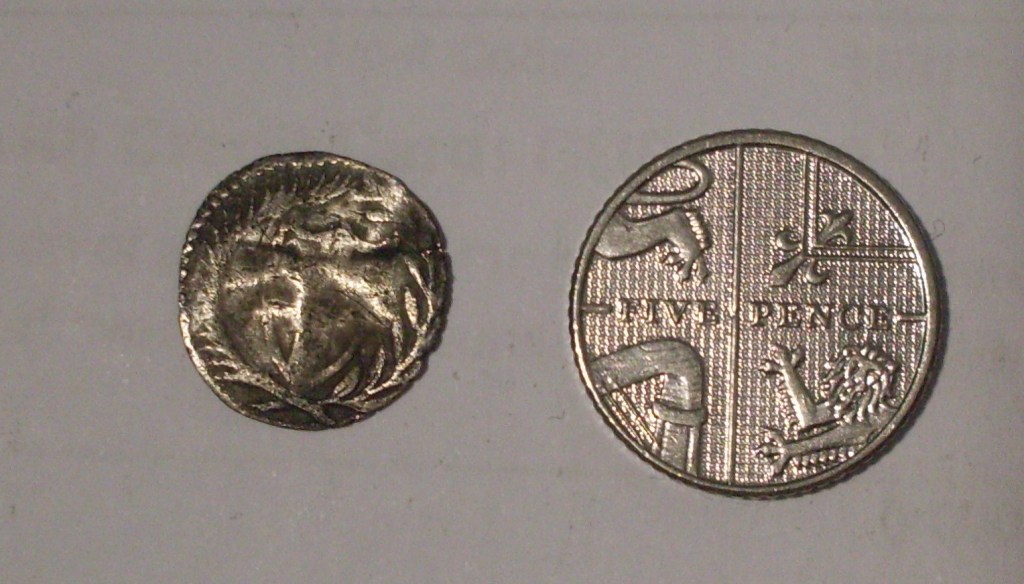
With the nominal value of 1 pence, this small silver coin is just 14mm in diameter and 1mm thick. On the reverse of the coin are twin shields bearing the St George’s cross and Irish harp respectively, whilst above them is the roman numeral denoting the value of the coin. On the obverse is a single shield with the St George’s cross surrounded by a laurel wreath.
Breaking away with the more traditional designs this coin does not bear the royal coat of arms which was usual for English coinage at the time. A clear indication of the turmoil the country was going through when it was struck.
The Commonwealth was the political structure created by parliament in England and Wales after the execution of Charles I in 1649. Although the king was deposed, fighting would continue within the British Isles, most notably in Scotland and Ireland. This would continue until 1653 when Oliver Cromwell was pronounced Lord Protector of all four constituent nations after parliament was dissolved.
Cromwell’s place is severely contentious in the annals of history of these islands. Ranging as someone who would promote religious tolerance amongst the different Christian groups (Except Catholics) to a bloodthirsty warmonger who would carry out almost genocidal acts in Ireland. Cromwell has been a figure of much debate by both contemporaries and historians alike. Some often portray him as an opportunistic hypocrite motivated by power, whilst others have described him as an “energetic campaigner for liberty of conscience.” He would pursue an effective aggressive foreign policy which was aimed at trying to limit the economic powerhouse which was the Netherlands. With Jews finally being allowed to return to England after over 350 years of banishment by king Edward I. This was in hope that they would help speed up the economic recovery of the country after a decade of civil war. Cromwell would also sign the Treaty of Paris in 1657, which would ally Britain with France against the Spanish. The terms would cede the ports of Mardyck and Dunkirk to Britain to help reduce the activity of corsairs and privateers which infested the Channel during this period.
Cromwell would be offered the crown of England in 1657, but he would stick to his principles and decline it due to being the arch-principle who brought down the previous king. However, the office would take on more of the trappings of the monarchy as time wore on, and it would be similar in all but name.
Cromwell would die of natural causes in 1658, and his son Richard would take over as Lord Protector. Richard was a poor substitute for his father and in 1660 would go into exile on the continent when the monarchy was restored that year under Charles II.
Cromwell has a very lasting legacy which is still felt amongst many who live here. The abolishment of the monarchy, although for a brief period of time, would allow more powers and freedoms to be granted to those outside of the system. When Charles II was crowned as king he would do so with much reduced powers than those enjoyed by his father, Charles I. Never again would parliament be dissolved at the whim of the monarch and the people of England (although still miniscule at this point in history) would gain a little say on how things would be run.
Not a very large post for the final month of 2021, as once again I will be showing off something I have talked to at length in previous blog posts.
Normally, when I add something to my collection which I have already spoken about before I often just quietly do it and feel no need to write about it here. On this occasion I wanted to show it off since this specimen was slightly unusual from the other examples often found.
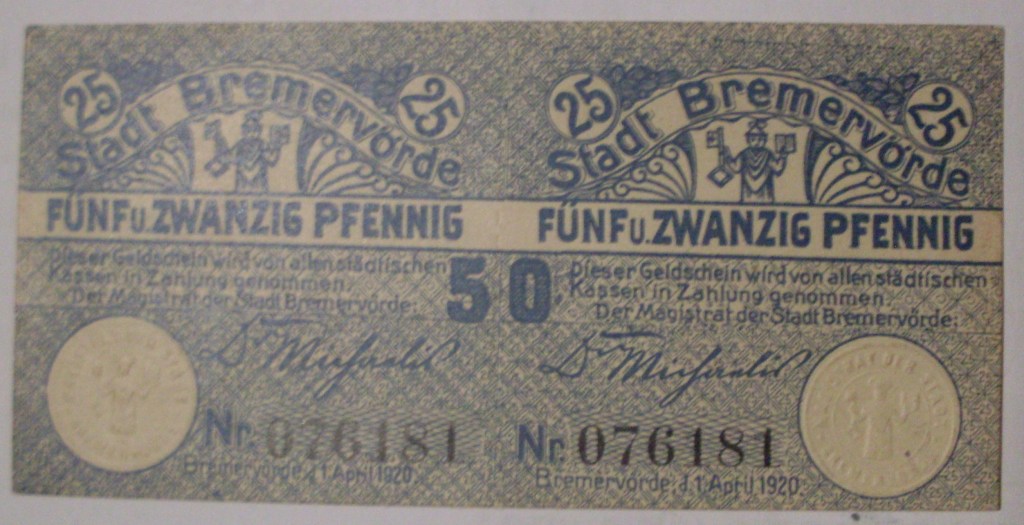
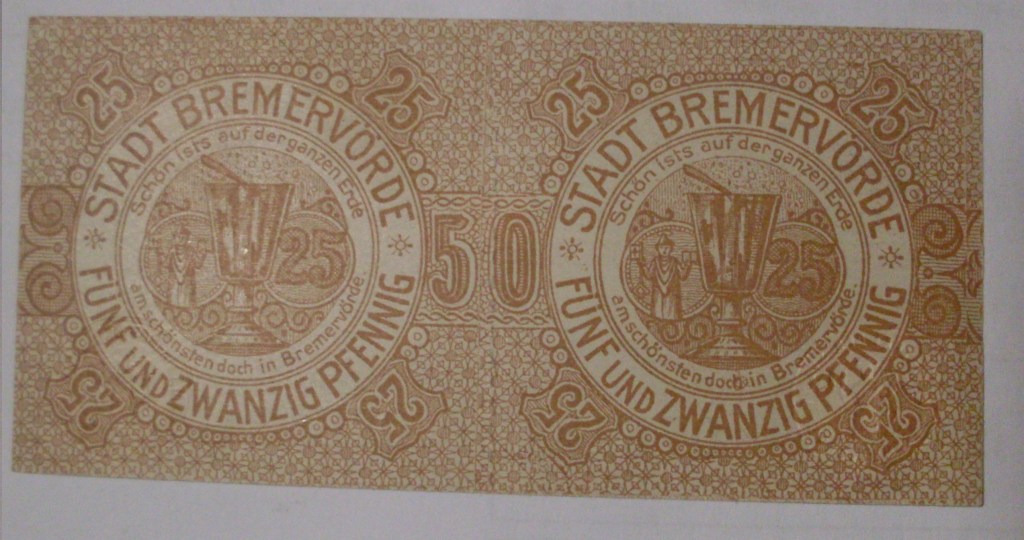
Once again I will be showing you another notgeld banknote from Germany. Dating from 1920, this note was printed in the small town of Bremervorde which is in the Rotenburg area of Lower Saxony. Situated not far from the city of Hamburg. This connection with the city shown in the embossed seals on the bottoms corners of the note.
With the nominal value of 50 pfennig, what really stands out (and is much more easier to see in the second photo) is the perforation down the direct centre of the note. The explanation for this is clearly shown on the design on both the front and back of the note. This is so the note can be broken down in half and used as 25 pfennig instead.
Quite novel in it’s design I am quite sure it is not unique amongst other notgeld notes out there. However, this is the first example I have seen, and the first specimen I was able to add to my collection.
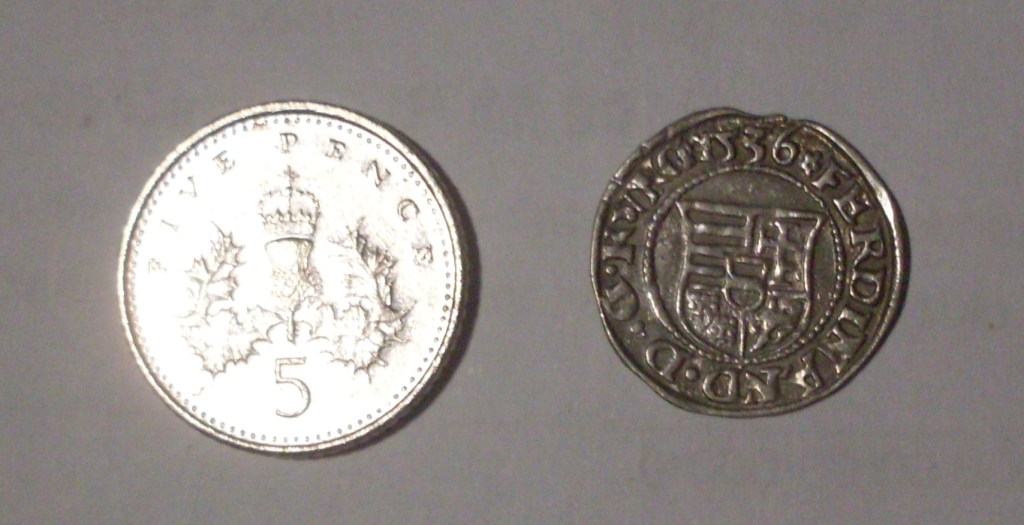
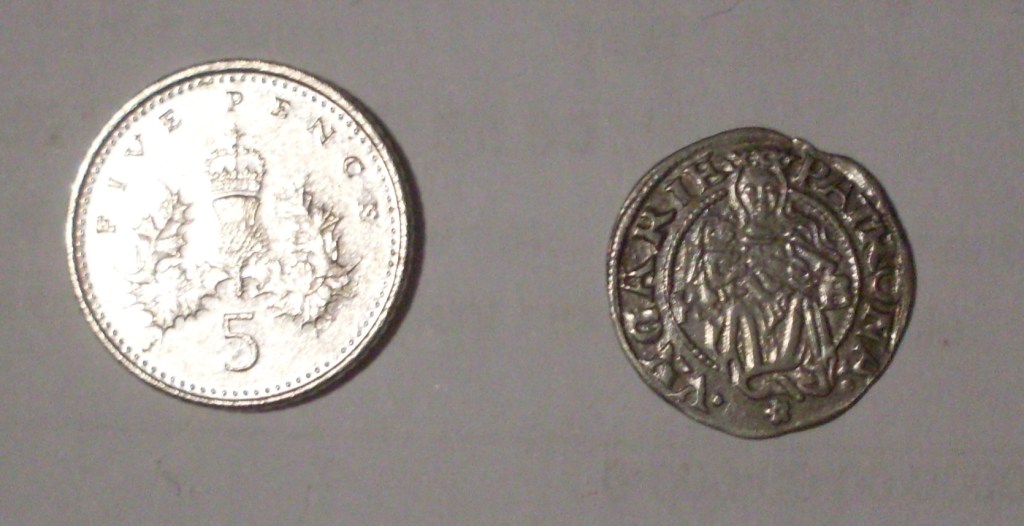
A return to central Europe this November, as this month I have managed to obtain a small silver coin from Hungary dating to the middle of the 16th Century.
Dating from 1536, this small silver coin was struck in Kremnica (in modern day Slovakia) during the reign of Ferdinand I. Held to the value of 1 denar, this coin would constitute 1/180th of a full thaler which was the main silver currency of much of central Europe, starting around the year 1500.
On the obverse of the coin is the quartered coat of arms of Hungary, with a small shield in the middle denoting the main crest of Austria (which was the main holdings of Ferdinand prior to ascension to Holy Roman Emperor in 1556). This central design is surrounded by the legend * FERDINAND · D · G · R · VNG * 1536 translating to Ferdinand, by the grace of God, King of Hungary. The reverse of the coin depicts a crowned image of Madonna with child, with the figure sitting between the letters KB denoting the mint where the coin was struck. The legend around the edge is PATRONA * * VNGARIE translating to Patroness of Hungary.
Ferdinand was born into the Habsburg family in 1503, but he wouldn’t take control of the family’s Austrian lands until 1519 when his brother, Charles, would ascend to the German imperial throne after the death of their grandfather Maximillian I. However, he would not fully inherit the title Archduke of Austria until 1521. In 1526, upon the death of his brother-in-law Louis II, Ferdinand would become king of Hungary. His rule however would be disputed by John Zapolya the Voivode of Transylvania. This dispute came about due to the nature of Louis II’s death, which occurred during the battle of Mohacs against invading Ottoman forces. The victory of the Ottomans at Mohacs would lead to a split in Hungary with a pro-Ottoman half being led by Zapolya, and the opposite being led by Ferdinand. Due to this split, Zapolya would be declared king by the nobility under Ottoman influence.
Ferdinand’s reign of Hungary would be overshadowed by this dispute with Zapolya and his wars to remove Ottoman influence from the country. Even with Zapolya’s death in 1540 his son, John II Sigismund, would continue his dispute with Ferdinand gaining support from the Ottoman ruler Suleiman the Magnificent. Eventually John II Sigismund would become king of Eastern Hungary, a vassal state under Ottoman rule, and would reign until his death in 1570.
Ferdinand would never remove Ottoman influence from Hungary, and despite Hungary losing around 70% of it’s territory to the Ottomans it would remain the small economic powerhouse of all of Ferdinand’s lands, outstripping those he held in Austria and Bohemia. Even after he ascended to the Imperial throne after his brother’s abdication in 1556.
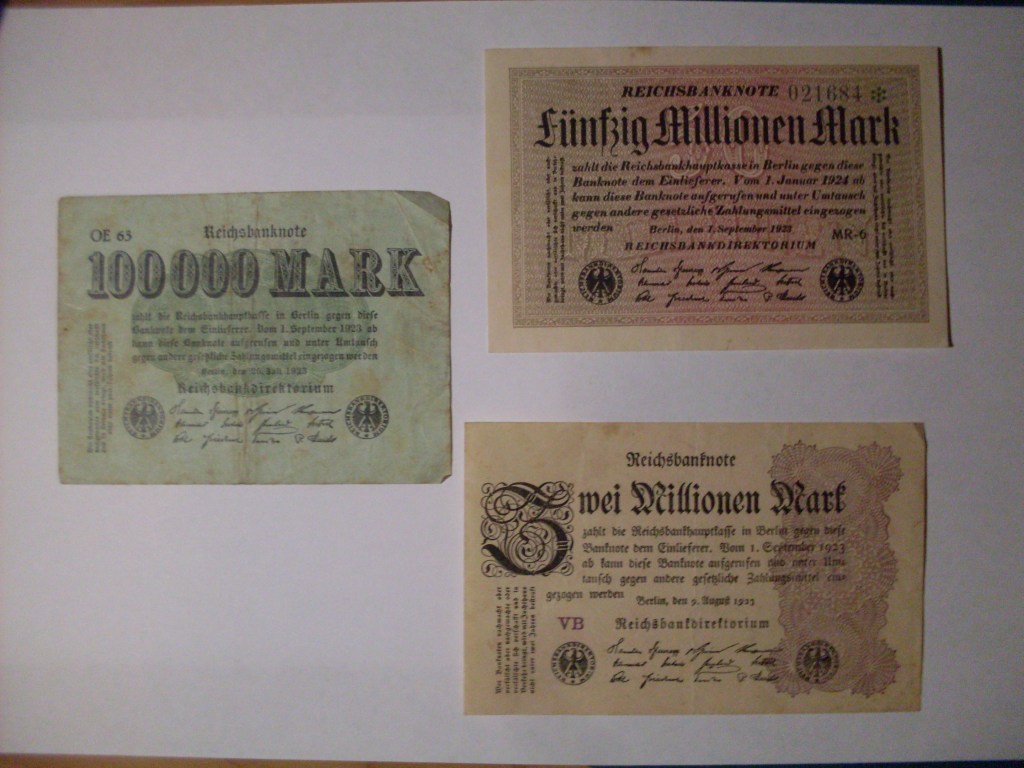
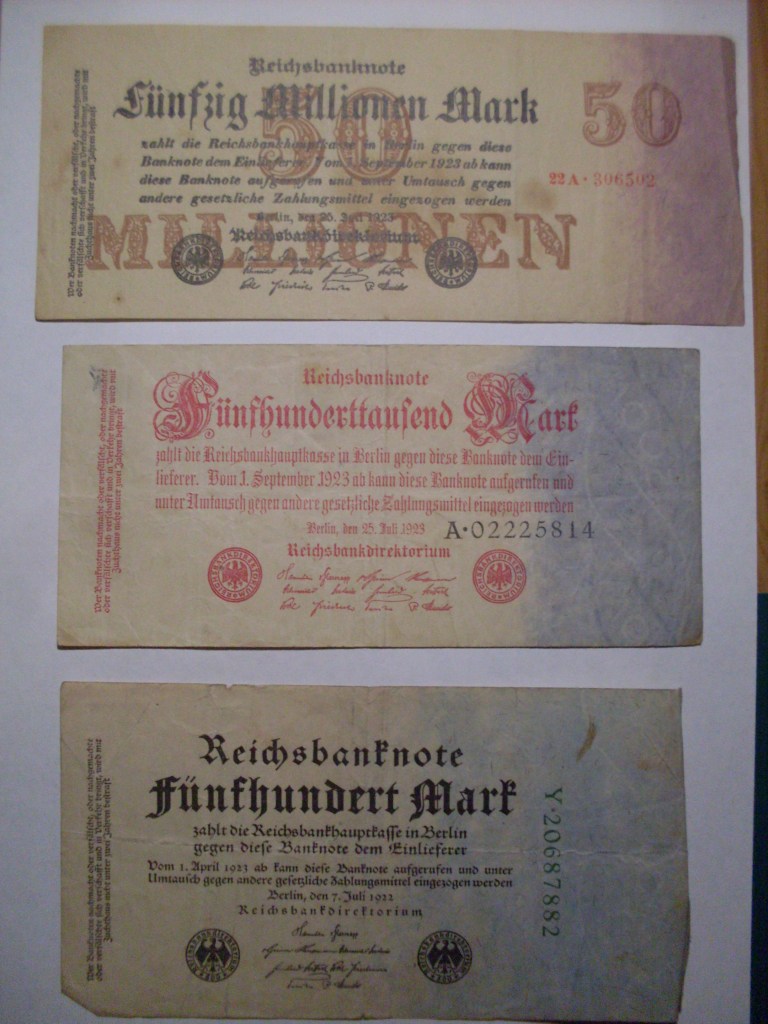
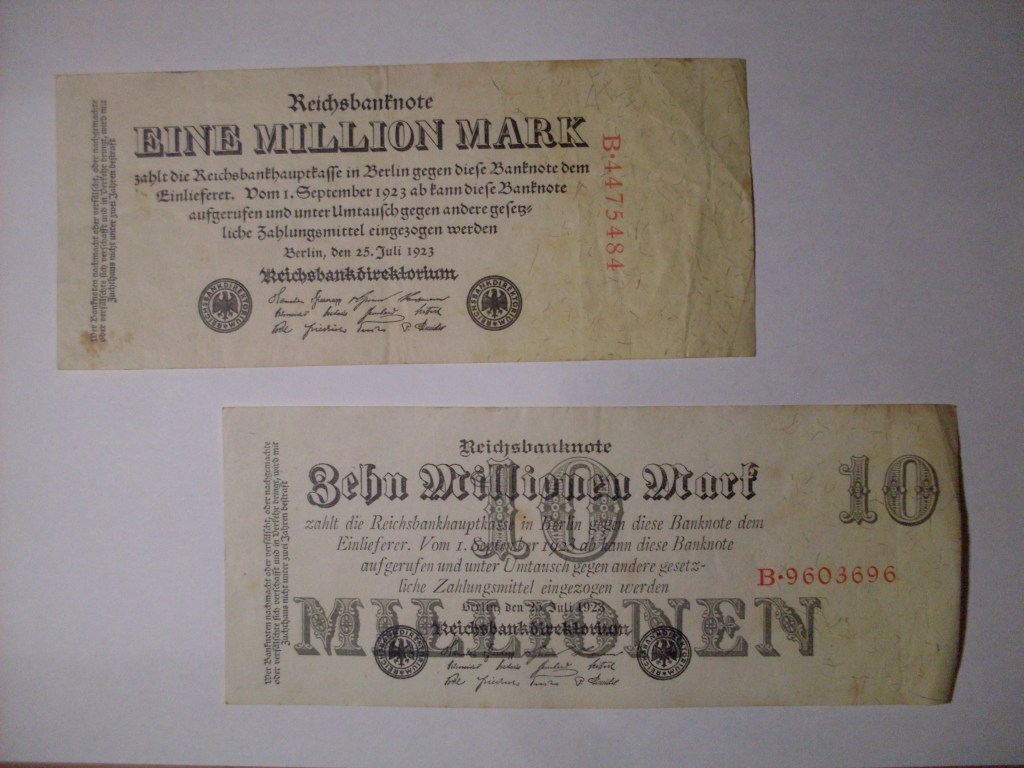
For September we return to Germany to look at some banknotes from a period in the country’s history which is heavily studied. Especially by those learning history here in the UK.
This period defined the inter-war years for Germany. It weakened the new Weimar Republic which emerged after the horrors of WWI and the overthrow of the Kaiser. This brief period of hyperinflation would set the scene and help sow the seeds for a much darker regime to follow.
When Germany lost the war in 1918, it was saddled with massive debts due to the increased borrowing the Kaiser and his government undertook to fund it’s effort during the conflict. Exacerbated further by the harsh conditions imposed upon Germany by the Treaty of Versailles in 1919. Despite some economic relief provided by the Young Plan, the debt burden was worsened by the printing of money with no economic resources to back it. Reparations as set out in the Versailles Treaty accelerated a decline in the German Mark as more money was printed to meet these obligations. By the end of 1919 it would take 48M to equal just $1 in value.
By the time Germany was to meet it’s first reparation payment in June 1921, the value of the Mark had slipped further with 330M now needed to just meet $1. As the reparations had to be paid in hard currency rather than the slowly falling ‘Papiermark’ (Paper money), the German government began to exchange marks for foreign currency at any value. This action would further destabilise the currency as it was seen by many as the German government selling their own currency in preference for foreign. Thus weakening the trust in it’s value.
1922 would mark the beginning of the rapid decline in the value of the German currency. By June of that year a conference organised by investment banker J.P Morgan tried to solve the situation and organise reparation repayments. Since no workable solution was able to be found, the inflation would continue to skyrocket. By the years end, 7200M would equal $1. The strategy employed by Germany was to mass print new banknotes in order to buy foreign currency to pay the reparations. This of course destabilised the economy greatly, with much of the banknotes now not being worth the paper they were printed on.
By 1923, Germany was no longer able to make it’s reparation payments and the French would respond by occupying the Ruhr valley, Germany’s main industrial region. The German government would encourage the workers of the region to adopt a policy of passive resistance by not helping the invading French in any way. The workers though would need to be supported financially during this ‘strike’ against the French occupation. Thus leading to more banknotes being printed.
By the end of 1923, new plans were proposed by the central German bank to tackle the crumbling economy and rein in the continual rising prices. A new currency was to be introduced in Germany, the Rentenmark, back by bonds indexed to the physical value of gold. In parallel to this, a new bank was set up to control this currency called the Rentenbank. The new bank would refuse credit to the government and currency speculators in an attempt to create value for the new currency.
Over the course of 1924, the new Rentenmark would be expanded in scale until it would be formally adopted as the de facto currency in Germany in August of that year. By the time of it’s formal adoption the value of the currency would be 4.2 rentenmarks to a single dollar. Conversion values between the old Mark and the new Rentenmark would be set at 1-trillion marks to 1 rentenmark.
Overall, hyperinflation in Germany would reach it’s peak around November 1923 with the average price of a loaf of bread at the time coming to 200,000,000,000 Marks. The economy would stabilise and prices would return to normal relatively quickly with the introduction of the Rentenmark. Despite being separate events, many Germans would conflate the hyperinflation of the 1920’s along with the Great Depression and see both together as one large economic crisis.
This month I had some long-awaited time off work, and due to the current pandemic hitting everywhere I did some day trips to other places here within the UK (A chance to see somewhere different from the small town I live in). One of these places was the city of York. A place I haven’t visited in about 10 years, and it has always been a charming city to visit for those who love history.
Whilst wandering the streets of York I came across an antique centre a stones throw away from the minster, and with time to kill before my train, I decided to have a look around.
Whilst perusing the cabinets I was more than tempted by the coins they had on offer, however in the last room at the back of the building I stumbled across what this month’s blog post will be about. At first, I dismissed it, but I found as I kept looking through the cabinets I was constantly drawn back to this item. It is nothing special or unique, but I found that by the end of the day I just had to have it.
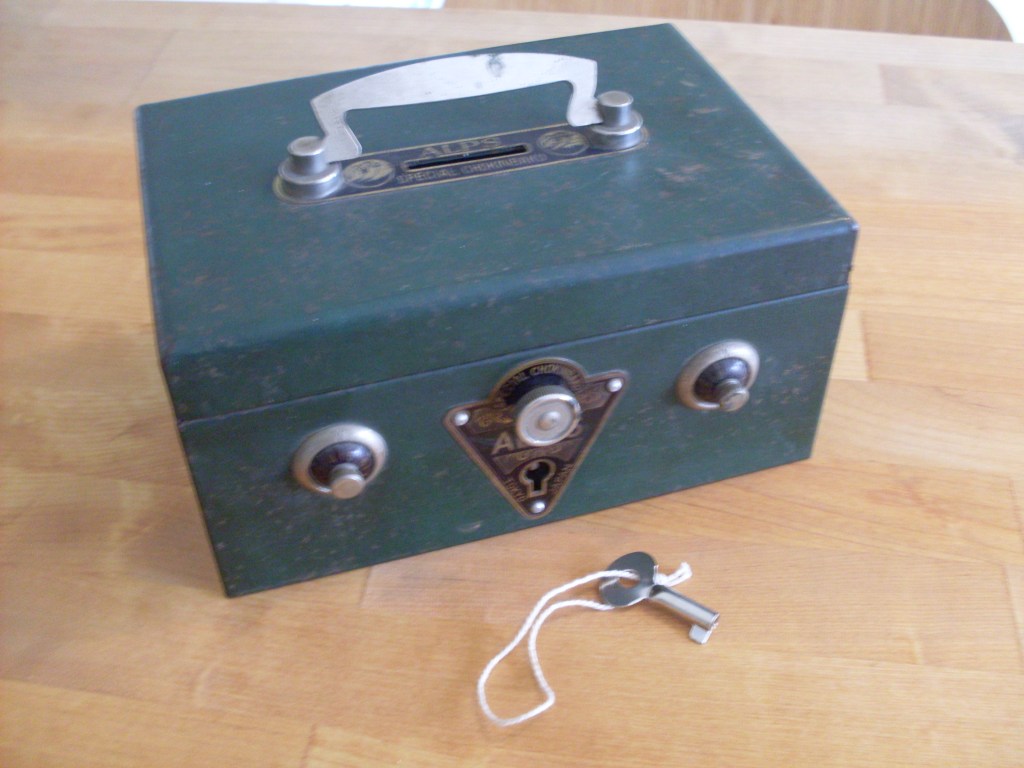
The item in question, although not a coin itself, is related to coins and money. A little drab, and the years have not been too kind, but this early Showa Era (1926 – 1989) Japanese money box had a charm of it’s own.
The box is made of metal and has a dial and key type lock. Both dials have to be set to the correct combination and the lock has to be opened by the key before the lid is able to be opened by the knob found just above the keyhole.
Made between 1926-1936, this moneybox was manufactured under the Alps brand in Tokyo. Other such brands exist at the time showing similar designs and lock mechanisms. Brands such as Mitsuba, Star, Mitsuwa, High Class, and Dial also look very similar to the Alps brand I purchased.
The word Chokinbako (貯金箱) can be translated into moneybox, money bank, or loosely for Western tastes “Piggy-bank.” So it can be assumed this was an item to save up money.
In the West, the oldest money box which has been discovered dates from the 2nd century BC at the site of the Greek colony of Priene in Asia Minor. Money boxes have also been excavated at Pompeii and Herculaneum, and soon make an appearance across much of the late Roman Empire. It is believed that in the west the popularity of the ‘piggy-bank’ originates in Germany where pigs were revered as a symbol of good luck. The oldest German piggy-bank dates from the 13th century and was discovered during construction work in Thuringia. In Asia, we can find the earliest known pig shaped container dating from the 12th century. It was discovered on the island of Java in Indonesia. Further pig shaped money boxes were also found in archaeological excavations in Trowulan, a village in the province of East Java and is believed to be the possible site of the capital of the ancient Majapahit Empire.
The term “piggy-bank” itself is in dispute with the earliest known use dating from the 1940’s. The earliest known use of “pig-bank” in English dates from 1903, which describes them as a Mexican souvenir. In Mexico piggy-banks are called ‘alcancia’ which originates from Andalusian Arabic.
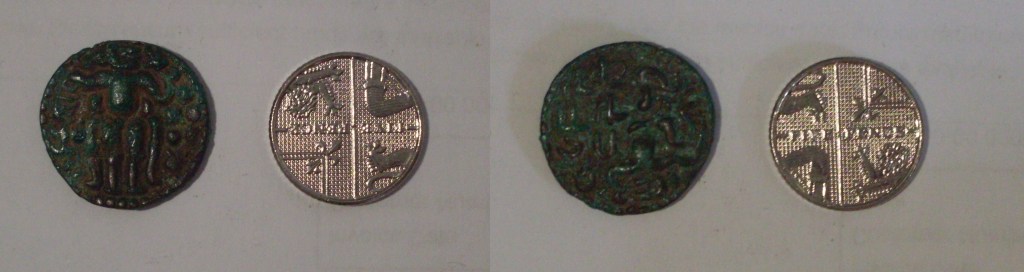
A returning coin design this month. We head back to medieval Sri Lanka and another meeting with the octopus man.
Similar to the coin I wrote back in July 2019, this one dates from the end of the Chola empire. From the Singhalese script on the reverse of the coin it denotes that it comes from the reign of Queen Lilavati. Most notably from the first of her reigns. This can be determined due to the clearness of the lettering, and the crispness of the design. Coins dating from her later reigns tend to suffer from quality issues.
Lilavati came to her first reign after the death of her husband Parakramabahu I in 1197. Most of her reign was written in the Culavamsa, a record written by Buddhist monks from the 4th century until 1815 covering all of Sri Lanka’s monarchs. Her first reign is described as “three years without mishap” as much of the Chola empire would start to chaotically decline in the years after Parakramabahu’s death. Lilavati’s next two reigns would be substantially shorter than her first. Her second would start in 1209 after the current ruler was assassinated. It would last for just a year, when in 1210, she would be deposed again when Chola territory was invaded by a force from southern India. The general who dethroned Lilavati would reign for just nine months before he was deposed by another general. This general, called Parakrama, would reinstate Lilavati as queen in 1211. Lilivati’s third reign would last for just seven months before she would be dethroned again by the same general who reinstated her. After this point she would leave the historical record, although it is believed she was not put to death by the general who overthrew her. However, scholars are in agreement that she very may well have by the tyrannical Kalinga Magha (1215 – 1236) who invaded and conquered Sri Lanka some time in 1215.
Something a little unusual from a very unheard of region of Europe this month. When I first saw these, I knew I had to add them to my collection due to the unorthodox shape and material used to make them. Brightly coloured, and hailing from the break-away state of Transnistria.
Each coin is made of a composite polymer plastic and weigh roughly 1g each and have the feel of fairground ride tokens. The coins are all roughly the same size and average around 27mm in diameter. On the reverse of each coin is the logo of the Transnistrian Republican Bank along with the value of the coin. The obverse of each coin features an important figure from Russian history, all of whom has some connection with Transnistria in some way:
On the 1 rouble is a portrait of famed Russian general Alexander Suvorov (1730-1800). He was responsible for founding the city of Tiraspol in 1792 which is now the capital city of Transnistria. A statue of him sits in the central square of the city.
The 3 rouble features a portrait of Francois Sainte de Wollant (1752-1818), a Dutch engineer who was responsible for building fortresses in the newly acquired land captured from the Ottomans during the Russian expansion of the 18th century. He built the fortress in Tiraspol and has a park named after him in the city.
The 5 rouble coin shows Pyotr Rumyantsev (1725-1796) who was another Russian general who led armies against the Ottomans in the 18th century. He was known as the governor of ‘Little Rus’ which encompasses much of the territory occupied by modern Ukraine today.
The 10 rouble shows a portrait of Catherine the Great (1729-1796) who ruled Russia as Empress during the period when the lands comprising Transnistria was captured from the Ottomans.
Modern Transnistria sits along the Dniester river between the countries of Ukraine and Moldova. A break away state, it has only been officially recognised by three other states, also break away states, Abkhazia, Artsakh, and South Ossetia. Transnistria gained it origins as an autonomous region within the Ukrainian SSR in 1924, but wouldn’t declare full independence until 1991 with the disintegration of the Soviet Union. A year later, fighting would break out in the region between Transnistria and Moldova. A ceasefire would be called only 5 months later with a joint commission of Moldova, Russia and Transnistria seeking to maintain peace in the region.
To date, the regions situation has still remained unsolved but it has developed it’s own semi-presidential government, parliament, police, military, postal system, vehicle registration system, and as can be seen in this post, it’s own currency.






 Numismatic Exploits