Collection update April ’17

This month I will be showing off some 17th and 18th century coins I managed to acquire at an extremely good price.  These coins hail from the Polish-Lithuanian Commonwealth which dominated Eastern Europe for much of the 16th and 17th centuries, until it’s decline in the mid to late 1600’s and eventually being partitioned in three stages by the Russian Empire (1772), the kingdom of Prussia (1793), and finally the Habsburg monarchy (1795).  Poland and Lithuania would then not be independent states again until 1918.

SDC12305

Now the picture above shows various coins throughout the life of the Commonwealth, with the 5p piece being shown as an example of the size of these coins.  All of them are hammered copper, as milled coins were still in it’s infancy during this period throughout many countries during this period.  Although some headway was being made in the process throughout France and Britain at this time.

The four coins on the left date from the mid-1660’s during the reign of John II Casimir Vasa.  They sport both emblems which are featured as the coat of arms of both nations which give the name sake of the Commonwealth.  There is the armoured horseman of Lithuanian and the argent eagle of Poland.  These coins come from a period when the Commonwealth is starting it’s century long period of decline.  During the two decades prior to these coins being struck, the Commonwealth had just lost a war against Russia, being forced to concede several parts of the Ukraine.  Poland also suffered an invasion from Sweden, known colloquially as ‘The Deluge’.  During this invasion Poland suffered heavily from the Swedes, with around 188 cities being sacked, and the population of many of them being severely destroyed (90% population destruction reported in Warsaw alone).  Some historians have argued that the destruction caused by the Swedish invasion was more costly to Poland than what the country suffered during WWII.  A figure estimated at 4 billion Zlotys (£750 million, $990 million) in 2012.

The coins on the right date from the mid-1750’s, from the reign of Augustus III.  During his reign he saw much upheaval and disorder by many of his subjects.  Augustus III and his predecessor Augustus II were relatively weak kings during the Commonwealths history.  More interested on their hold of the Electoral seat of Saxony in the Holy Roman Empire, they used the Commonwealth as a vehicle to increase their standing with the German provinces.  This caused the ferment of unrest as mentioned previously causing many reform movements to me founded.  Consequently, this led to the rise of the Polish Enlightenment.  The most interesting thing about the Polish Enlightenment is the key strata of society which spurred the movements.  In Western Europe, many of the Enlightenment movements were started by the lower classes in the bid for more freedom, tolerance and equality in society.  In Poland, it was the nobility (a mere 10% of the population at the time) which started the trend.

Finally, the coin at the bottom of the group, dates from the reign of Stanislaw II, the successor of Augustus III.  Also the last king of the united Polish-Lithuanian Commonwealth.  His reign saw the final collapse and destruction of the Commonwealth.  With the final blows starting with the first partition of Poland in 1772.  His successful attempt at a constitutional reform in May 1791 came too late however, and the Commonwealth ceased to exist as a political entity after the third partition in 1795.  The constitution set up by Stanislaw is unique in that it is the first constitution of the modern period in Europe, second worldwide after the US constitution of 1787.

Tied in with the coins above, I also acquired one more coin from the Kingdom of Prussia.  Dating from 1795, it coincides with the final year of the Polish-Lithuanian Commonwealth, with Frederick William II being one of the chief overseers of the Commonwealths death throws.

imgonline-com-ua-twotoone-XTF9hD6lPQaw

As well as overseeing the final partition of the Commonwealth, Frederick was keen in wars across much of Europe.  Particularly fighting against the French in attempts to keep (which was seen at the time), poisonous pervading influences of the French Revolution from tainting other European countries.  However, poor finances and promises to coalition partners caused much of his efforts to be stunted, a situation further exacerbated by the newly acquired Polish territories in 1795.
Collection update March ’17

This months additions to my collection are items I purchased on my trip to Austria.  The prices of items there were a tad bit expensive (read: very), so the amount of pieces I obtained were few.  I did however manage to procure something I have been trying to get a hold of for a long time.  So I think I will start off with that!

imgonline-com-ua-twotoone-3Mpx2AzZ1LcD

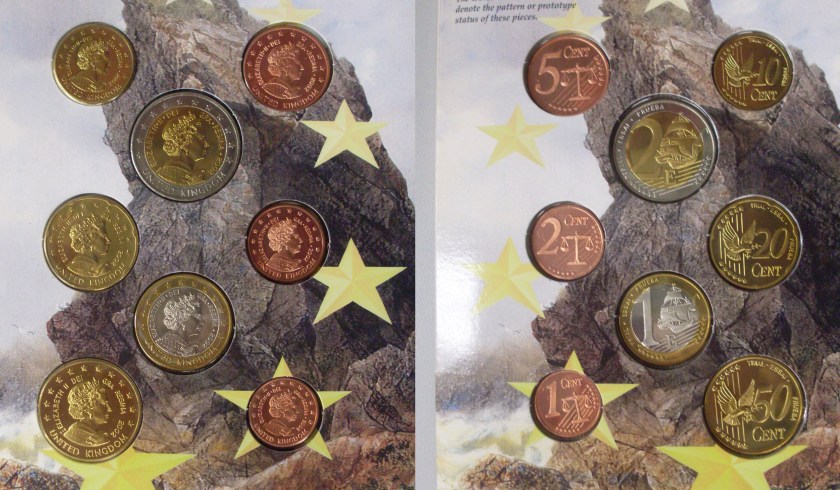
As you can see in the picture, these are prototype Euro coins for the UK.  Now obviously as we all know the UK did not adopt the Euro, and with Brexit, we can safely say any chance of that happening in the future is infinitesimally small.   These sets were created in 2002 by the International Numismatic Agency to showcase what British Euro coinage would look like, and another set was produced in 2004 with a Scottish theme to it.  This set, being the 2002 one without the 5 euro coin, is only one of 20,000 made.  Apart from showing Queen Elizabeth on the front (Golden Jubilee design), the designs on the reverse were picked to symbolise Peace, Commerce and Justice.  Now the UK was not the only EU member country who do not use the Euro.  Others such as Poland, Denmark, Sweden, the Czech Republic et al also have prototype sets like this floating around in collectors circles.  I did see the set for Denmark, but due to the price was unable to acquire it.  To be quite honest, it was secondary on my personal agenda over this one regardless.  This set being more desirable to me now now that the UK has voted to leave the EU.  A fact which renders a lot of the bumf on the back of the sleeve mute.

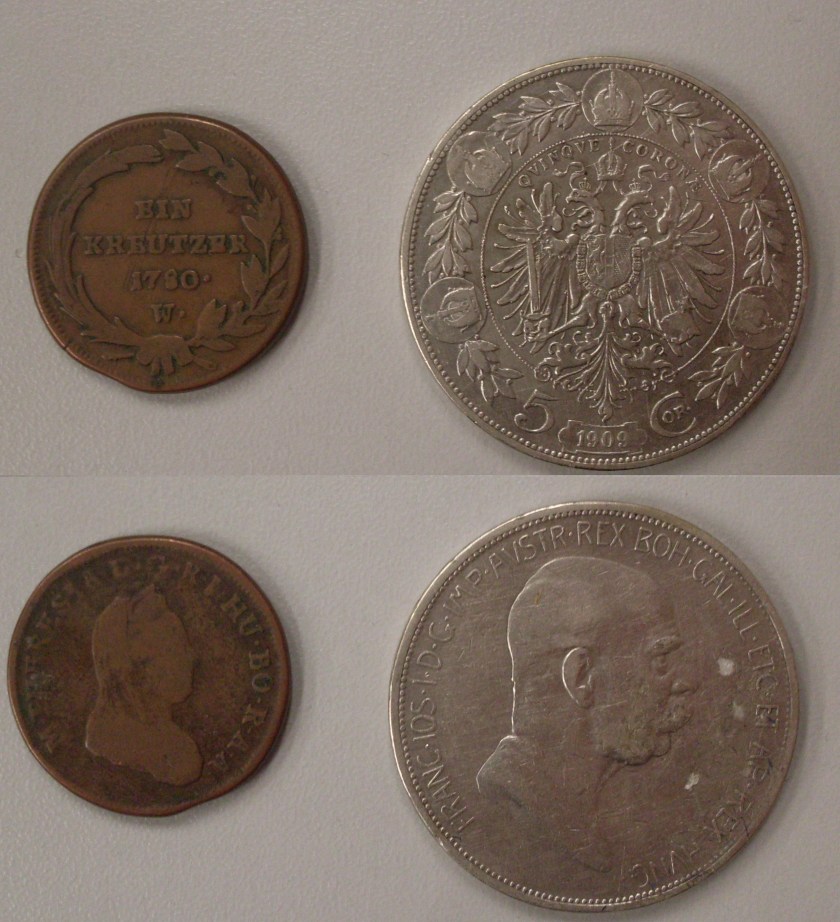
The next two items I purchase were two Austrian coins from the reigns of Maria Theresa and Franz Joseph I.

imgonline-com-ua-twotoone-PSRobNktePmh

The coins themselves are nothing spectacular, both showing signs of wear and tear.  With the 5 Corona coin of Franz Joseph being almost solid silver (which explained the 30 euro price tag on it).  So why did I purchase these coins?  More for the historical significance of the people represented on them than anything else.

Maria Theresa is important as being the only female ruler of Habsburg line, being the leading ruler of vast swathes of 18th century Europe, stretching from Italy in the South, to the Netherlands in the North, as well as numerous regions/countries/lands in central Europe as far East to central Romania.  She enacted many financial and educational reforms which strengthened Austrian control in the region as well as try and bring it kicking and screaming into modernity.  Something which she laid the foundations for, but wouldn’t bear fruit well until the late 19th century when it was implemented properly.

Franz Joseph I bears the title as Austria’s longest reigning monarch, as well as the second longest in Europe (missing out on the top spot to King Louis XIV of France by 4 years).  During his reign he witnessed the oncoming of the industrial revolution, the formation of both Germany and Italy as countries, and the outbreak of the First World War.  Surviving an assassination attempt in 1853 by a Hungarian nationalist he enacted a stance of harsher controls over Hungary and the other Balkan states under the Austrian crown.  This fermented further dissent in the local populaces who were being ground under the chafing strap of Austrian authority, which eventually led to the assassination of Archduke Franz Ferdinand in 1914 and the events which transpired afterwards.  Franz Joseph died in 1916, and his successor Charles I saw the abolition of the Austro-Hungarian empire, and with it the monarchy itself.

Collection update February ’17

This month’s acquisitions were not as numerous as last months.  I only bought a couple of small groups of coins, but also acquired some banknotes along with them.  The majority of the coins bought had a silver content, and this was due in part because I have recently started looking into what is known as ‘stacking’.  I will create a post going into further detail about this later in the future, but to summarise it succinctly, it is the process of purchasing precious metals, be it in coin or bullion form, in the aim of creating a significant investment stockpile.  I personally think this might be a good idea if I am collecting coins seriously, as it could possibly finance further purchases in the future, but also act as a fall-back pension scheme because the way my country is being run….I will be lucky to live long enough to get one…

sdc12211

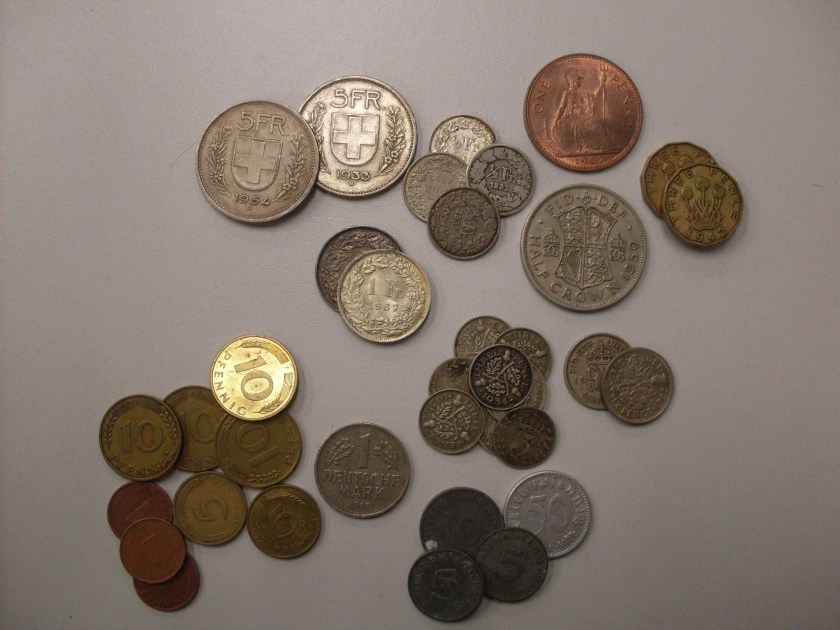
Now the coins I got came from three different countries, Germany, Switzerland and the UK.  Roughly half of them contain a silver content.  Overall the coins themselves are not overly interesting.  The designs are rather lacklustre, and although not pictured here, the German coins right at the bottom of the picture date from the Nazi regime of the 1930’s-40’s.  The reverse is not shown, due to obvious reasons, but in my personal opinion, I feel items of this nature shouldn’t be hid or shunned.  They allow historians, archaeologists, and others to approach sensitive subjects and crack them open for debate and discourse.  Sweeping distasteful history and subjects under the rug over the fear of offending a persons sensibilities does a disservice for the general population as a whole.  By denying the chance to educate people about why these events happened, we run the risk of these events repeating themselves.  Something which frighteningly is looming on the horizon.  However, small political rant over, the banknotes are much more interesting items to discuss this time.

sdc12212

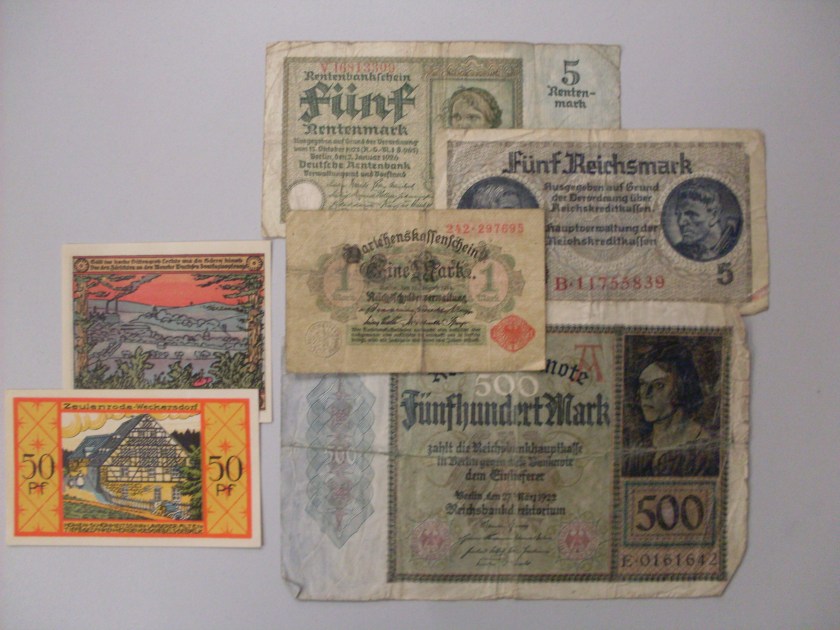
These banknotes were part of a single lot, along with the German coins shown in the previous photo.  Now the main reason I bought the group was not because of the coins, or in fact three fifths of the banknotes present.  No, the main reason was the two banknotes on the far left of the picture.  These two brightly coloured notes are what are known as ‘Notgeld’.  Predominantly a staple of Germany and Austria circulated during the inter-war years of WWI and WWII.  They are one, if not the most, of my favourite things in the numismatic world.  Each note is brightly decorated with scenes, architecture or local myths and legends of each town which issued the banknote.  They are not dissimilar to the trade token coinage used in London during the 18th century, or the company coinage used in remote mining towns across the US back in the day (and many other examples besides).  Albeit the German examples can sometimes be described as works of art in some cases.  I generally purchase these things every chance I get, and have actually amassed a small forest of these things.  I remember last year whilst visiting the Netherlands buying every single one from an antique market stall in Amsterdam.  I got a few funny looks whilst going through airport security on my way back with over 300 banknotes in my possession.  Suffice to say, I could wax lyrical about these things, but I think that too would be a perfect subject for another blog post at a later date.

First Steps.

Now that the new year has started and we approach the end of January, it is time to share my first attempts at buying interesting items for my collection.  Now although I only started the blog recently, I had intentions to possibly start last month (Dec 2016).  Thus, I will be combining the results of what I got into this one entry instead.

The first thing to cover (pun not intended) is a first day cover of the new 50p piece being brought into circulation here in the UK.  It is to commemorate the 950th anniversary of the battle of Hastings, a significant turning point in my country’s history.

sdc12176

I will admit, I am not a fan of first day covers and actually relish the search amongst my pocket change for special issues like these.  Buying them straight off, even though they are in fantastic condition, feels a little like cheating and cheapens the whole adventure of finding them.  What twisted my arm in this respect was that the company selling the coin also included a special offer.  For just the price of the first day cover, which was £10 at the time, they also included a solid silver recreation of one of William the Conqueror’s coins.  I personally think the coin itself is ugly, further reinforced by the fact a large ‘COPY’ is engraved in the centre of the coin on the side not shown, but being offered free when it is valued at three times the price of the one I am buying….well count me sold!  I mean owning silver is not a bad thing is it?

My next purchase was a small collection of 19th and early 20th century coins.  When I first saw them for sale I knew I had to have them.  There were coins dating from early to mid 19th century I had not seen before, as well as some coins from countries I just don’t own a lot of.  The picture below shows a small smattering of the coins I myself thought were the more interesting of the lot.

sdc12175

My favourite pieces had to be the three coins on the top right of the photo.  These are 8 Maravedies pieces from Spain.  I like them due to their unusual design on the reverse of the coin, as it is something I have not come across before.  The interest was sparked further by the fact a female ruler present on the coins also, something I did not know Spain had had, which led me to go delving into a history fact finding mission.  I love finding something which causes me to go and find out the reason behind it, especially when I learn something new, which brings me to this next photo.  These small coins were included in the collection above, and had me completely confused when trying to work out where they were from.  The fact they were very worn didn’t help much.  The mixture of Britannia on one side, and Greek lettering on the other had me immediately think of Cyprus.  However, I thought wrong and it led to a dead end.

sdc12169

After an hour of searching and exhausting options through endless google searches I managed to pinpoint the provenance of these coins.  It turns out that they hail from the confederation of Ionian Islands which were controlled by the British after the Napoleonic Wars in 1815 until they were finally reunited with Greece 50 years later.

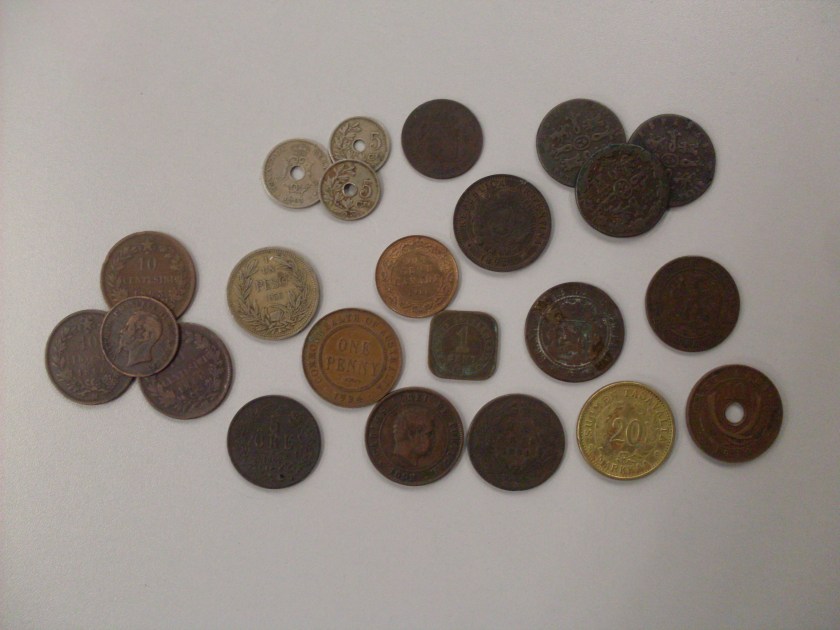
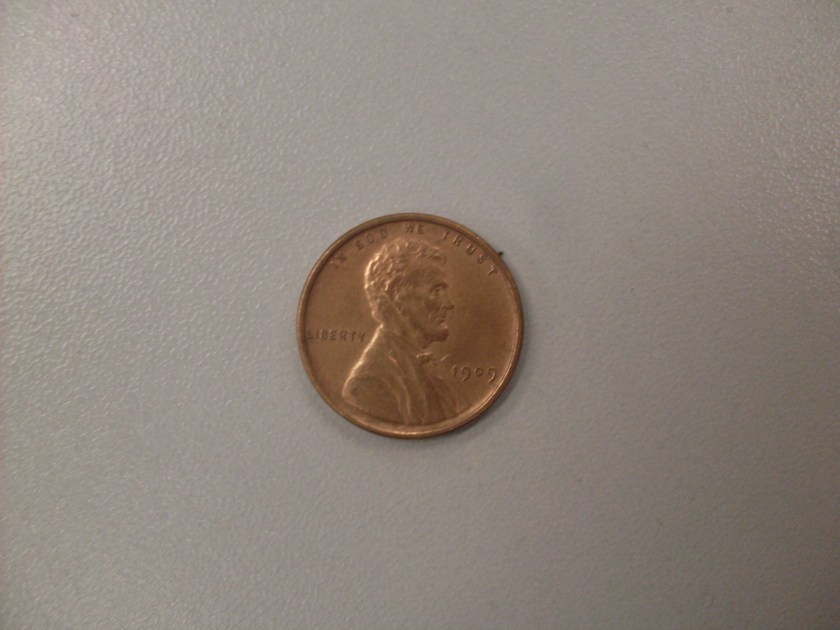
The last of the items I purchased was a large bulk collection of coins, mainly dating from the early to mid 20th century.  It included many pre-decimal coins from Britain (silver coins included), as well as no end of US one cent coins.  I also feel I could buy a small log cabin somewhere in the wilderness of Canada with the amount of 1 cent coins I got too.  However, I also got coins from a wider variety of places.  From the Falkland Islands, to Japan and Singapore.  From Russian kopeks to South African rands, and everything in between.  The variety was truly astounding, although a vast majority I have already got examples of.  The one coin which stood out from all this though was a single US one cent coin.  The reason it stood out is because it is the first example of this type of coin to feature Lincoln on it.  Dating from 1909 and designed by Victor Brenner, it replaced the Indian Head cent.  Although the design on the reverse changed in 1959 to the Lincoln Memorial, the figure of Lincoln remained, and continues to do so today.

sdc12171