Of Greeks and Dolphins.

We are heading back to ancient civilisations this month, but rather than greeting the Romans, we are heading a bit further east to their Greek neighbours.
SDC13232

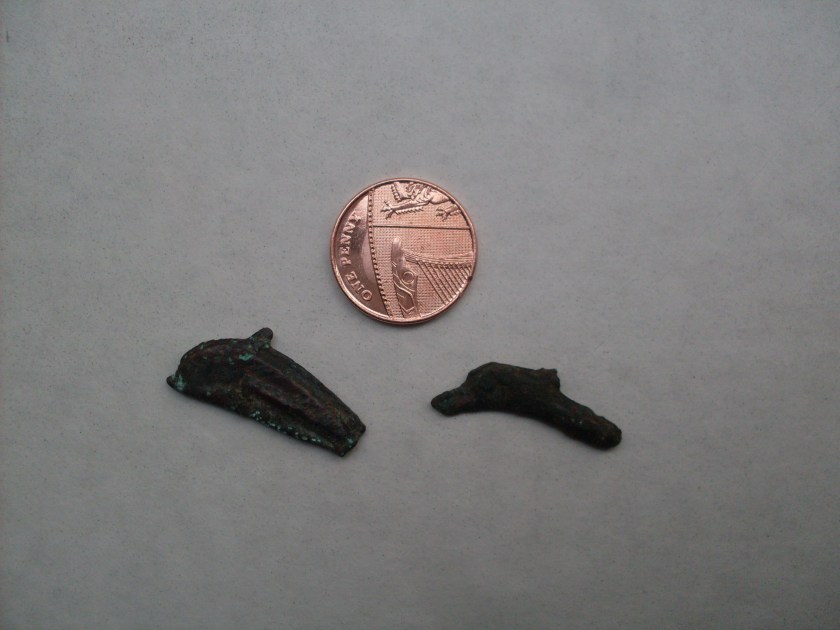
The coins I have gained this month fall into the weird shaped and unusual category which I am so fond of.  In the picture above you can see two bronze ‘Dolphin’ coins from the city state of Olbia, which was part of the Greek Sarmatian area of the Black Sea.

Olbia is located in what is now known as Parutyne, in Ukraine on the northern shore of the Black sea.  The Black sea is known for it’s large population of bottle-nose dolphins.  This may be why the Greek city state decided to cast their coins in the distinctive shape of the creature.

The coins are unusual in that most Greek city states would often mint their coins in the distinctive round shape many of us are familiar with today, whereas Olbia would instead cast these dolphin shaped coins.  Archaeologists are led to believe that the coins originated as sacrificial tokens used in the temple of Apollo Delphinios.  The dolphin itself is known as a divine creature in Greek mythology, and with a large presence of the creatures in the Black sea, it doesn’t take a far leap of the imagination to make a possible connection.

The coins themselves date from around the 5th-4th century BC, and were made using a casting method often used by the ancient Celts in France and which originated in this area.  Many of the dolphins themselves had their tails removed during the process of removing the coins from the ‘trees’ they were attached to during the casting process.  Probably due to speed over efficiency to move onto the next batch.  Quality of the coins varied wildly, as can be seen in the photo, and variations of the coins do exist.  Some have the dolphins distinctive fin, and some will also have the eye moulded onto them.  In some very rare cases, there are known examples of the coins to feature words or inscriptions.
Collection Update Feb ’19

We are heading back to Asia this month for my latest addition to my collection.  China more specifically.

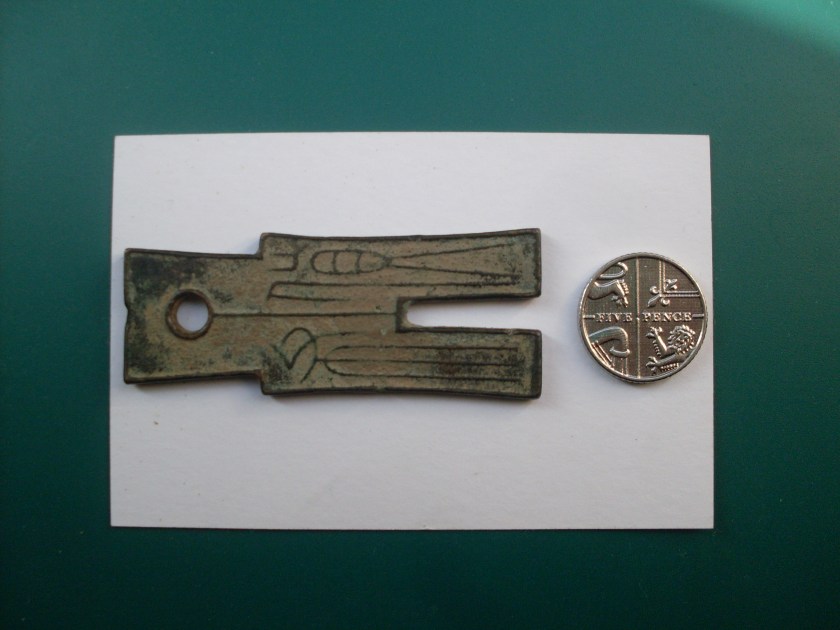
The piece I got this month is something I have only ever managed to see in museums or in books.  However, I got lucky and through some of my contacts found someone willing to sell on an example from their own collection.

SDC12846

From the picture above you can see a Huo Bu (money spade) from the reign of the emperor Wang Mang (9-23AD).  Now, this is not the first time I have acquired a coin from this Chinese emperor, and I have written briefly about his reign in a previous blog post back in January last year (Here).  So I won’t regurgitate anything in this post.  So I would like to explore spade coins in general.

Chinese spade coins were first made during the Zhou dynasty (~1045 – 256 BC) and resembled a small spade or weeding tool often used by the people as an alternative form of currency.  The original spade coins would have a hollow handle at the top of the coin, representative of the wooden handle you would insert.

Towards the later period of the Zhou dynasty, the legs would be less pointed and early forms of Chinese characters would start to appear on the coins.  Further changes would happen during the warring states period (475- 221 BC).  Each of the individual states would start producing their own spade coins, and they would become much smaller and would no longer have the hollow handle at the top.  Different shapes would also begin to be produced, with examples known to exist including arched feet, rounded feet, and coins with three holes (Pictures and examples of which cane be found here).

After Emperor Qin Shi Huang has conquered the warring states in 221 BC he replaced spade coins with the titular round coins with square holes many of us are familiar with and associate with in regards to ancient Chinese coins.  This would continue until we reach our reoccurring blog favourite, Wang Mang.  When he became emperor he reissued spade coins, in an attempt to impose some legitimacy to his dynasty after he usurped the throne and forge a link with previous dynasties.  The spade coins by this time had proven to be unpopular however despite several different types being cast and issued.  Round coins were ultimately reintroduced shortly afterwards, and the spade coin was resigned to it’s place in Chinese numismatic history.

SDC12847