Tearing up Money

Not a very large post for the final month of 2021, as once again I will be showing off something I have talked to at length in previous blog posts.

Normally, when I add something to my collection which I have already spoken about before I often just quietly do it and feel no need to write about it here. On this occasion I wanted to show it off since this specimen was slightly unusual from the other examples often found.

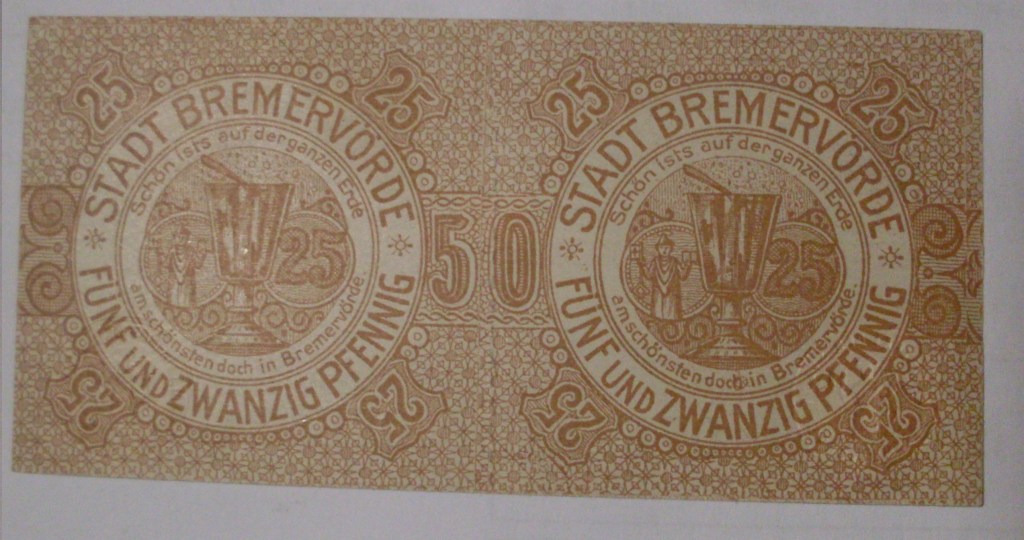
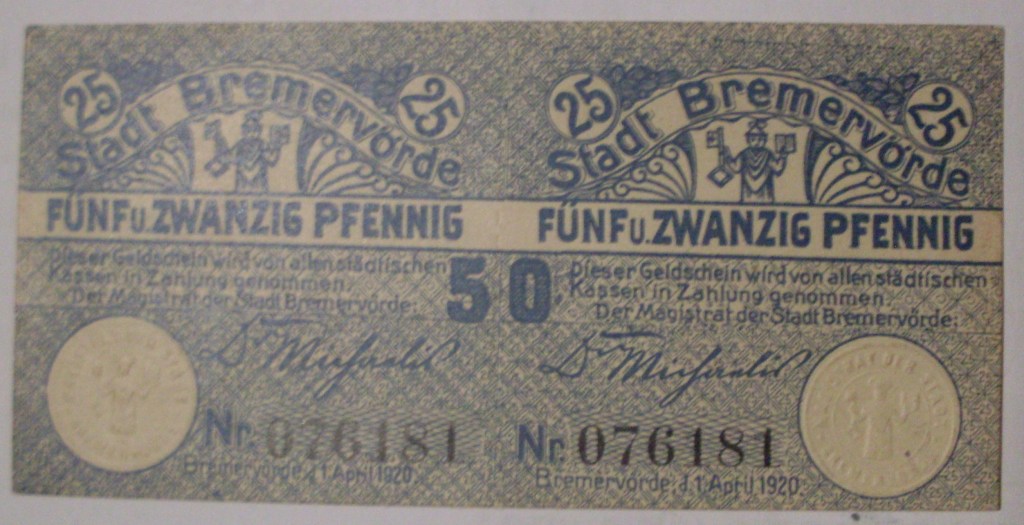
Once again I will be showing you another notgeld banknote from Germany. Dating from 1920, this note was printed in the small town of Bremervorde which is in the Rotenburg area of Lower Saxony. Situated not far from the city of Hamburg. This connection with the city shown in the embossed seals on the bottoms corners of the note.

With the nominal value of 50 pfennig, what really stands out (and is much more easier to see in the second photo) is the perforation down the direct centre of the note. The explanation for this is clearly shown on the design on both the front and back of the note. This is so the note can be broken down in half and used as 25 pfennig instead.

Quite novel in it’s design I am quite sure it is not unique amongst other notgeld notes out there. However, this is the first example I have seen, and the first specimen I was able to add to my collection.

Not worth the paper it’s printed on…

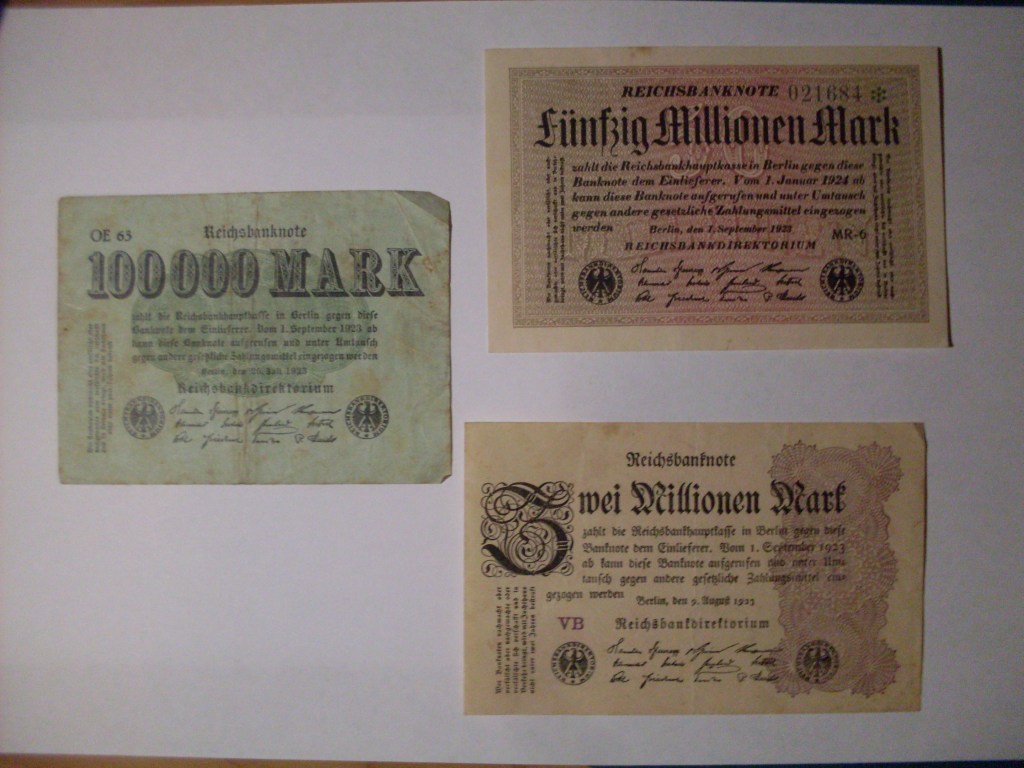
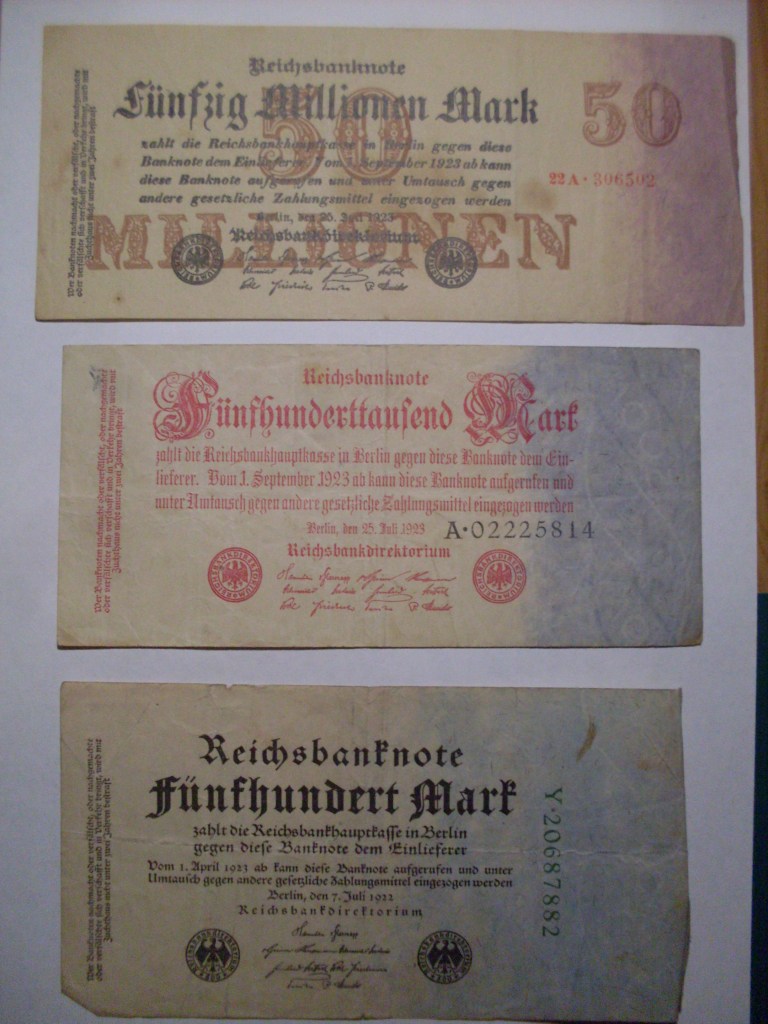
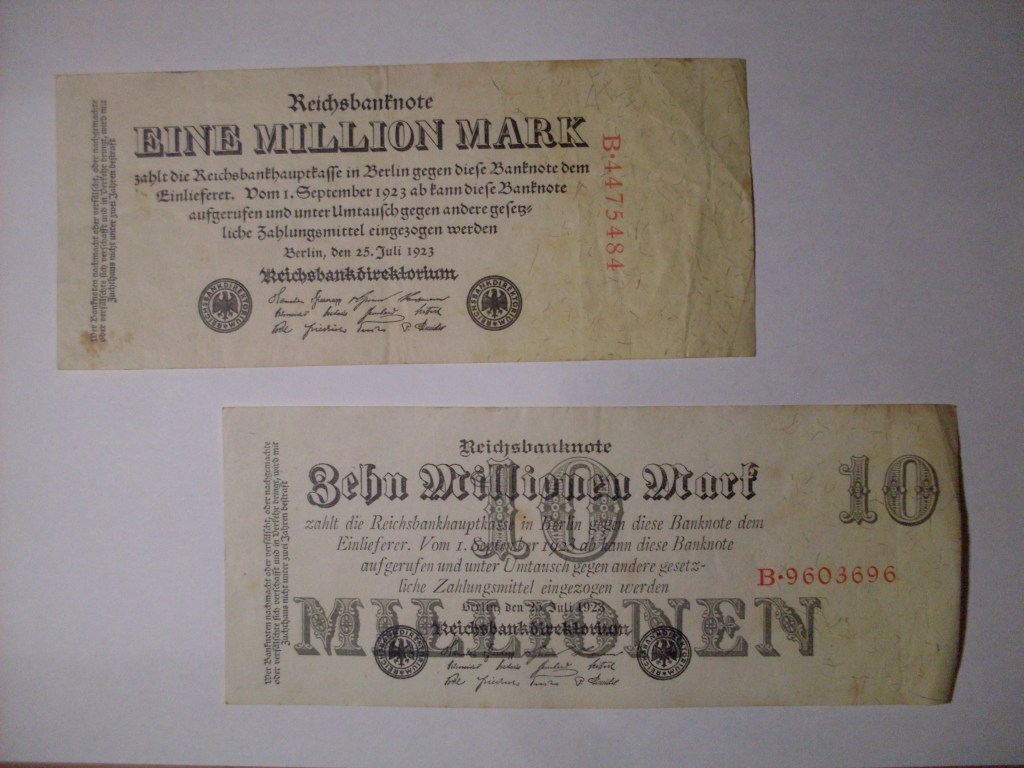
For September we return to Germany to look at some banknotes from a period in the country’s history which is heavily studied. Especially by those learning history here in the UK.

This period defined the inter-war years for Germany. It weakened the new Weimar Republic which emerged after the horrors of WWI and the overthrow of the Kaiser. This brief period of hyperinflation would set the scene and help sow the seeds for a much darker regime to follow.

When Germany lost the war in 1918, it was saddled with massive debts due to the increased borrowing the Kaiser and his government undertook to fund it’s effort during the conflict. Exacerbated further by the harsh conditions imposed upon Germany by the Treaty of Versailles in 1919. Despite some economic relief provided by the Young Plan, the debt burden was worsened by the printing of money with no economic resources to back it. Reparations as set out in the Versailles Treaty accelerated a decline in the German Mark as more money was printed to meet these obligations. By the end of 1919 it would take 48M to equal just $1 in value.

By the time Germany was to meet it’s first reparation payment in June 1921, the value of the Mark had slipped further with 330M now needed to just meet $1. As the reparations had to be paid in hard currency rather than the slowly falling ‘Papiermark’ (Paper money), the German government began to exchange marks for foreign currency at any value. This action would further destabilise the currency as it was seen by many as the German government selling their own currency in preference for foreign. Thus weakening the trust in it’s value.

1922 would mark the beginning of the rapid decline in the value of the German currency. By June of that year a conference organised by investment banker J.P Morgan tried to solve the situation and organise reparation repayments. Since no workable solution was able to be found, the inflation would continue to skyrocket. By the years end, 7200M would equal $1. The strategy employed by Germany was to mass print new banknotes in order to buy foreign currency to pay the reparations. This of course destabilised the economy greatly, with much of the banknotes now not being worth the paper they were printed on.

By 1923, Germany was no longer able to make it’s reparation payments and the French would respond by occupying the Ruhr valley, Germany’s main industrial region. The German government would encourage the workers of the region to adopt a policy of passive resistance by not helping the invading French in any way. The workers though would need to be supported financially during this ‘strike’ against the French occupation. Thus leading to more banknotes being printed.

By the end of 1923, new plans were proposed by the central German bank to tackle the crumbling economy and rein in the continual rising prices. A new currency was to be introduced in Germany, the Rentenmark, back by bonds indexed to the physical value of gold. In parallel to this, a new bank was set up to control this currency called the Rentenbank. The new bank would refuse credit to the government and currency speculators in an attempt to create value for the new currency.

Over the course of 1924, the new Rentenmark would be expanded in scale until it would be formally adopted as the de facto currency in Germany in August of that year. By the time of it’s formal adoption the value of the currency would be 4.2 rentenmarks to a single dollar. Conversion values between the old Mark and the new Rentenmark would be set at 1-trillion marks to 1 rentenmark.

Overall, hyperinflation in Germany would reach it’s peak around November 1923 with the average price of a loaf of bread at the time coming to 200,000,000,000 Marks. The economy would stabilise and prices would return to normal relatively quickly with the introduction of the Rentenmark. Despite being separate events, many Germans would conflate the hyperinflation of the 1920’s along with the Great Depression and see both together as one large economic crisis.

The price of war

A fairly short post this month.  Mainly because I got something I have already talked about before.  In this post I wrote back in 2017 I talked about my favourite numismatic material I like to collect.  Well this month I got myself several notgeld coins to add to my collection.


Two of them are 5 pfennig coins, and the other is 10 pfennig.  They were made in two different towns within Germany, with the coins from Düren being of boring design.  Both coins feature the value of the coin, and the city name on both faces.  The last coin, a 5 pfennig, was made in Bonn and shows a design of one of the bridges which stretch over the Rhine in the city.  Both cities are found in the Rhine area of Germany, although Bonn actually straddles the river.  The 5 pfennig coins seem to be made from iron, whilst the 10 is made from zinc.

The coins date from the last few years of WWI, when war critical supplies are running low within Germany.  As explained in my linked blog post, notgeld were issued by local administrations to help bridge the void left by a failing central government at the time.  Although most forms of notgeld often seen are in the form of banknotes, as you can see coins were also issued.

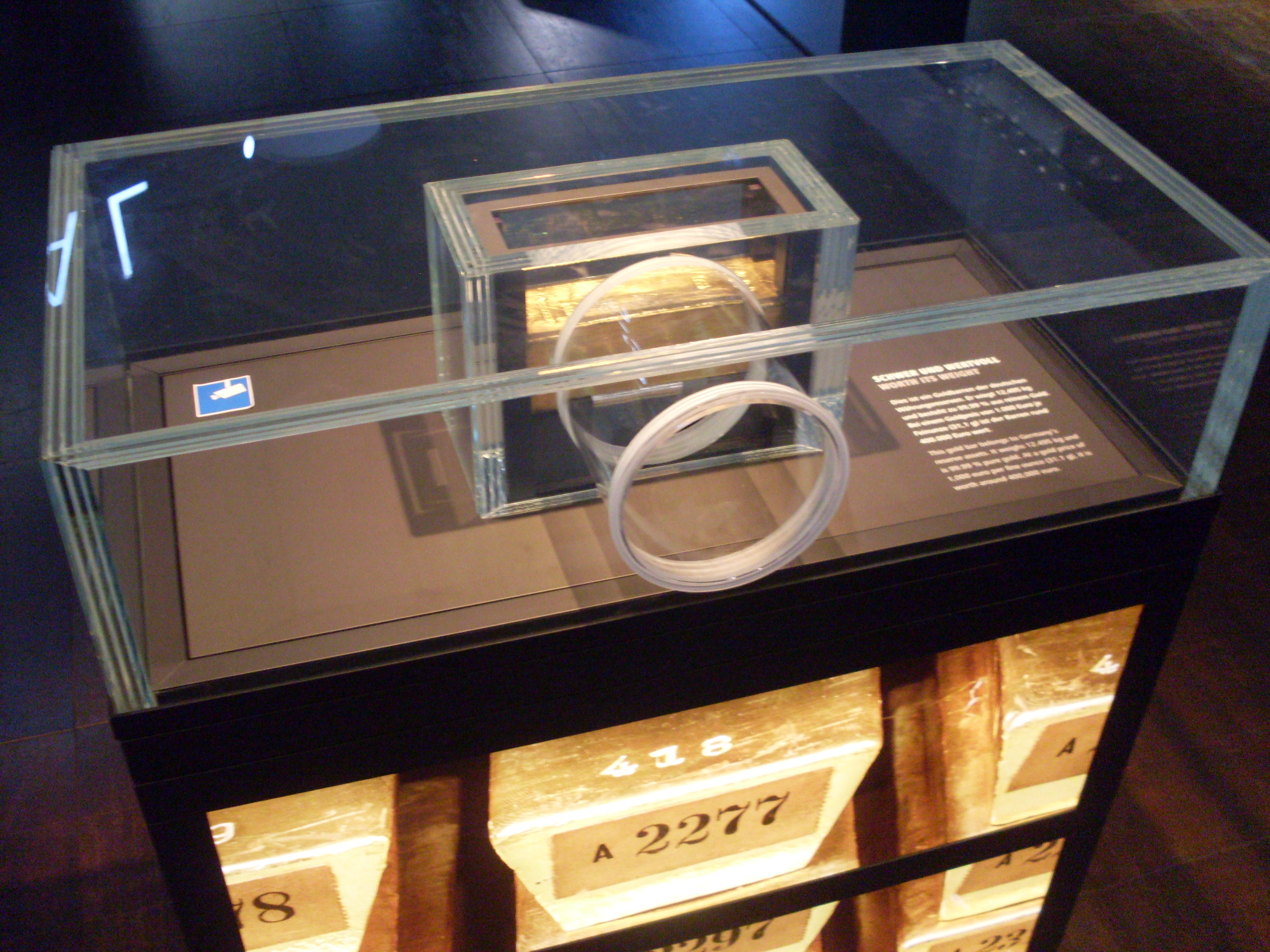
German Bundesbank Money Museum

SDC12921

At the start of this month I recently went to Germany to visit some friends for my birthday.  Whilst there I finally had a chance to visit the Bundesbank Money museum in Frankfurt.

I should start off by saying how great this museum actually is.  It is far larger than any other money museum I have visited so far, although I will admit that the number of items on display are far fewer than others I have been to, in terms of actual historical items.

The museum is split into 4 general areas.  Two of which actually showcase the variety of coins and banknotes globally and within Germany itself, drawing examples out from monetary history.  The other two sections of the museum deal with finance itself and the role money has in society as well as how the banking sector works.


These last two sections were completely new to me.  Well, to be more honest, new in the sense that the information presented was a lot more wide-ranging and complete compared to other museums.  Often monetary policy and economic theory is just a small afterthought in most money museums.  The sections start by showing how money had evolved from the simple exchange of goods to precious metals, to the more modern equivalents of balance transfers and electronic accounts.  It goes through the history of banks, and how many ideas still used today in modern financial institutions were started back in medieval Italy and Venice.

Once through this section, visitors then get to come to grips to the more heady topics of inflation, printing of money, price exchanges between different currencies etc.  Quite heavy topics to the uninitiated, and to most quite boring (one of the main complaints from a friend who visited the museum with me).  I will admit, although have some interest in the area of economics, I did gloss over a lot of it (But to those with a keen interest, I do wholly recommend a visit).

Of course, sprinkled throughout the museum, including the economic sections on monetary policy, Germany’s financial history is explored.  With the hyperinflation of the early 20th century being a great showcase into understanding some of the more heavier topics discussed in the later sections.

SDC12918

Overall, I fully enjoyed the museum.  There was a dearth of information (written in both English and German) explaining a wide range of topics within the hobby itself.  Of course most relating to Germany and the Eurozone.  A definite must see if you happen to be in the Frankfurt area, with the added incentive being that it is completely free to enter!

SDC12924

Collection Update Aug’ 18

SDC12754

I fear that this month’s update will be quite lengthy as I recently acquired a large number of German coins stretching through just over 200 years of history.  During that time Germany went from a collection of individual states disguised as the Holy Roman Empire, to eventual unity.  Two world wars, being split again, and another eventual reunification requires me to be very scant on details otherwise it would turn into a very lengthy essay!

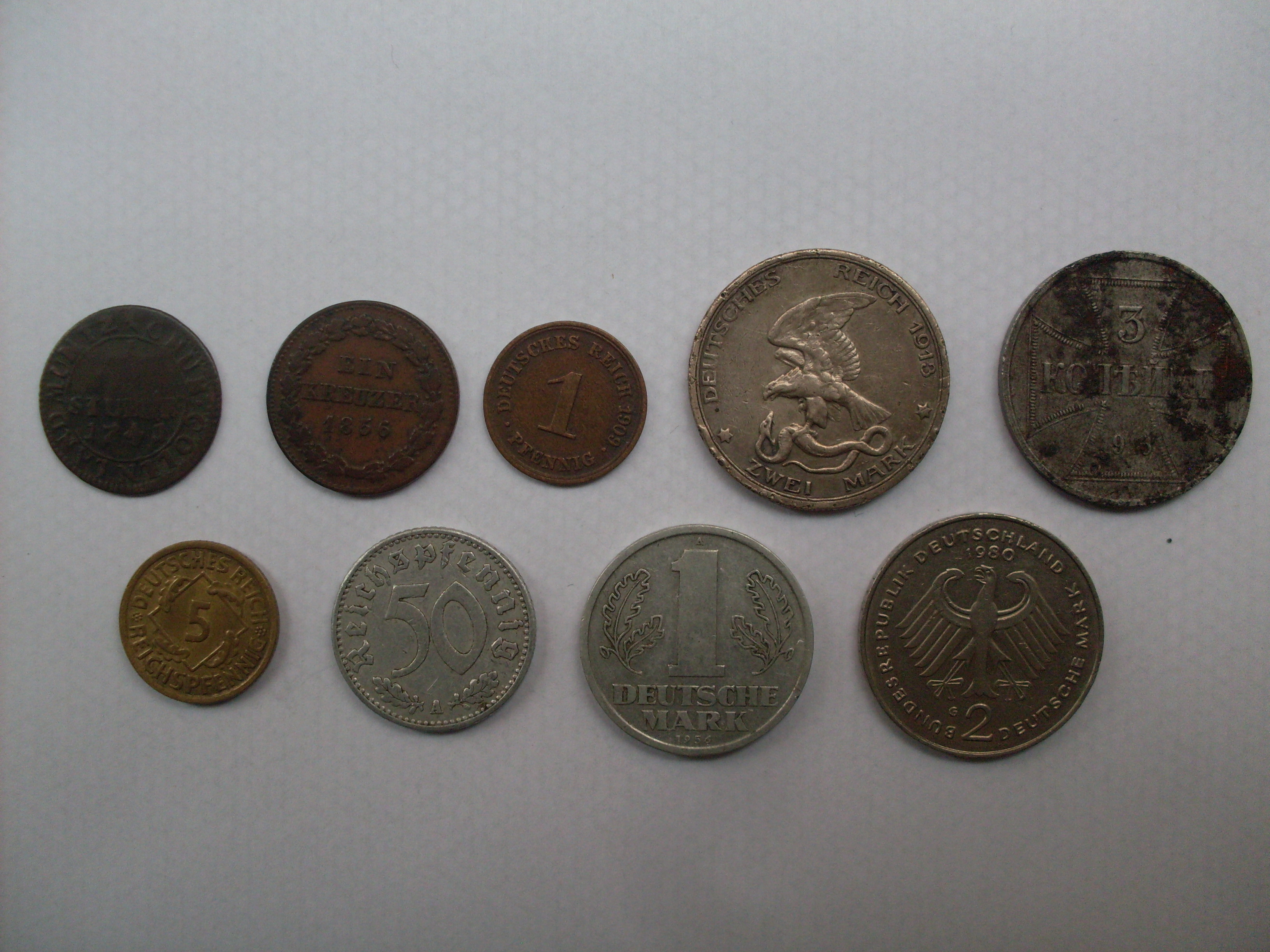
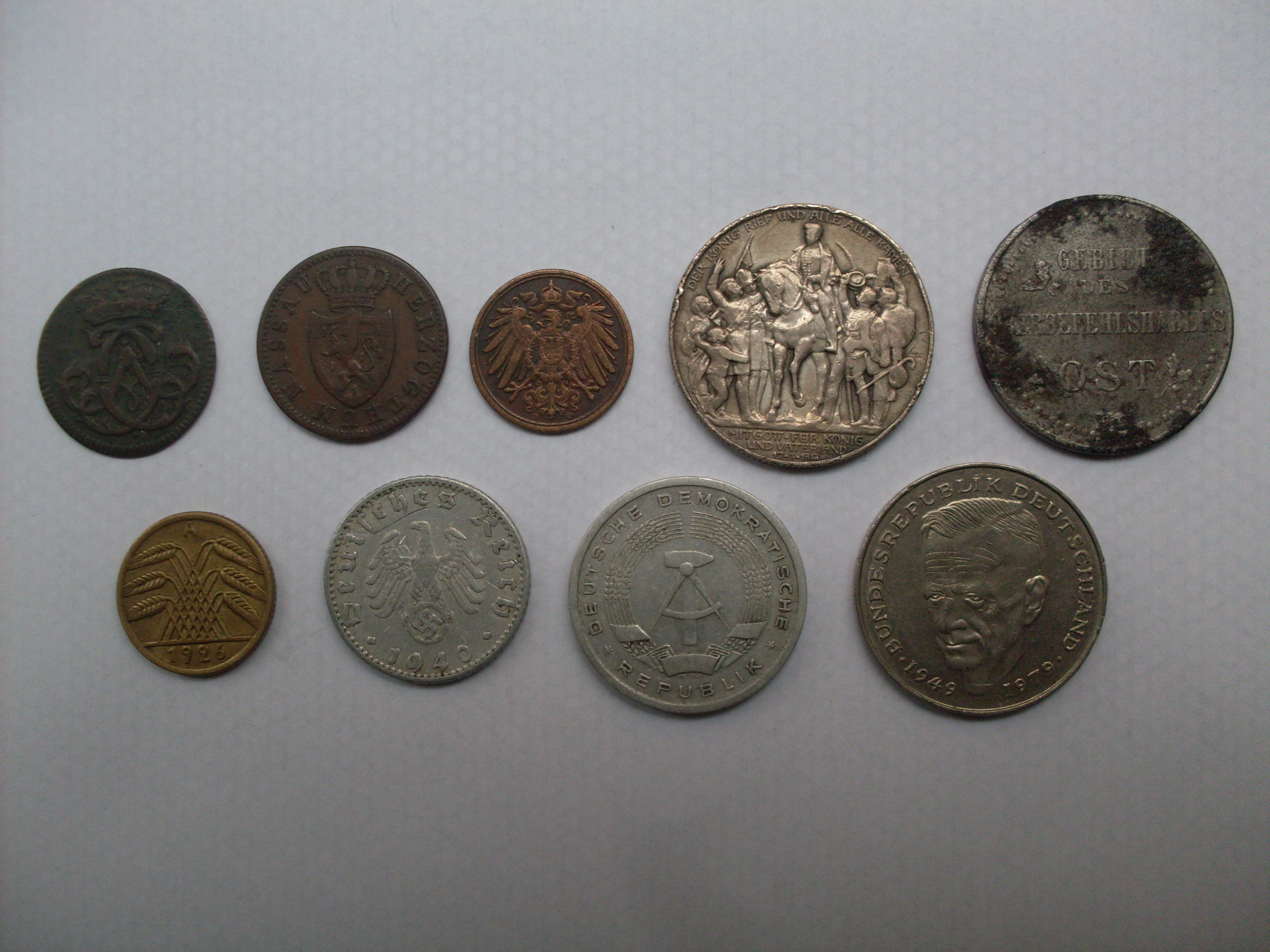
Our delve into Germany’s past starts with the first coin, which is a 1/4 Stuber from the German state of Cologne (dated 1741).  Cologne at this time was an archbishopric and was issued under the name of Archbishop Clemens August (his stylised monogram taking up the obverse side of the coin).

The beginnings of the Holy Roman Empire are unsure, and many scholars cannot agree whether it was Charlemagne who became the first emperor in 800AD, or Otto I in 962AD.  However, by the middle of the 18th century when the 1/4 Stuber was minted, the state of Prussia had come to dominate the Empire in it’s politics with the accession of Frederick I (the Great) to the throne of Prussia.  Frederick would eventually spark the War of the Austrian Succession (1740-48) and more importantly the Seven Years Wars (1756-63) which would sow the seeds for the American Revolutionary War, and add further fuel to the fire which caused the French Revolution.

By the time of the minting of the next coin (1 Kreuzer, 1856, Duchy of Nassau), the Empire had been dissolved 50 years previously in 1806.  This happened when Emperor Francis II’s armies were defeated by the French under Napoleon at the battle of Austerlitz.  The Emperor abdicated after signing the Treaty of Pressburg, where many of the Empire’s western territories were organised into a French satellite state called The Confederation of the Rhine.  After the end of the Napoleonic wars in 1815, the Confederation was replaced by the German confederation until 1866 when it became part of the North German Confederation founded by Prussia.  A forerunner of the German Empire which would be formed under Prussian leadership in 1871.

The unification of Germany occurred under the leadership of the Iron Chancellor, Otto von Bismarck.  The desire for a unified Germany was borne out of the revolutions which occurred in 1848-9, with the idea of pan-Germanism and the discontent felt with the traditional autocratic political structure of the current individual German states.  Bismarck desired a unified Germany, but with Prussia at the helm, not Austria.  So a series of wars were initiated to establish dominance.  The first is known as the Second Schleswig War (1864), in which Prussia and Austria attacked Denmark.  Achieving victory, both Austria and Prussia were ceded territory from Denmark, and the northern frontier of the future German Empire would be established.  However, due to collusion with Austria, the outcome of this war led to the Austro-Prussian War (1866).  The result of this war allowed Prussia to assert control over what would be the empires future southern provinces.  It also ended the idea of forming a German empire which included Austria, as this would weaken any Prussian control.

Finally, in 1870, the French declared war on Prussia starting the Franco-Prussian War (1870-1).  The French Emperor, Napoleon III, was worried about being encircled by two family members of the same house (A candidate of the Hohenzollerns was in line for the throne of Spain).  Some clever politicking by Bismarck and the infamous Ems Dispatch caused conflict to be started.  Prussia, with assistance from the Southern German states, easily defeated France. With the chief adversary to German unification being defeated, the new German empire was proclaimed in 1871 in the Hall of Mirrors in the Palace of Versailles with the Prussian King Wilhelm I becoming emperor.
SDC12753

The next few coins come from the German Empire, with the large 2 Mark (1913) being a special anniversary coin commemorating Prussia re-entering the Napoleonic Wars a century prior.  The last in the top row is a 3 Kopeks (1916) made from solid iron.  These would be issued by occupying German forces on the Eastern front in the Russian territories they had captured during WWI.

After Germany’s loss in WWI the Weimar republic was created in 1919.  The first coin on the second row is a 5 Reichpfennig (1926) from the Republic.  The Republic suffered many problems from it’s inception, ranging from hyperinflation during the Great Depression of 1929, political paramilitaries from both the Left and Right, and a contentious relationship with the victors of WWI, most notably France.  The people of Germany blamed the Republic for the loss in WWI and the humiliating requirements of the Treaty of Versailles rather than the wartime government.  This created the perfect condition for Hitler and the Nazi party to rise to power, which as everyone knows, led to WWII and the horrors committed within.  The next coin is a 50 Reichpfennig from this period, dated 1940 below the eagle and swastika.

After Nazi Germany’s defeat in WWII, Germany was split in half between the Western Allies and Soviet Russia.  The part controlled by the West was called the Federal Republic of Germany, whilst the part under Soviet control was called the German Democratic Republic.  The last two coins each come from both parts of Germany.  The 1 Deutsche Mark (1956) comes from East Germany, and it is testament to the conditions at the time under Soviet rule as the material the coin is made out of is aluminium.  Compared to the 2 Mark (1979) coin from the West which is a much more solid cupro-nickel coin.

With the fall of the Berlin Wall in November 1989, it paved the way for Germany to be reunited again after 45 years of separation in October 1990 with the Treaty on the Final Settlement with Respect to Germany.  This was further reinforced by the collapse of the Soviet Union the following year, and Germany was able to become fully sovereign in March 1991.
Collection update May ’17

This month I will be talking about two small coins which I got as part of a small group of silver coins mainly from Denmark.  The Danish coins themselves date from the early 20th century, and like most Scandinavian coins of that era, their design, in my own personal opinion are something to be desired.  Generally sporting the value of the coin itself whilst displaying the monogram of the current monarch.  A bit lacklustre.  The second coin I want to talk about can easily fit into this category, as the design on the reverse is nothing to write home about, but the bust of the monarch is rather interesting to say the least.  However, I will move on to the first coin, as it has a bit more history attached to it.

imgonline-com-ua-twotoone-jkFhueRz2vhIj

Now above is a small silver coin from the city of Hamburg dated 1738.  It is about 17mm in diameter and about 1mm thick.  On the obverse we see the three towered castle which is the coat of arms of the city, whilst on the reverse is the date and value between some branches.  Sadly, sometime during it’s life the coin has been pierced to be worn as jewellery, thankfully it hasn’t marred much of the designs on both sides of the coin.  Even if it does leave a large ugly hole staring glaringly at you.
Hamburg itself is in a unique position within Germany, occupying an area in the north of Germany at the southern point of the Jutland peninsular. The full name of the city is the ‘Free and Hanseatic City of Hamburg’, tipping its hat to it’s medieval past and links to the Hanseatic trade league that it was a member of.  For much of Hamburgs existance it was a free city within the Holy Roman Empire, and later German Empire, being a state in it’s own right.  During the middle ages, Hamburg was one of the improtant ports within Europe due to it’s location near the North and Baltic seas, as well as being on the confluence of the rivers Elbe, Alster and Bille.  This was further strengthed by it’s status as a free city.  It was not, in fact, until after the Second World War that Hamburg lost it’s total independence from Germany itself as it was subsumed into the administration of Western Germany during British Occupation in 1949.  Where to this day it has grown to be the second largest city in Germany.

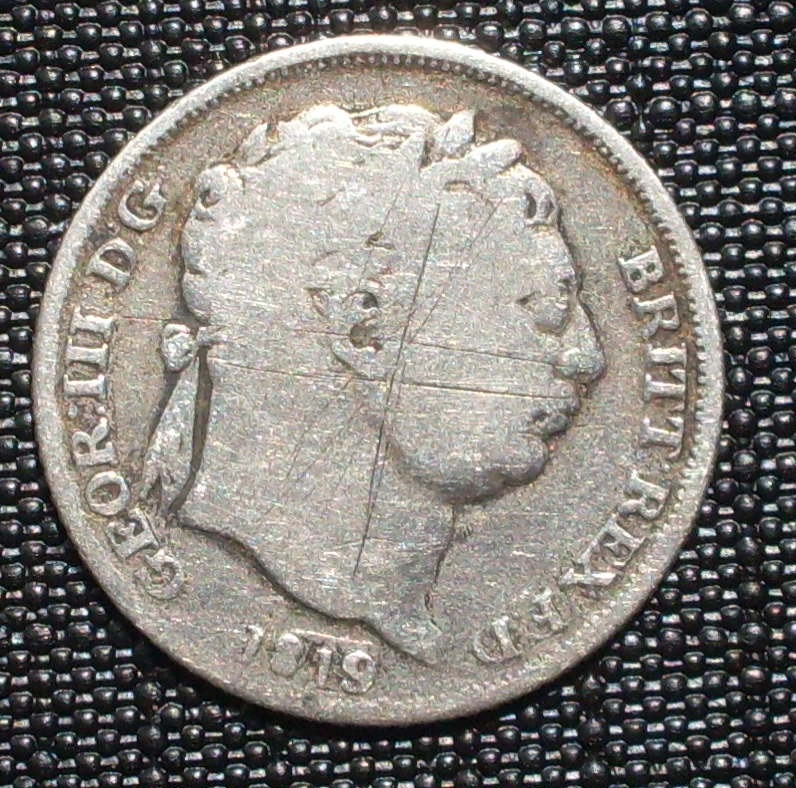
The second coin I mentioned is a silver threepence from the UK from 1819.  Now as I mentioned previously, the design of the coin itself is rather dull, but really I want to talk about the bust of George III displayed.

SDC12314

Now although the coin itself is very worn, and suffering from deep scratches on the face, a clear outline of the bust can be seen.  This bust design is known to collectors as the ‘bull-headed George’.  This was due to the engraver at the time, the Italian Benedetto Pistrucci, being unable to engrave a proper portrait from life due to George being very much insane. This portrait was thus put into use for several years between 1816-1820, and was met with much public hostility from all sectors of society.  One high ranking official in the Houses of Parliament has even been noted to have said ‘send the lot to the provinces so no-one has to see them’.  By this he meant the anywhere that wasn’t London or the south of England.  A view which is still often in use today.  Eventually the design was withdrawn from use, and the mint reverted back to the older ‘Young head’ design of the late 18th century, much to many peoples relief.  George was succeeded by his son George IV in 1820.

Notgeld

I mentioned in a previous blog post that I would focus a blog entry on Notgeld, and it is time to deliver on that promise.  German notgeld has to be my personal favourite numismatic item to collect.  The artwork and sometimes vibrant colours often put some of the more contemporary banknotes we have today to shame.  It also allowed the individual issuing authority to show pride in their towns and cities, and display individuals and events particular to that region.  Below is a very small selection of notgeld from my own personal collection to show the variety in the different pieces that were issued:

So what is Notgeld?

Notgeld is emergency money issued in both Austria and Germany from during WWI and the inter-war years prior to WWII.  Issued during the economic crises and eventual global collapse post 1918, they were an attempt to bridge the void left by a failing economy provided by the central government at the time.  They are not too dissimilar to token coinage issued in other countries throughout history, and other examples of such issues could be ‘Necessity money’ in both Belgium and France, the ‘Gun money’ issued in Ireland, ‘Company tokens’ issued by US mining companies, or the business tokens/’Condor tokens’ issued by businesses in Britain during the late 18th century.

Who issued the Notgeld?

 Notgeld was often issued by a non licensed body in the separate towns and cities, usually a local savings bank or a local state/privately owned business.  This limited the use of the notgeld to the town or area to which it was produced.  Although this didn’t stop them from travelling from further afield.  Each issuing body would often issue different series of notgeld for the local area.  Often comprising sets of a common theme.  With some of the more ambitious sets numbering around 7-8 notes.  Some of these sets could show different landmarks in the area, or retelling of an important event which happened close by.  Some of the sets even tell local tales and legends, with each banknote actually being numbered (with a letter) so the story can be placed in the correct order.  Very similar to cigarette cards at the time.

What were they made from?

 The main material notgeld was produced out of was from paper or card stock.  Usually anything which was close to hand and in abundance.  Coins were also minted in a fashion, from cheap base metals such as aluminium, or silk, linen, compressed coal, leather, clay and even re-purposed postage stamps.  Some of the recycled materials also included playing cards, which are highly sought after by the collecting community.

How long were they issued for?

Although issued for most of the inter-war period, they were only produced in small batches for actual general use.  So general periods can be 1914-18, 1922, and 1923.  After the general need was met, some further production was carried out on the different series for the collectors of the different notes.  Usually this demand was created by the various ‘sets’ the issuing bodies released.  As with most things, there is always someone out there willing to collect it.  This production of notgeld for collectors, has resulted in many examples surviving today still in mint condition, with those bearing the hallmarks of circulation being far outweighed by those that haven’t.

SDC12311

What was the issuing value of notgeld?

During the first issues of notgeld typical values never strayed higher than 1 Mark, with many being valued no more than 50 Pfennig.  However, during the hyperinflation of the 1920’s, higher and higher denominations were being printed, with some reaching at the height of the crises, into the 10’s of millions of marks.  This at the time when banknotes issued by the central government were reaching into the hundreds of millions.  During this period, coal dust compressed notgeld became increasingly common.  However, surviving examples are now extremely rare as they were often exchanged for actual coal, or even burned themselves for fuel.

When did notgeld stop being used as currency?

Notgeld ended it’s role as an emergency money after the collapse of the Weimar government in the early 1930’s.  A move synonymous with the rise of the Nazi party and the chancellorship of Hitler, when the national currency was reformed and the Reichsmark came into force.


Below I have added some links to some good notgeld resources online.  Usually with further links and lists to help identify any notgeld you may have:

https://notgeld.com/

http://germannotgeld.com/

https://www.notgeldmarket.com/

Collection update April ’17

This month I will be showing off some 17th and 18th century coins I managed to acquire at an extremely good price.  These coins hail from the Polish-Lithuanian Commonwealth which dominated Eastern Europe for much of the 16th and 17th centuries, until it’s decline in the mid to late 1600’s and eventually being partitioned in three stages by the Russian Empire (1772), the kingdom of Prussia (1793), and finally the Habsburg monarchy (1795).  Poland and Lithuania would then not be independent states again until 1918.

SDC12305

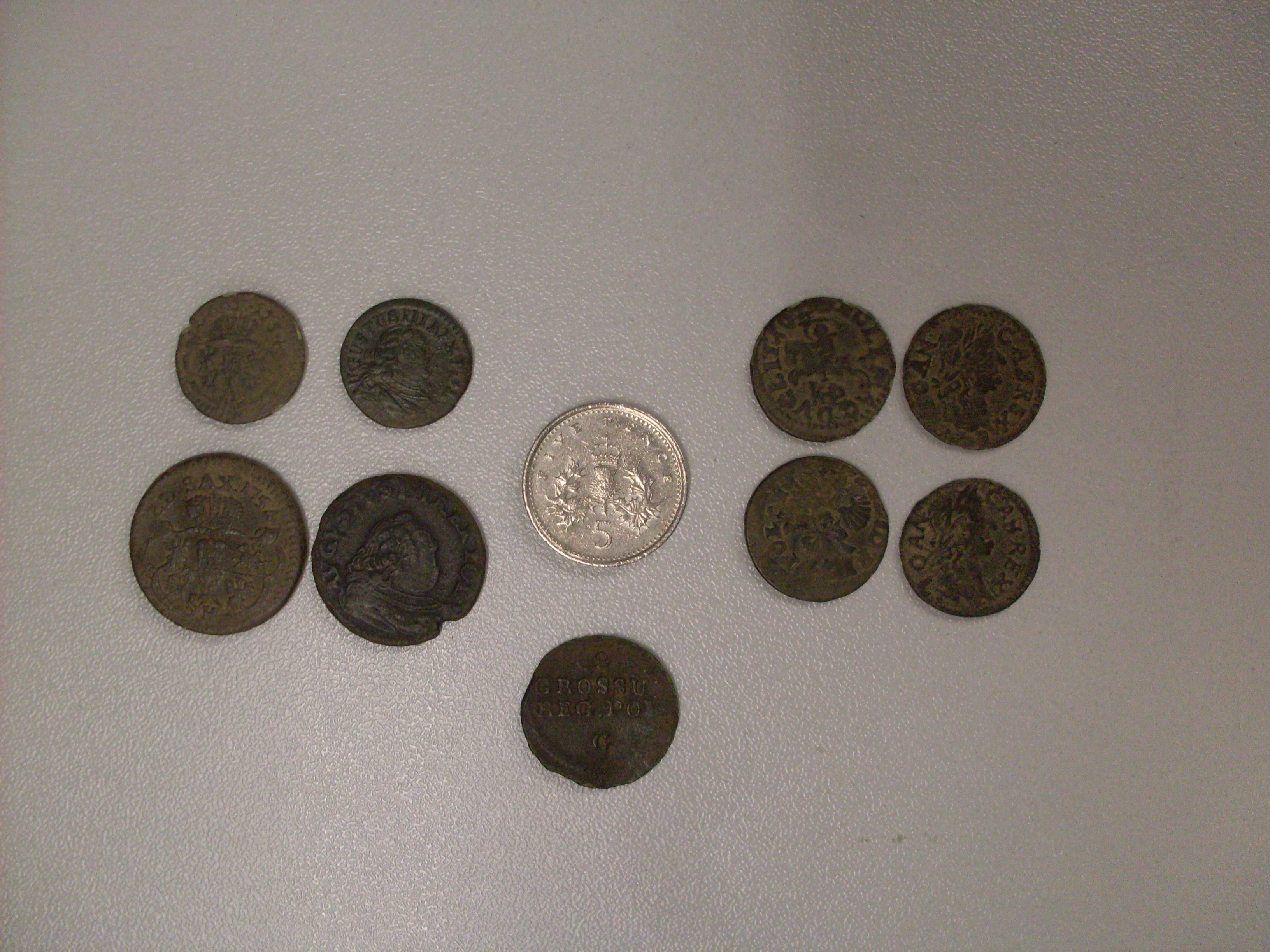
Now the picture above shows various coins throughout the life of the Commonwealth, with the 5p piece being shown as an example of the size of these coins.  All of them are hammered copper, as milled coins were still in it’s infancy during this period throughout many countries during this period.  Although some headway was being made in the process throughout France and Britain at this time.

The four coins on the left date from the mid-1660’s during the reign of John II Casimir Vasa.  They sport both emblems which are featured as the coat of arms of both nations which give the name sake of the Commonwealth.  There is the armoured horseman of Lithuanian and the argent eagle of Poland.  These coins come from a period when the Commonwealth is starting it’s century long period of decline.  During the two decades prior to these coins being struck, the Commonwealth had just lost a war against Russia, being forced to concede several parts of the Ukraine.  Poland also suffered an invasion from Sweden, known colloquially as ‘The Deluge’.  During this invasion Poland suffered heavily from the Swedes, with around 188 cities being sacked, and the population of many of them being severely destroyed (90% population destruction reported in Warsaw alone).  Some historians have argued that the destruction caused by the Swedish invasion was more costly to Poland than what the country suffered during WWII.  A figure estimated at 4 billion Zlotys (£750 million, $990 million) in 2012.

The coins on the right date from the mid-1750’s, from the reign of Augustus III.  During his reign he saw much upheaval and disorder by many of his subjects.  Augustus III and his predecessor Augustus II were relatively weak kings during the Commonwealths history.  More interested on their hold of the Electoral seat of Saxony in the Holy Roman Empire, they used the Commonwealth as a vehicle to increase their standing with the German provinces.  This caused the ferment of unrest as mentioned previously causing many reform movements to me founded.  Consequently, this led to the rise of the Polish Enlightenment.  The most interesting thing about the Polish Enlightenment is the key strata of society which spurred the movements.  In Western Europe, many of the Enlightenment movements were started by the lower classes in the bid for more freedom, tolerance and equality in society.  In Poland, it was the nobility (a mere 10% of the population at the time) which started the trend.

Finally, the coin at the bottom of the group, dates from the reign of Stanislaw II, the successor of Augustus III.  Also the last king of the united Polish-Lithuanian Commonwealth.  His reign saw the final collapse and destruction of the Commonwealth.  With the final blows starting with the first partition of Poland in 1772.  His successful attempt at a constitutional reform in May 1791 came too late however, and the Commonwealth ceased to exist as a political entity after the third partition in 1795.  The constitution set up by Stanislaw is unique in that it is the first constitution of the modern period in Europe, second worldwide after the US constitution of 1787.

Tied in with the coins above, I also acquired one more coin from the Kingdom of Prussia.  Dating from 1795, it coincides with the final year of the Polish-Lithuanian Commonwealth, with Frederick William II being one of the chief overseers of the Commonwealths death throws.

imgonline-com-ua-twotoone-XTF9hD6lPQaw

As well as overseeing the final partition of the Commonwealth, Frederick was keen in wars across much of Europe.  Particularly fighting against the French in attempts to keep (which was seen at the time), poisonous pervading influences of the French Revolution from tainting other European countries.  However, poor finances and promises to coalition partners caused much of his efforts to be stunted, a situation further exacerbated by the newly acquired Polish territories in 1795.