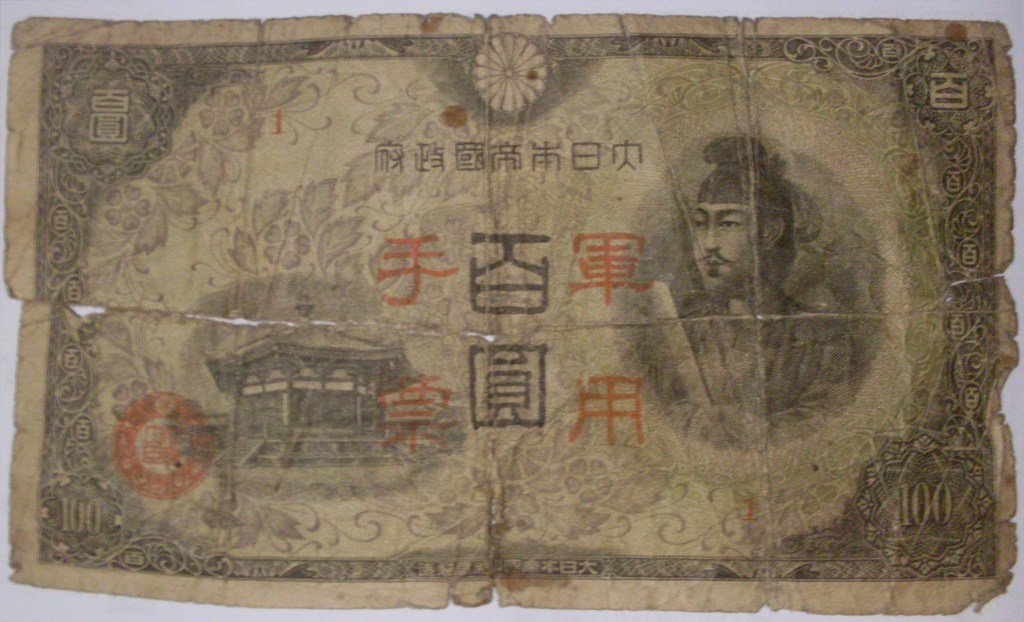
A rather sad looking banknote has made it’s way into my collection this month. It has clearly seen better days, with many small rips and tears into it. The note itself is Japanese in origin, but was for use in Hong Kong during WWII.
Japan was notorious for issuing it’s own currency to the territories it occupied during WWII. Many of them forced to use the Military Yen.
The military yen was very similar in design to yen issued by the Bank of Japan except for large red text declaring that it was military issue and not official Japanese currency. The military issues were not backed by gold or silver, thus they could not be exchanged for the official Japanese yen issued by the central bank. The forcing of local populations to use the military yen officially allowed the Japanese to dominate the local economies of the territories it had occupied.
Hong Kong was captured by the Japanese on December 25th 1941. The following day the Japanese authorities decreed that Hong Kong was to use the military yen as it’s official currency. The official exchange rate between the Hong Kong dollar and the new military yen was set at 2 to 1, however, by October 1942 it had risen to 4 to 1. The use of the Hong Kong dollar was outlawed.

By 1944 the Japanese military was becoming more desperate in the war effort and would mass print more military yen banknotes to put into supply within Hong Kong. This quickly resulted in hyperinflation, and food rationing became a daily norm for much of the population.
When Japan surrendered unconditionally in 1945 and Hong Kong was returned to British authority many of the military yen banknotes were seized. At the time it was roughly estimated 1.9 billion banknotes were seized by British military authorities, and just prior to Japan’s surrender a further 700 million banknotes had been intentionally destroyed.
In September 1945, the Japanese Ministry of Finance declared that all military yen were to be null and void reducing them to worthless pieces of paper. The people of Hong Kong were left in absolute poverty at a stroke. Attempts for redress of these actions happened throughout much of the 20th century, with a court case finally being heard in 1993. The people of Hong Kong sued the Japanese government for the money that was lost due to the voiding of the military yen. A verdict was given in 1999 ruling against those seeking redress citing the Treaty of San Francisco as one of the reasons to deny compensation.
 Numismatic Exploits