The Octopus man cometh…

Well… Not actually an octopus man, but the design of this months coin certainly does fit the bill.  SDC13233

This small copper coin, dating from around the beginning of the 11th century, hails from the Chola empire which dominated the southern part of the Indian sub-continent for centuries.  The Chola dynasty is known as the longest recorded dynasty in history, with written records dating as far back to the 3rd century BC.  It survived and thrived until it’s eventual decline and collapse in the 13th century.

The chola empire had much influence within SE Asia, with the majority centred around what is now modern day Malaysia.  It was further extended north, when strong trade links were established with China.

The Cholas left a lasting legacy after their long rule. Their patronage of literature and their zeal in the building of temples has resulted in some great works of Tamil literature and architecture. The Chola kings were avid builders and envisioned the temples in their kingdoms not only as places of worship but also as centres of economic activity. They pioneered a centralised form of government and established a disciplined bureaucracy. The Chola school of art spread to SE Asia and influenced the architecture and art of the region.

SDC13234

The image on the coin itself shows the king Raja Raja I standing with the traditional garment called a ‘dhoti’.  The garment depicted is when gives the design it’s unique look and the apparent appearance of extra appendages.  The other side of the coin shows the king sat upon his throne surrounded by dancers.

After the empires decline, there is an oral tradition that a rebel branch of the dynasty fled and thrived in the Philippines until the 16th century.  It created a small ‘Indianised’ kingdom in the region until Spanish conquistadors under the command of Miguel Lopez de Legaspi conquered the region after sailing from Mexico.

Collection Update Jan ’18

This month I am presenting the last installment of my Asia focus in regards to additions to my collection.  It is safe to say that no foray into Asia would be complete without at least touching upon China.  It dominates the region, and would be extremely hard not to at least acquire several coins from it’s extremely long history.  I have also attained another Japanese copper coin (2 Sen, Meiji Era), as well as another silver Indian coin (1 Jital, 1210-1235) from the Dehli Sultanate.

imgonline-com-ua-twotoone-ZmFusHpunV

I will start off with the rather worn and virdigrised coins on the piece of card.  Both are clearly Chinese, and the one on the left dates from the year 7-14AD.  It is a 1 Wu Shi coin from the ‘Emperor’ Wang Mang.  I use the term emperor in quotes as Wang Mang was a court official during the Han dynasty who overthrew the Emperor of the Liu family and started the new Xin dynasty (which means ‘renewed’ in Chinese) under his control.  Wang Mang was killed when the capital Chang’an (called Xi’an today) was attacked by forces loyal to the previous Han dynasty in 23AD.  The Han dynasty was restored a few years later in 25AD and would continue to rule China until the start of the Three Kingdoms period in 220AD.

The coin on the right dates from 1094-98AD, and is a 1 cash coin from the Emperor Zhe Zong of the Song dynasty.  Not much happened during Zhe Zong’s reign.  He inherited the throne at the age of nine, and was under control of his grandmother until her death in 1093.  He attempted reforms to gain further control on the empire, but due to political infighting amongst his courtiers, many of the reforms were not fully implemented.  This would eventually lead to the collapse of the Song dynasty in the 12th century.  Zhe Zong himself would die at the age of 24 in 1100.

The final two Chinese coins date from the early 20th century when China underwent massive political change and upheval.  Following the turn of the 20th century, China was in the grips of the Boxer Rebellion (1899-1901), a movement which was anti-foreign, anti-colonial, and anti-Christian.  A pro-nationalist movement which had risen up in response to meddling from foreign powers in Chinese affairs, and aggressive Christian missionaries infiltrating all aspects of Chinese life.  Chinese government officials were split on how to deal with the movement as some held sympathies due to harsh demands and exploitation inflicted by the Western Colonial powers during the previous decades.  The attitude of the Empress changed in favour of the Boxers in 1900, when international intervention was beaten back at the Battle of the Taku Forts. Eight different foreign powers sent troops to China to deal with the rebellion, and the now hostile Qing government. In 1901 the rebellion was quelled and ultimately the ruling dynasty’s control of the country.  With defeat and the apparent weakness of the ruling Qing dynasty(not just in the Boxer Rebellion, but the previous Sino-Japanese war), many military officers, students and court officials advocated a change of government to that of a Republic.  The Wuchang uprising sprung up in 1911.  Several months later, other provinces in China followed suit after receiving appeals from rebel forces, and by March 1912 the Empress of the Qing dynasty abdicated, leaving China to become a Republic.

Collection update November ’17

This time I have gotten some new coins with a different flavour for a change.  As it is nice to step outside the bounds of Europe and N. America every so often!

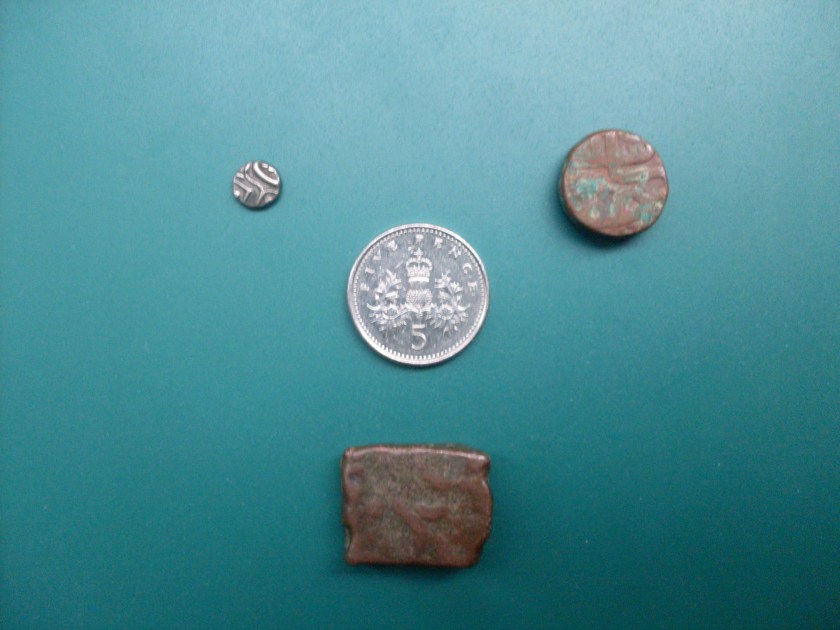
SDC12468

All these coins originate from India (except the 5p of course haha) and are especially small in comparison to any other coin I have in my collection.  They have a broad range of dates during India’s very long history.  Dating from before colonial activity to British rule.

The first coin is a small silver 1 Chakram piece (top left) dating from 1860-1901.  This is by far the smallest coin I have ever held in my hands, and now keep it in a small bag in case I ever drop it (which I have done and spent a furtive 20 minutes searching for it again).  It hails from the Travancore region of India located at the very southern tip of the sub-continent.  During the period of this coins minting, the kingdom of Travancore was under direct British rule.  Travancore would exist as a kingdom until 1949 when it was merged with the kingdom of Cochin. It would later form a part of the state of Kerala in 1956, with the position of king being replaced by govenor (known as a Rajpramukh) being appointed by the president of the newly formed Indian state.

SDC12469

The next coin is a 1 paisa piece (bottom) from Hyderabad, located in the South central region of India.  It dates from around 1763-1774, the period when the British East India Company was gradually exerting more control in the region creating presidencies and protectorates.  Hyderabad wouldn’t come under the sphere of British influence until 1805 when the Maratha Empire loses in the second Anglo-Maratha war.  Hyderabad itself gained it’s independence from the Mughal empire during the early 18th century when Mir Qamar-ud-Din Sidiqqi broke away from the empire and set up the Asaf Jah dynasty in control of the region.  The ruler (known as the Nizam) would control Hyderabad until 1948 when he was deposed by the new Indian army in operation Polo to prevent a potentially large hostile state remaining in the middle of the newly formed country.  The coin itself is rather worn, but a more detailed picture can be found here.

Finally, the last coin (top right) is a 1/2 Tonga from the Gujarat region of India, located in the far west of the country.  It dates from 1512-1526.  A period before any western colonial powers had an influence in the country.  Much of northern India during this period was either in control or influenced by outisde muslim forces.  Gujarat was no exception, and was attacked in the late 12th century, by Islamic forces from Eastern Iran.  The invasion failed, but Muslim influences were transmitted peacefully due to close proximity of her neighbours.  Gujarat would maintain close ties with Egypt, a powerful member of the Muslim world in the middle to late medieval period, which would later evolve to close ties with the Ottomans.  Most notably in the form of working together to prevent Portuguese naval expansion in the Red Sea area.  Gujarat would remain independent until it was conquered by the Mughal empire in 1572.  This however would not diminish the region, as the port city of Surat would continue to flourish being the only major westward facing Indian port.  This would cause the city to becoming a major trading hub on par with that of Beijing or Venice, eventually gaining the title of Bab al-Makkah (gate of Mecca).