Collection update September ’17

imgonline-com-ua-twotoone-br86NzvJvak4dhB

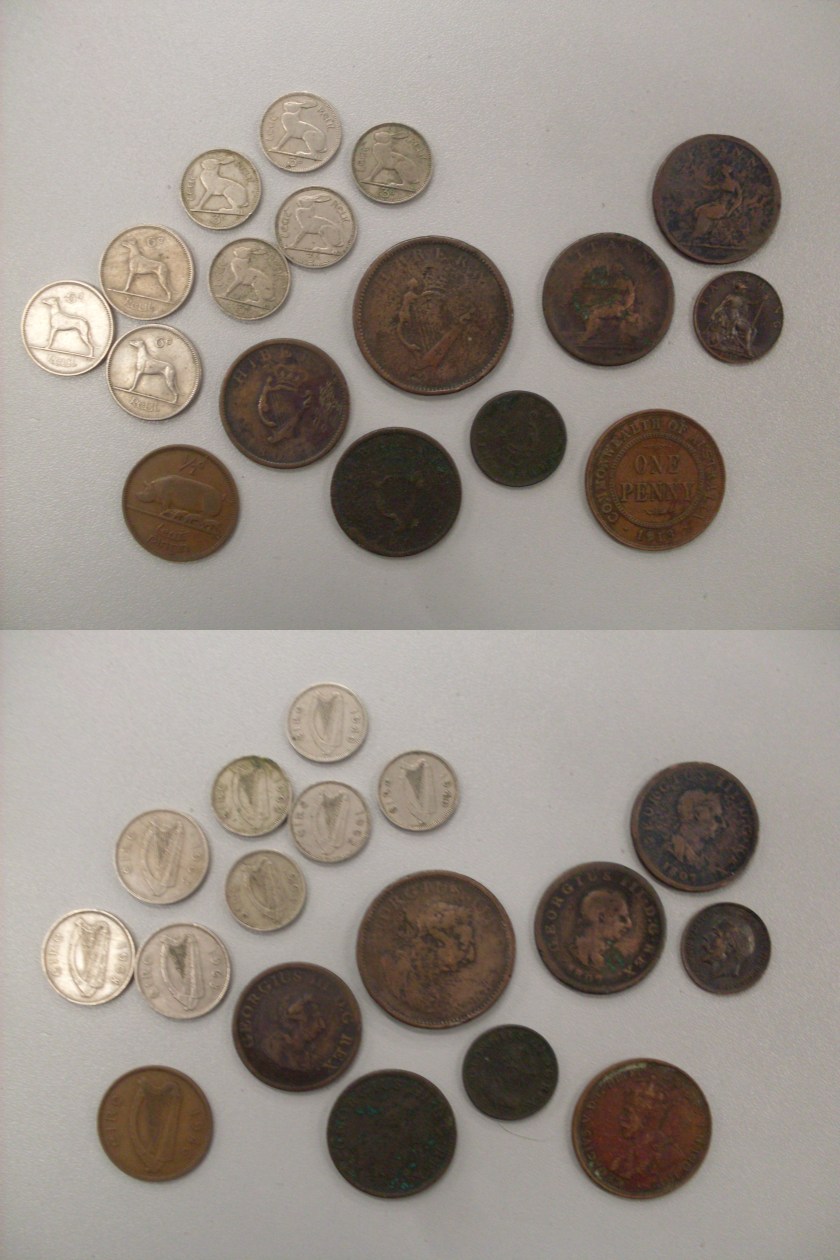
This month I got a selection of British and Irish coins, many of which I have already shown in my collection update blog posts before.  From the pictures above you can see the full range of Hibernia coins minted for Ireland during British rule, as well as a selection of coins minted for Ireland after they achieved independence in the 1920’s.  Most Irish coins still retain the harp, which is a symbol of the country itself, and is commonly featured on the country’s coat of arms.  An icon which has now been translated onto the Euro coins issued by the country.  As well as the British and Irish coins, I also acquired a coin from Australia dated from 1913.

Although George V is shown on the obverse of the coin, Australia by this point in time had become a fully independent country from Britain after the confederation bill was passed by the UK parliament in 1901.  Upon it’s independence, and it’s formation into a unified country it adopted the name Commonwealth of Australia, which can be seen on the reverse.  Despite gaining independence from Britain, Australia still retained the British monarch as it’s head of state, which is still prominently featured on it’s money today.  Similar to Canada, and other former colonial possessions.

Finally, another coin I received was a British penny dating from 1797.  From the reign of George III.

imgonline-com-ua-twotoone-LIpkAa1Cm6

Sadly, the coin itself is in bad condition, and much of detail has been lost.  However, the profile of George and Britannia can be made out.  One thing which, although not clearly seen in the pictures, is that the legends and date which decorate the edge are still clear.  This coin does need a special mention as it is the first modern British penny minted.  Prior to this, there was no official mass produced penny by the government except the silver penny which had been discontinued years beforehand and was the mainstay of British coinage for much of the previous eight centuries.  Due to it’s size and distinctive shape, it is commonly referred to as a ‘Cartwheel’ penny due to it’s uncanny resemblance to a cartwheel.
Collection update June ’17

SDC12365

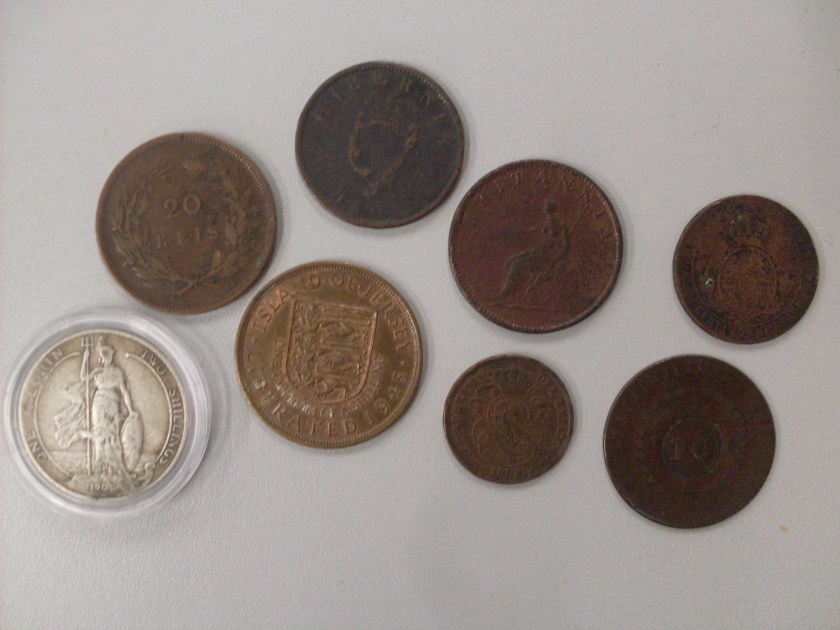
This month I managed to acquire a small smattering of 19th and early 20th century copper coins, with one silver 1904 florin.  The florin itself is interesting due to the fact it is the first design change of how Britannia was depicted on the coinage of Britain.  The usual design choice is with Britannia seated facing left, with her shield and trident by her side.  A image which can easily trace it’s roots back to Roman provincial strikes during their ~300 year occupation (The Royal Mint has a small page detailing more information about Britannia and the Romans.).  On the Florin of Edward VII we can clearly see she is standing facing right, with her customary trident and shield in hand.  This design was used until 1911 when it was changed to a pattern of crossed sceptres and shields depicting the coat of arms of the four constituant countries of the UK.

Keeping within the UK for a moment more we also have a bronze coin from the island of Jersey dated 1945, commemorating the liberation of the island from occupying German forces at the end of WWII.  Along with Guernsey and Alderney, the Channel Islands were the only part of the British Isles to be occupied by German forces during the war.  They were held from June 1940 till their peaceful liberation in May 1945.

SDC12366

To the top centre of the pictures there is a Hibernian penny dated 1805.  Unfortunately, the coin is badly worn, and the inscription, especially the portrait, of George III on the obverse is barely visible.  Hibernian coins were minted for the sole use in Ireland, and were minted after a 20 year gap due to the Napoleonic wars and the American War of Independence.  Minted in Soho, these coins were the first official issue of Irish coins in a base metal.  Most official coins being minted in precious metals such as silver.  This therefore caused a shortage of change (which was not just endemic to Ireland, but the UK as a whole at the time) leading to many ‘tokens’ being minted by locals throughout the country to fit this need.  These tokens were known as Evasion Tokens, and will be the topic of my next blog entry.

Finally, the last coin worth talking about, is the Brazillian 20 reis coin which has been counterstamped in the bottom right corner of the pictures.  Even though it is severely worn, the coin dates from the mid-1830’s when the Empire of Brazil was suffering from a series of revolts, uprisings and civil unrest.  Brazil at this time was under the control of Pedro II, the son of Pedro I who returned to Portugal to install his daughter on the throne.  Brazil was therefore ruled by a weak regency council as Pedro II was underageat the time.  The unrest began due to several wars with neighbours, but the straw which broke the camels back in regards to the currency could either have been the Cabanagem or the Malê Revolt.  Regardless, the currency was devalued in an attempt to save the country’s finances, and to save costs by not reissuing a new currency, the government simply cut the value of the coins in half.  So a 20 reis coin became a 10, and a 40 reis coin became a 20 and so on.  The new value of the coin was the counterstamp clearly seen in the middle of the reverse over the original value.  I do own several Brazillian coins with these counterstamps, but there are surviving types of this coin which do not bear the counterstamp, unfortunately I have only had the privilege of seeing them in pictures only.