Tearing up Money

Not a very large post for the final month of 2021, as once again I will be showing off something I have talked to at length in previous blog posts.

Normally, when I add something to my collection which I have already spoken about before I often just quietly do it and feel no need to write about it here. On this occasion I wanted to show it off since this specimen was slightly unusual from the other examples often found.

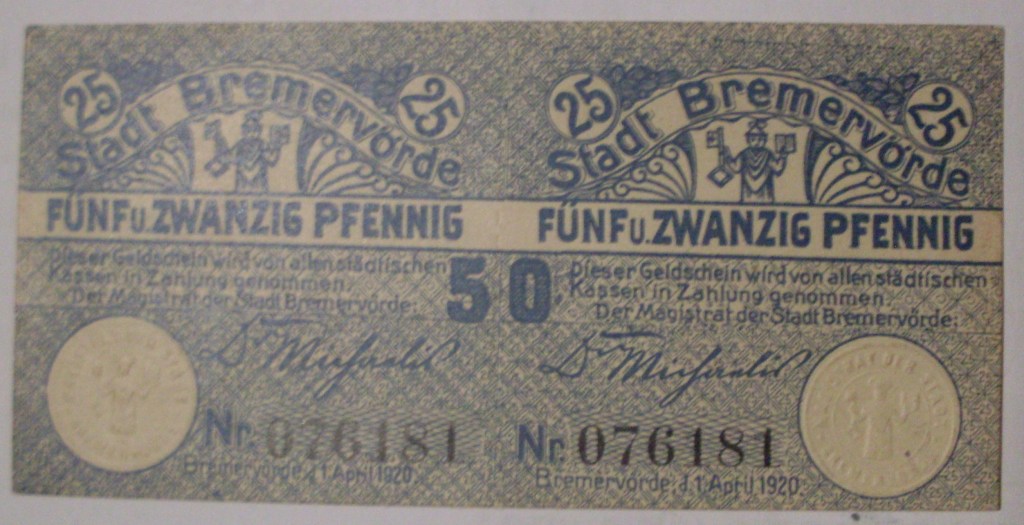
Once again I will be showing you another notgeld banknote from Germany. Dating from 1920, this note was printed in the small town of Bremervorde which is in the Rotenburg area of Lower Saxony. Situated not far from the city of Hamburg. This connection with the city shown in the embossed seals on the bottoms corners of the note.

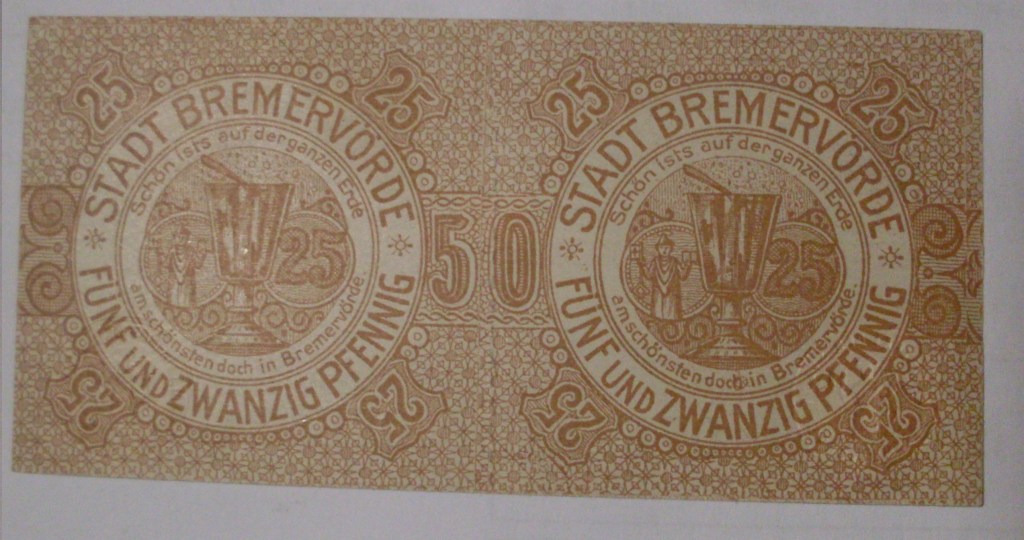
With the nominal value of 50 pfennig, what really stands out (and is much more easier to see in the second photo) is the perforation down the direct centre of the note. The explanation for this is clearly shown on the design on both the front and back of the note. This is so the note can be broken down in half and used as 25 pfennig instead.

Quite novel in it’s design I am quite sure it is not unique amongst other notgeld notes out there. However, this is the first example I have seen, and the first specimen I was able to add to my collection.

The price of war

A fairly short post this month.  Mainly because I got something I have already talked about before.  In this post I wrote back in 2017 I talked about my favourite numismatic material I like to collect.  Well this month I got myself several notgeld coins to add to my collection.


Two of them are 5 pfennig coins, and the other is 10 pfennig.  They were made in two different towns within Germany, with the coins from Düren being of boring design.  Both coins feature the value of the coin, and the city name on both faces.  The last coin, a 5 pfennig, was made in Bonn and shows a design of one of the bridges which stretch over the Rhine in the city.  Both cities are found in the Rhine area of Germany, although Bonn actually straddles the river.  The 5 pfennig coins seem to be made from iron, whilst the 10 is made from zinc.

The coins date from the last few years of WWI, when war critical supplies are running low within Germany.  As explained in my linked blog post, notgeld were issued by local administrations to help bridge the void left by a failing central government at the time.  Although most forms of notgeld often seen are in the form of banknotes, as you can see coins were also issued.

Notgeld

I mentioned in a previous blog post that I would focus a blog entry on Notgeld, and it is time to deliver on that promise.  German notgeld has to be my personal favourite numismatic item to collect.  The artwork and sometimes vibrant colours often put some of the more contemporary banknotes we have today to shame.  It also allowed the individual issuing authority to show pride in their towns and cities, and display individuals and events particular to that region.  Below is a very small selection of notgeld from my own personal collection to show the variety in the different pieces that were issued:

So what is Notgeld?

Notgeld is emergency money issued in both Austria and Germany from during WWI and the inter-war years prior to WWII.  Issued during the economic crises and eventual global collapse post 1918, they were an attempt to bridge the void left by a failing economy provided by the central government at the time.  They are not too dissimilar to token coinage issued in other countries throughout history, and other examples of such issues could be ‘Necessity money’ in both Belgium and France, the ‘Gun money’ issued in Ireland, ‘Company tokens’ issued by US mining companies, or the business tokens/’Condor tokens’ issued by businesses in Britain during the late 18th century.

Who issued the Notgeld?

 Notgeld was often issued by a non licensed body in the separate towns and cities, usually a local savings bank or a local state/privately owned business.  This limited the use of the notgeld to the town or area to which it was produced.  Although this didn’t stop them from travelling from further afield.  Each issuing body would often issue different series of notgeld for the local area.  Often comprising sets of a common theme.  With some of the more ambitious sets numbering around 7-8 notes.  Some of these sets could show different landmarks in the area, or retelling of an important event which happened close by.  Some of the sets even tell local tales and legends, with each banknote actually being numbered (with a letter) so the story can be placed in the correct order.  Very similar to cigarette cards at the time.

What were they made from?

 The main material notgeld was produced out of was from paper or card stock.  Usually anything which was close to hand and in abundance.  Coins were also minted in a fashion, from cheap base metals such as aluminium, or silk, linen, compressed coal, leather, clay and even re-purposed postage stamps.  Some of the recycled materials also included playing cards, which are highly sought after by the collecting community.

How long were they issued for?

Although issued for most of the inter-war period, they were only produced in small batches for actual general use.  So general periods can be 1914-18, 1922, and 1923.  After the general need was met, some further production was carried out on the different series for the collectors of the different notes.  Usually this demand was created by the various ‘sets’ the issuing bodies released.  As with most things, there is always someone out there willing to collect it.  This production of notgeld for collectors, has resulted in many examples surviving today still in mint condition, with those bearing the hallmarks of circulation being far outweighed by those that haven’t.

SDC12311

What was the issuing value of notgeld?

During the first issues of notgeld typical values never strayed higher than 1 Mark, with many being valued no more than 50 Pfennig.  However, during the hyperinflation of the 1920’s, higher and higher denominations were being printed, with some reaching at the height of the crises, into the 10’s of millions of marks.  This at the time when banknotes issued by the central government were reaching into the hundreds of millions.  During this period, coal dust compressed notgeld became increasingly common.  However, surviving examples are now extremely rare as they were often exchanged for actual coal, or even burned themselves for fuel.

When did notgeld stop being used as currency?

Notgeld ended it’s role as an emergency money after the collapse of the Weimar government in the early 1930’s.  A move synonymous with the rise of the Nazi party and the chancellorship of Hitler, when the national currency was reformed and the Reichsmark came into force.


Below I have added some links to some good notgeld resources online.  Usually with further links and lists to help identify any notgeld you may have:

https://notgeld.com/

http://germannotgeld.com/

https://www.notgeldmarket.com/
Collection update February ’17

This month’s acquisitions were not as numerous as last months.  I only bought a couple of small groups of coins, but also acquired some banknotes along with them.  The majority of the coins bought had a silver content, and this was due in part because I have recently started looking into what is known as ‘stacking’.  I will create a post going into further detail about this later in the future, but to summarise it succinctly, it is the process of purchasing precious metals, be it in coin or bullion form, in the aim of creating a significant investment stockpile.  I personally think this might be a good idea if I am collecting coins seriously, as it could possibly finance further purchases in the future, but also act as a fall-back pension scheme because the way my country is being run….I will be lucky to live long enough to get one…

sdc12211

Now the coins I got came from three different countries, Germany, Switzerland and the UK.  Roughly half of them contain a silver content.  Overall the coins themselves are not overly interesting.  The designs are rather lacklustre, and although not pictured here, the German coins right at the bottom of the picture date from the Nazi regime of the 1930’s-40’s.  The reverse is not shown, due to obvious reasons, but in my personal opinion, I feel items of this nature shouldn’t be hid or shunned.  They allow historians, archaeologists, and others to approach sensitive subjects and crack them open for debate and discourse.  Sweeping distasteful history and subjects under the rug over the fear of offending a persons sensibilities does a disservice for the general population as a whole.  By denying the chance to educate people about why these events happened, we run the risk of these events repeating themselves.  Something which frighteningly is looming on the horizon.  However, small political rant over, the banknotes are much more interesting items to discuss this time.

sdc12212

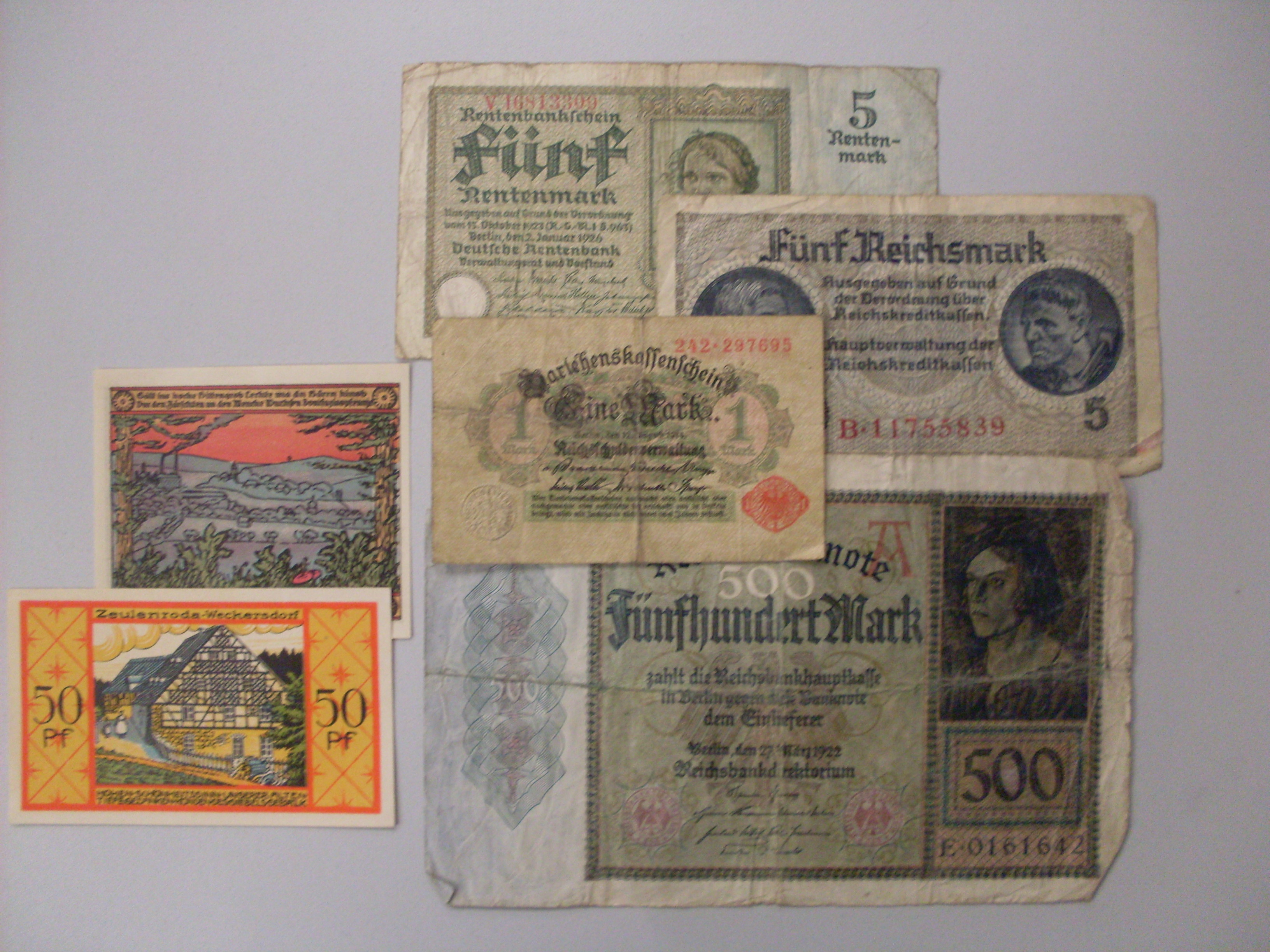
These banknotes were part of a single lot, along with the German coins shown in the previous photo.  Now the main reason I bought the group was not because of the coins, or in fact three fifths of the banknotes present.  No, the main reason was the two banknotes on the far left of the picture.  These two brightly coloured notes are what are known as ‘Notgeld’.  Predominantly a staple of Germany and Austria circulated during the inter-war years of WWI and WWII.  They are one, if not the most, of my favourite things in the numismatic world.  Each note is brightly decorated with scenes, architecture or local myths and legends of each town which issued the banknote.  They are not dissimilar to the trade token coinage used in London during the 18th century, or the company coinage used in remote mining towns across the US back in the day (and many other examples besides).  Albeit the German examples can sometimes be described as works of art in some cases.  I generally purchase these things every chance I get, and have actually amassed a small forest of these things.  I remember last year whilst visiting the Netherlands buying every single one from an antique market stall in Amsterdam.  I got a few funny looks whilst going through airport security on my way back with over 300 banknotes in my possession.  Suffice to say, I could wax lyrical about these things, but I think that too would be a perfect subject for another blog post at a later date.