Collection update August ’17

SDC12389

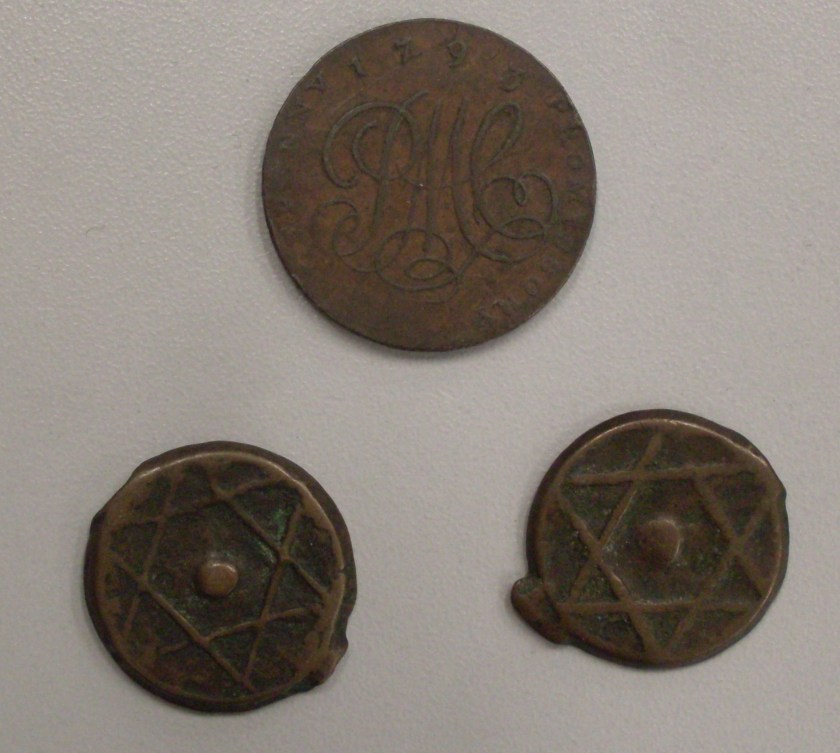
This month’s additions are a pair of bronze coins from Morocco and yet again another token.  I feel like I am getting more tokens these days than I am actual coins!  However, this token is a window into local Welsh history particular to Anglesey.

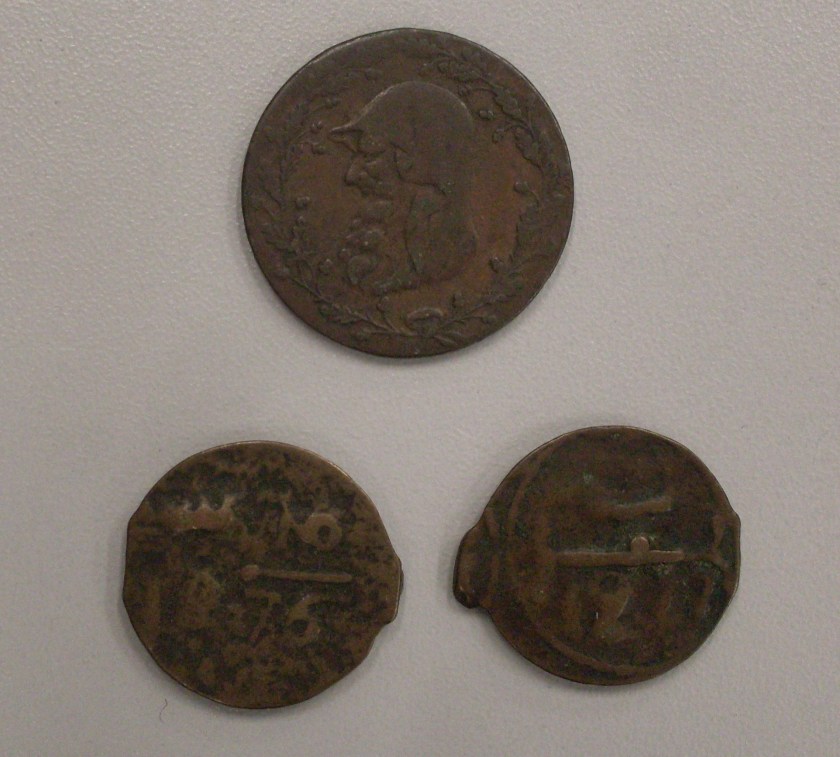
Now the story of this token references back to some of my previous blog posts, in particular, that during the late 18th century it was the practice of the British Royal Mint not to produce coinage of low numeric value as it was seen as to cheapen the name of currency.  This produced a lot of problems for the lower classes whose daily lives revolved around transactions involving small denomination coins.  As we can see, one of the outcomes was the evasion money I mentioned last month.  Another type of coinage which appeared was coins being minted by businesses and companies.  The token I acquired this month is known as the Anglesey Penny, or as it is more well known, the Druid Head Penny.  These coins were produced by the Parys Mountain Copper works to help facilitate the payment of it’s workers at it’s site in Amlwch, Anglesey.  This can be clearly seen by the PWC monogram on the reverse of the coin,  and although the picture is faded due to wear and time, a legend around the monogram promises to pay the bearer ‘one penny’ by the company itself.  The coins were first produced in 1787 and continued on until 1821 when it was made illegal to produce them.  During this time frame the idea became popular and a half-penny was minted as well, with production of these half-pennies starting in 1788 a year after the penny itself was introduced.  So why the druid motif?  This harkens back to ancient Anglesey history where the island was the spiritual home of the druidic order in Britain.  It therefore was the main focal point for the ancient Celtic religion until the druids were exterminated by the Romans in 77AD, which resultantly brought the celtic tribes under their control.
SDC12390

The other two coins which hail from Morocco are 2 bronze cast coins with the denomination of 2 Falus.  The dates are faded and worn and hard to discern, but both date from around 1275-1277 in the Arabic calendar (1858-1860).  At this time Morocco was ruled by Sultan Abd al-Rahman, who would die in 1859.  Morocco would continue to use cast bronze coins until machine milled coinage was introduced in 1882.  Apart from the cast bronze coins, Morocco also used silver and gold hammered coins for larger denominations.  Uniqely, there was no fixed exchange rate between the different denominations of coins Morocco produced, nor were the weights of the individual coins regulated.  Thus, it would be safe to assume that after haggling the price with the seller, you can further spend more happy hours haggling about the exchange rate.

Evading the law!

Another talk about token coinage again this time.  Today I would like to focus on a British token coinage issued during the late 18th century called ‘evasion tokens’.

imgonline-com-ua-twotoone-chQoJCLLAU

Now the picture above (although blurry, and the token itself quite worn), shows one of the many different types of evasion tokens which were minted during this period.  So why do these things exist?

During the late 18th century in Britain counterfeiting was rampant, with some reports saying that only 2/5th’s of the coins in general circulation were actually genuine.  These figures come from around 1753, by 1771 it was getting out of control, and magistrates were applying more and more pressure to find the counterfeiters and destroy the minting machines.  It was then that the counterfeiters found a loophole in the law which allowed them to continue making the fake coinage.

The laws at the time stated that only ‘Regal’ coinage was covered by the counterfeiting laws.  Thus, if a coin was not an ‘exact’ copy of one issued by the government, then the law is technically not being broken, and thus any punishment is evaded.  They were not coins, but tokens.  Hence the name ‘evasion tokens’.  Most of these tokens were thus changed to suit the work-around in the law.  So a large number of figures replaced King George, such as Isaac Newton, William Shakespeare, and even George Washington (the example in the photo shows Pope Gregory II).  George III wasn’t completely removed either, with his facing changed, or the legend around his bust altered.  The legends themselves were often nonesense or humourous in nature.  With some saying ‘Brittania Rules’, ‘These Bonny Isles’, ‘Bonny Girls’ and so on.  There were some instances of company names being included on the reverse of some tokens too.  Speaking of the reverse, these were also a target for changes, with Britannia being slightly altered, or replaced with the Irish harp entirely.  The legend was also subject to change, with similar epithets to those placed on the obverse, often more outlandish with examples of ‘Englands Glory’ and ‘Hilarias’ being used.

The tokens themselves were often widely accepted by the populace at the time for a couple of reasons.  First and foremost, there was a dire need of small change at the time, due to indifference by the government towards a copper coinage.  It was a widely held belief that copper was not a fit enough metal to strike a ‘regal’ coinage, and thus striking copper coins was not an especially important activity for the Royal Mint to pursue.  Secondly, many of the native provincial Britons were illiterate and if the ‘coin’ on offer looked somewhat genuine and something they were used to, they were happy to accept it.

The earliest examples of evasion tokens date from the mid-1770’s, but the majority seem to come from between 1795 and 1800.  There are thousands of different designs out there, and were first started to be catalogued in 1892 by Atkins, which then wasn’t updated until in 1987 by Cobwright, with a further revision in 1993 (A walk in the Monkolokian Forest in search of the Spiny Fubbaduck – yes, that is the title of the work by Cobwright).