Ave Imperator! Another ancient coin added to my collection this month, this time of the Roman variety.
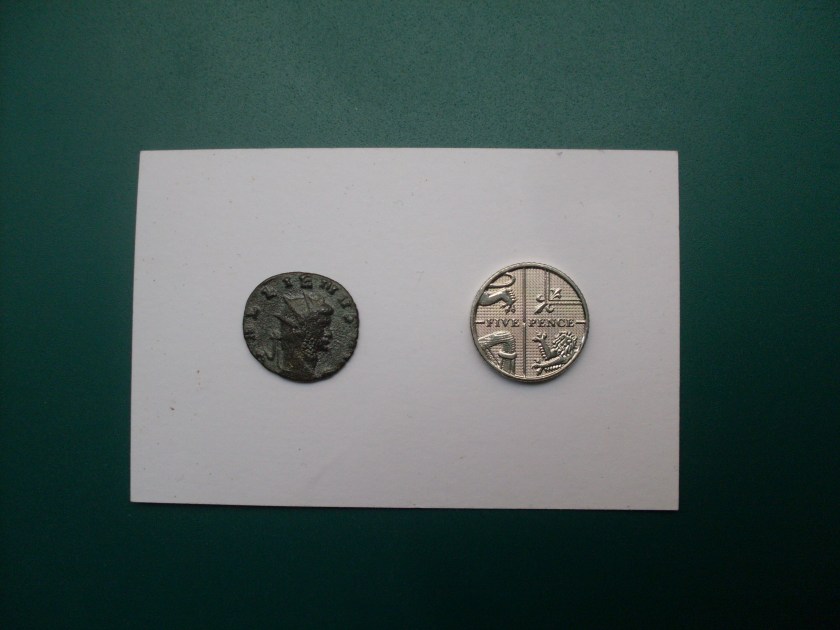
The coin showcased this month is a billon antoninianus from the Roman emperor Gallienus, who reigned as Roman Emperor from 253-268AD. For the first seven years of his reign he ruled jointly with his father Valerian, who split the empire in half. With Valerian ruling in the east, and his son Gallienus ruling in the West. Gallienus would become sole ruler in 260 when his father was defeated and captured by the Sasanian Empire at the battle of Edessa (Now known as Urfa in the South-eastern part of Turkey). After Valerian’s capture several usurpers to the imperial throne would rise up and declare themselves independent from Rome. Civil war soon broke out.
Gallienus would have some success in defeating the usurpers, most notably the ones who arose in the eastern parts of the Empire. He would fail however to put down those in the West, which would later form the Gallic empire under the Roman general Postumus. Gallienus would die in 268 whilst being besieged in Mediolanum (modern day Milan) when one of his soldiers would stab him to death as part of a conspiracy.
Gallienus reigned during what is known as the ‘Crisis of the Third Century’ when barbarian migrations, political turmoil, civil wars, and peasant revolts would almost cause the collapse of the Roman empire. The period would start in 235 with the assassination of the emperor Severus Alexander by his own troops. With many claimants to the title of Emperor (around 26) during the next half century, many of whom were Roman army generals. The Crisis would culminate in the Empire splitting into three distinct competing provinces. With the Gallic Empire in the west, the Roman Empire centred on Rome in the centre, and the Palmyrene Empire in the east.
The emperor Aurelian would unite the fractured empire in the early 270’s, and the crisis would end under the rule of Diocletian in 284 with many much needed political, social and economic reforms.
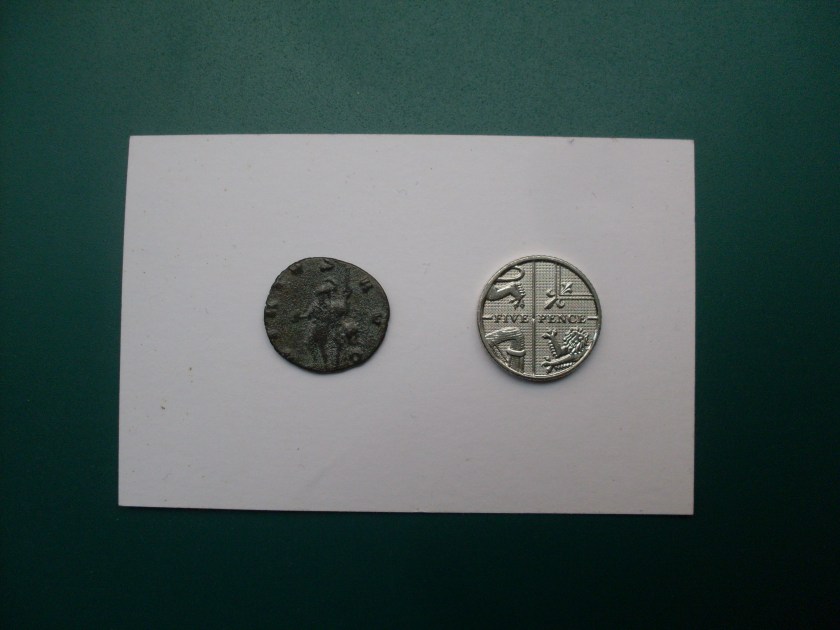
During this period, due to the increased military activity, the coinage of the Empire grew more and more debased. As can be clearly seen with the acquisition I got this month. The antoninianus is thought to have the nominal value of two denarii and was initially silver. But over time more and more copper would find itself into the coin (which of course caused hording of the older and more pure denarii and inflation in line with the decreased perceived value of the new issues) leading to an almost doubling in size of the coin during the reign of emperor Aurelian in an attempt to arrest inflation. The debasement would continue till the coin itself would be wholly copper. The coin I have seems to be towards the end of this transition as it still has a very faint silvery sheen to it, unfortunately not seen clearly in the photo’s. The term to describe coins with this type of debasement are known as ‘billon’, and would not be limited to the Romans. Examples of billon coins can be found starting from the ancient Greeks right through to the Middles Ages.
 Numismatic Exploits