Death and Taxes

Another month and another new coin to add to my collection. March, this time, sees an addition from my own country. A small silver coin from the 14th century.

The coin is quite small, measuring just 14mm in diameter and o.5mm thick. A halfpenny from the reign of Edward III. On the obverse is a forward facing bust of Edward with the legend EDWARDUS REX surrounding it. On the reverse is a long cross with three pellets in each quarter. The legend surrounding the cross says CIVITAS LONDON, which denotes that the coin itself was struck at the mint in London.

As there is no date on the coin, it will have be assumed to have been minted sometime during his reign of 1327-77. A reign which was seen as relatively stable compared to the chaotic and unorthodox reign of his father Edward II.

Edward’s reign is notable for several significant military events. The first, which led to the others, was the start of the series of conflicts which would eventually be known as the Hundred Years War, starting in 1337 and lasting until 1453. During Edward’s reign this conflict would lead to two English victories against the French which would pass into national legend. The battles of Crecy, and Poitiers, and siege and capture of Calais would lead to a favourable outcome for England in the first phase of the war and eventually led to the Treaty of Bretigny in 1360. The treaty gave England large territorial gains in France, whilst Edward would renounce the English claim to the French throne. The treaty would break down by 1369, and France would declare war against England once again.

Domestically, Edwards reign would also see the first wave of the Black Death to hit England in 1348. This would eventually kill off 40-60% of England’s population at the time. It would slow down and disappear by December 1349, but would return again in the 1360’s causing another 20% of the population to fall victim. The Black Death would again return in intermittent phases throughout the 14th and 15th centuries on a local or national scale. The effects would be less severe than the first few waves, and the last recorded outbreak was the Great Plague of London 1665-66. This would be ended with the events of the Great Fire in 1666.

From Terrible to Great

After a brief month long hiatus I am back to writing updates to my coin collection. This time it is two very small coins from the frosty lands of Russia.

Both coins are known as ‘wire money’ due to the way they are created. A strand of silver wire is cut into pieces and then beaten flat with the design to be imprinted. A method inherited from the Tartar overlords of the Golden Horde who controlled much of Russia during it’s early history. Russian peoples would adopt the same practice in the 1360’s, imitating the Mongol coins, before eventually designing their own.

Both coins I acquired come from infamous rulers of Russia. The coin on the left dates from the mid to late 16th century and comes from the reign of Ivan IV, more commonly known as Ivan the Terrible. The coin on the right dates from the late 17th century from the reign of Peter I, again, more well known as Peter the Great. Both of these rulers have much history dedicated to them, and I could write a very long post detailing everything about it. However, since this is a blog aimed more towards numismatics, I instead would like to focus more on the history of wire money itself.

During the early reign of Ivan IV (1530’s) Russian coinage was reformed. Coins weighing just over half a gram were minted in Novgorod, and would feature a horse and rider wielding a spear. These coins were known as kopeks and that is what is shown in the pictures here.

Sadly the coin dating from Ivan IV’s reign is badly struck, so you can only just see the spear and front of the horse. In Russian, the word “spear” is similarly close to the word “Kopek”, and it is often assumed that is how the coin got it’s name. However this etymology is often disputed. Modern Russian coins feature an updated version of the rider carrying a spear, continuing the tradition.

Whilst Novgorod was minting kopeks, in Moscow a smaller coin was minted which was valued as half a kopek. These coins were called ‘denga’, the plural of which is ‘dengi’ and is the word that is still used today in Russia to refer to money.

Originally the amount of dengi in circulation was much higher than that of kopeks, but by the reign of Peter I it had flipped. This was due mainly to heavy devaluation of the coinage, with silver kopeks dropping in weight to just over a quarter of a gram by 1717 when it was discontinued. It would be replaced under Peter I’s coin reforms by the Rouble. Becoming, at the time, one of the most advanced monetary systems in Europe based on the decimal system.

Kopeks however, would still be minted during this period, but no longer out of precious metals. In fact, the kopek would continue to exist until 2009 when minting for circulation would finally cease. By the time of it’s final year the value of a kopek had diminished so much it would roughly equate to 1/60th of an American cent.

50 years since D-Day

Today (15th Feb) marks the 50th anniversary of D-Day. Well Decimalisation Day that is.

Back in 1971, on this day, the UK changed it’s currency system from the old “pound, shilling, and pence” system to the one it uses today. The old system, although often associated with the UK due to it being the last user of the system within Europe, was first standardised and introduced by Charlemagne in the mid-8th century. Charlemagne would popularise the system across much of Europe due to the expanse of the Carolingian Empire. King Offa of Mercia would be the first king in the British Isles to adopt the system in the late 8th century.

The names of the coins were based on Roman coins, those of the ‘librae’, ‘solidi’, and ‘denarii’. Which led to the well known abbreviations L, s, d. With a stylised ‘L’ forming the symbol for the British currency to this day (£).

The way the system worked was that there were 12 pennies to one shilling. 20 shillings to a pound, which meant that there were 240 pennies to one pound. With a pound also corresponding to the actual weight in silver of 240 pennies. Although of course, due to debasement and re-striking of coins, this would not last throughout much of the lifespan of the system.

Despite it’s name, there were also a multitude of other coins used which enabled easier transactions to be done throughout the period of use. Farthings made up one quarter of a penny, and this coin would be discontinued in 1960. Whereas the halfpenny would last a little longer, being demonetised in 1969. Other coins such as guinea was produced, and originally was minted to correspond to be worth exactly one pound (20 shillings) monetary value in gold. However, due to the fluctuations in the price of gold, it’s value varied wildly until it was fixed at the value of 21 shillings. The first guinea was produced in 1663, and would last until it’s demonetisation in 1814.

With the spread of colonialism, the system also made it’s way to other countries around the world. Many of these countries would quickly abandon the system after independence, with the USA quickly adopting a decimal system in 1792. Others would continue to use it a while longer, with Australia changing to a decimal system in 1966, 65 years years after gaining independence. Nigeria was the last country in the world to use the pre-decimal system, finally abandoning the Nigerian pound in 1973.

There were also similar systems based on Roman coinage such as the ‘livres tournois’ system in France which was adopted during the Middle Ages, and the system in Spain which used 20 maravedis to 1 real, and 20 reals to 1 duro (5 pesetas).

Calendar Roundup

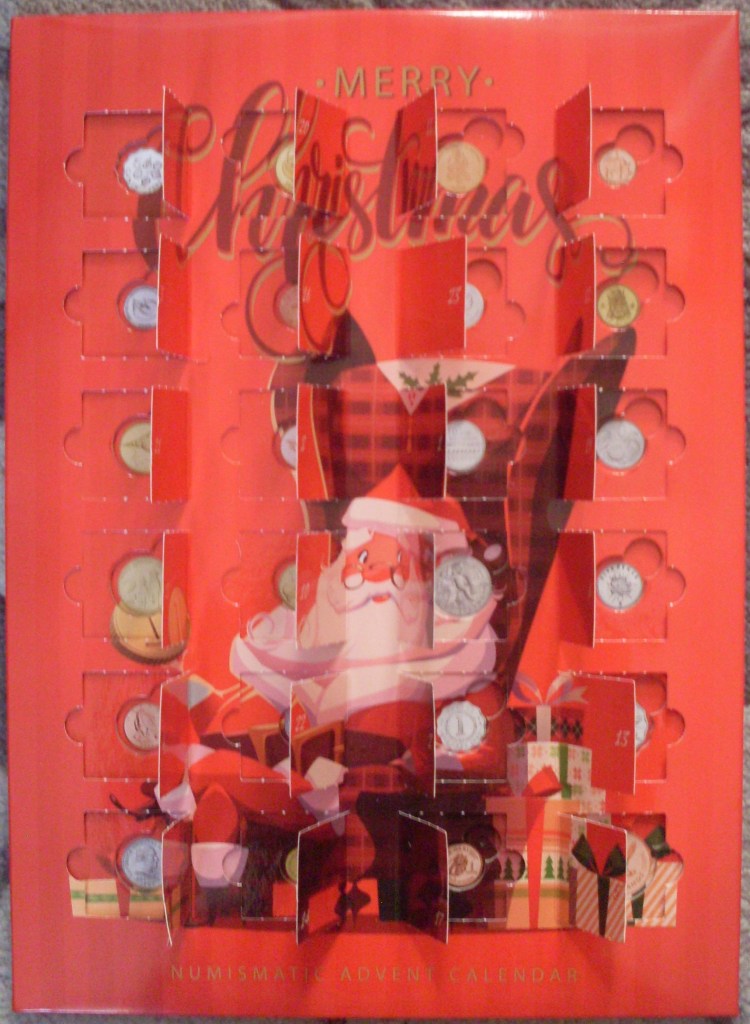
Christmas is over and it has now been a few days since my (almost) daily post run talking about each coin I got from the calendar ended. So I guess it is time to share my thoughts about the calendar itself and whether it was worth the money I paid for it.

I originally bought the calendar from The London Mint Office, which is a coin trader and dealer based not far from London. They are not the cheapest of dealers out there, but on occasion they do special promotions and offers which I have taken up more than once.

The calendar they have produced this year, was likewise, not cheap and substantially a lot more than the chocolate variety you can find in most supermarkets and corner shops. The calendar though is not cheaply made. The card stock used is of much finer quality than most store bought calendars and after receiving a fair number of knocks during the month has manged to retain much of it’s rigidity and shape. The coins were also held firmly in place, so if some accident would occur causing a door to be opened prior to it’s actual day, the likelihood of losing one would be slim.

Each door on the calendar also had a brief description of the coin revealed behind each door so there was no chance of not knowing the provenance or nominal value of the coin received each day.

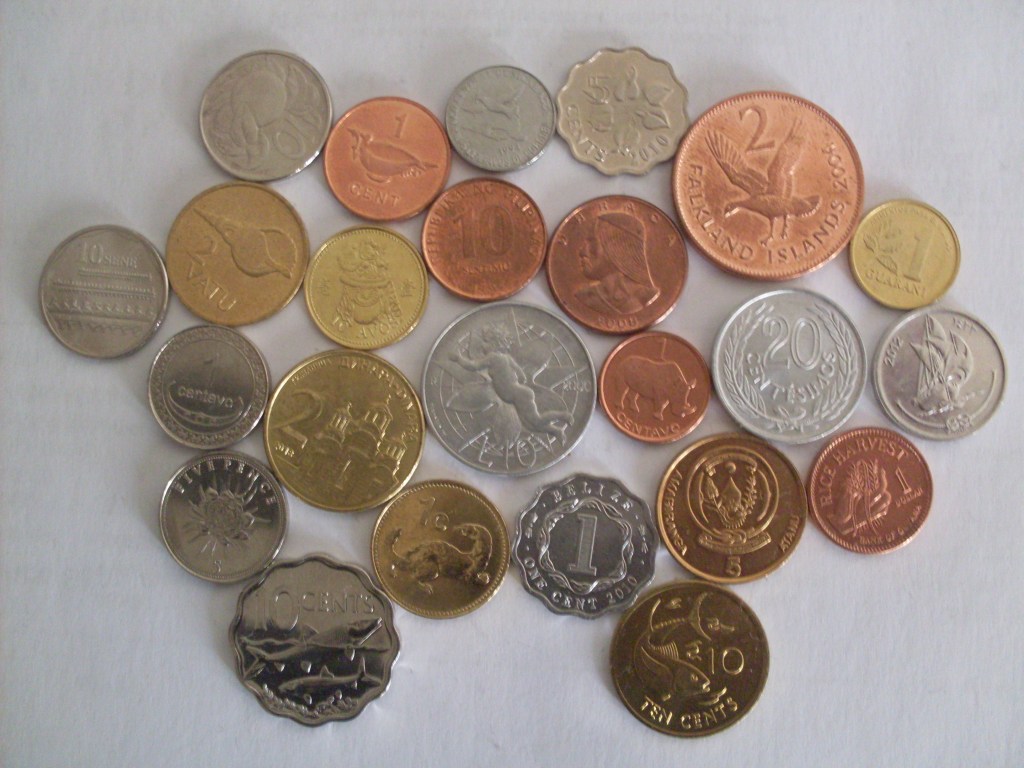
The variety of the coins in terms of their origin was also uniquely varied. Despite a couple of them, most were coins I actually do not have in my collection even though they were of fairly low value coins of themselves. This is was a pleasant surprise for me, compounded more by the fact that I also got some coins from countries I actually don’t own any for. Furthermore, there were a few special strikes within the calendar, nominal commemorative coins similar to 50p and £2 coins here in the UK. The FAO coin from Paraguay (day 14) also opened up a new collection avenue for the future as I may try and attempt to collect more of them.

So was the calendar worth it to me. Yes and no. From a financial worth of the calendar it was definitely not worth the price I paid for it. Yes, the coins are in great condition with all of them ranging between Very Fine and Almost Uncirculated condition, but the numismatic value of the coins overall are not spectacular.

However, in terms of fun and enjoyment, yes it was worth it. Actually getting a Christmas calendar where the item behind the door each day was something I was genuinely interested in was a new and novel experience. Adding new coins to my collection which for the most part I actually don’t own or have very few examples of was also a nice experience. So the collector side of me was definitely thoroughly pleased.

Would I be getting another calendar like this next year if one is available? Most likely not. Despite having fun with it, from a personal financial viewpoint I really can’t persuade myself to pay for another. Would I recommend it? For the more established collector, or those looking for a financial investment, a very strong no. There would be little for you to gain from this product. But if you are fairly new to the hobby, looking for a novel experience, or having the money spare, then by all means get this calendar. I had fun with it, and discovering new coins and learning a little about each country along the way was certainly a better way to spend this December than what I normally would have.

Day 23 & 24

So here we are at the final post in the 2020 calendar run, and since I forgot to post yesterday (…again) I will go through the coin I got for day 23 too.

On the penultimate day of the run we got a small aluminium coin from the island nation of the Maldives. Valued at 10 laari, the reverse of the coin has the value in the middle superimposed on a map of the island archipelago.

The obverse of the coin features a traditional sailing boat of the islands, often called a ‘batheli’ or ‘odi’ locallay. Below the boat is a rope with a knot design. Above the boat is the date of mintage according to boat the Gregorian calendar and Arabic calendar.

Finally, for the last day, we have a medium sized commemorative coin from San Marino.

This is by far the most interesting of the coins out of the calendar, mainly due to it’s very esoteric design. Made from aluminium with a value of 10 lire, this coin was a commemorative design with the theme of patriotism (I am 100% not sure about this, but information regarding the design was scant at best).

On the obverse is a bust of a figure with a flame in it’s outstretched palms. The figures head resembles a stylised view of the globe, with the visible continent being Europe (closely resembling the image found on many Euro coins). The figure is flanked by stars and other celestial bodies.

The reverse shows yet another globe design in the background, with a poinsettia flower above it. A figure of a child supersedes them both with it’s arm outstretched to the top left. The value of the coin is at the bottom, whilst the date of minting is to the right.

Day 22

It is an absolutely tiny coin behind the door of day 22. Dating from 1994, we have a chromium plated steel coin from Nicaragua.

On the obverse of the coin we have the name of Nicaragua surrounding the coat of arms of the country. It was first adopted in 1823, 2 years after Nicaragua had gained it’s independence from Spain.

The coat of arms features the Phrygian cap as it’s central feature, an article of clothing which traces it’s roots back to antiquity in Eastern Europe and Anatolia. In more modern history, due to the American and French revolutions of the 18th century, the cap has come to symbolise the idea of freedom and liberty. Below the cap there are five volcanoes which express brotherhood with the other central American countries. Over the cap is a rainbow signifying peace, and finally all are encapsulated within a triangle to represent equality.

The coat of arms also features on the flag of NIcaragua.

On the reverse of the coin is a bird with a sprig of peace flying over a silhouette of the country of Nicaragua itself. This is surrounded by the legend “Central bank of Nicaragua” (translated into English), with the date and value of the coin at the bottom.

Day 21

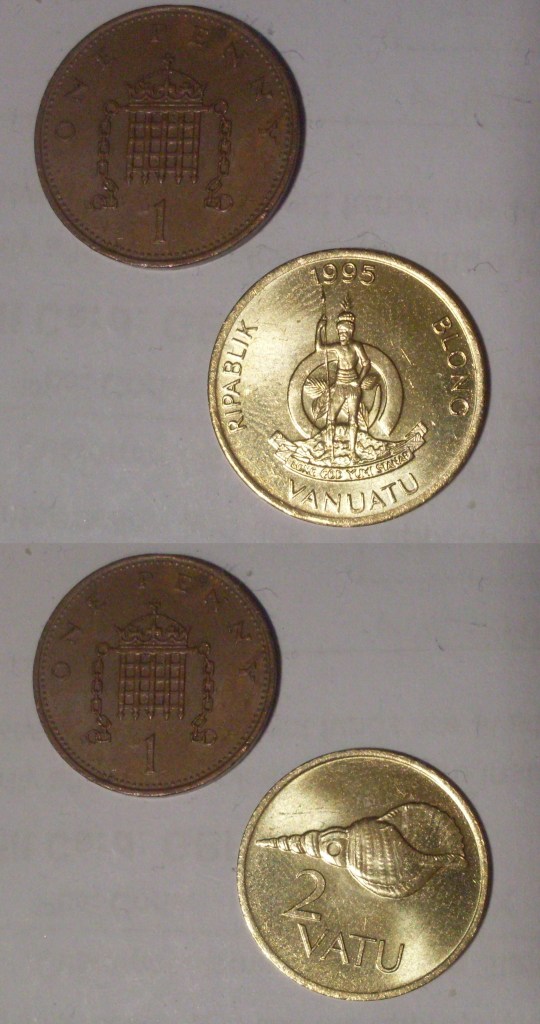
Another return to the Pacific today as the coin behind door 21 is a 2 vatu coin from Vanuatu. A small island archipelago southeast of the Solomon Islands which I got back on the 8th.

On the obverse side of the coin we have an image of the coat of arms of Vanuatu. It is a depiction of a Melanesian warrior standing on a mountain superimposed on a boar tusk and two crossed namele fern fronds.

The warrior is a depiction of Walter Lini the first prime minister of an independent Vanuatu (Vanuatu gained it’s independence from France and Britain in 1980). The boar tusk and namele leaves represent prosperity and peace respectively and are actually part of the national flag of Vanuatu.

On the reverse side of the coin, along with the value, there is a design showing charonia tritonis (also known as a triton) shell. The triton is a large sea snail found throughout the Indo-pacific oceans. The shell of the triton is well known and often seen as traditional decorative object evocative of the ocean. The shell is also sometimes used as a trumpet, as shown by the shell on the coin due to the presence of a hole carved near to the tapered end of the shell.

Day 19 & 20

So two days at once today because to be honest I completely forgot to update the blog yesterday.

Yesterday, the coin behind door number 19 was a small 10 cent coin from the Cook Islands:

On the obverse of the coin we have a re-appearance of Lizzie, whilst on the reverse we have a depiction of an orange. Oranges grow naturally on the Cook Islands and are one of the main fruits used for export. Although tourism accounts for nearly 65% of the country’s economy. Traditionally, oranges was used to brew beer on the islands, along with banana’s, paw paws, and hops.

The coin I got for day 20 was a 10 cents coin from the Seychelles.

On the obverse of the coin there is a representation of the coat of arms of the Seychelles. This coat of arms dates from 1976 when the Seychelles gained independence from Britain and the colours were updated slightly in 1996 to represent the colours on the flag. Although of course they can’t be seen on the coin.

On the reverse there is a stylised picture of a tuna fish. Tuna is one of the many species of fish caught in the Seychelles, wish fishing making up to 82% of the country’s economy in 2013. Despite this, growth in tourism is the main driver of the economy in the Seychelles as it employs at least 30% of the population compared to just 3% for fishing and agriculture. Other exports from the Seychelles also include coconuts and vanilla.

Day 18

Day 18 and we head to the Balkans to the country of Serbia for our calendar coin.

On the obverse we have the coat of arms of Serbia which was officially adopted in 2004, and was modelled on the design used in the royal coat of arms of the Kingdom of Serbia which was abolished at the end of WWI in 1918.

The reverse side of the coin has a depiction of the Gracanica Monastery next to the value of the coin itself. The monastery is a Serbian Orthodox monastery located in Kosovo. It was built by the Serbian king Stefan Milutin in 1321 on the ruins of a much older 6th century Christian basilica. Over it’s life, the monastery has been heavily damaged by foreign powers in the region. For much of the medieval period it was due to invading Ottoman forces, with the final act happening during the Ottoman retreat after the second siege of Vienna in 1683.

During WWII, the monastery was partially destroyed, and the building was restored by local nuns. It has been serving as a convent ever since. Finally, the monastery received bomb damage during the Kosovo War (1998-99) by NATO forces, and has again been renewed and restored.

In 2006 the monastery was placed on UNESCO’s world heritage list.

Day 17

Today I got a coin from a country I genuinely have no modern coins from, which is becoming a rarity these days as my collection grows larger.

Today’s coin is a small copper coin from Guyana. Dating from 2002, on the obverse is the coat of arms of Guyana which was created for the country in 1966 when it gained independence from Britain.

On the obverse, along with the value of the coin, is a hand gathering rice which is one of the main agricultural products of the country. The other is the production of demerara sugar which accounts for 28% of the country’s export earnings.

Along with agriculture, Guyana also exports gold, bauxite, shrimp, timber, and minerals. In 2015, Guyana was further able to broaden it’s exports when deep water oil wells were discovered.