Day 16

Day 16 and we once again return to SE Asia. This time the coin from the calendar is from the Philippines.

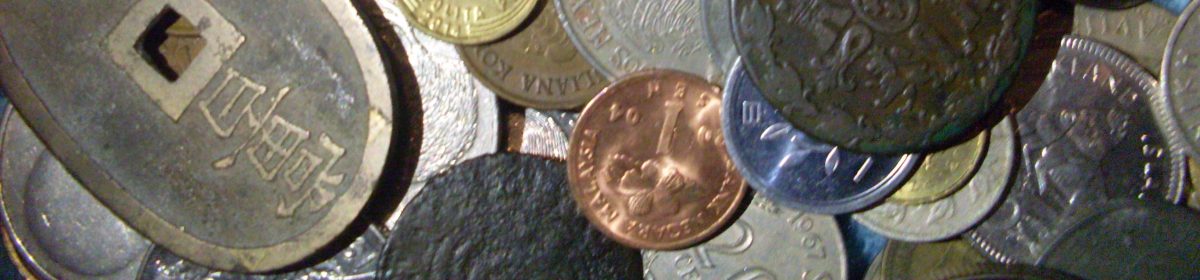
A small copper plated steel coin, it dates from 1996. On the obverse we have the value of the coin above the date of mintage. Whilst on the reverse we have the coat of arms of the National Bank of the Philippines above another date. The date on the obverse actually relates to the year the National Bank was established.

However, the history of a Philippine central bank stretches back further to the start of the 20th century.

It was in the year 1900 when an act was passed by the First Philippine Commission (a body established by the United States as the Philippines were under colonial control of the US after their victory in the Spanish-American war) to place all banks under the supervision of Bureau of the Treasury. This was further consolidated in 1929 when the Department of Finance took over this role.

By 1933 an idea of a Philippine central bank was beginning to take form, and with the mounting moves for Filipino independence from the US a proposal was made to the US to help establish a central bank and grant Philippine independence after 12 years. This proposal however would be rejected by the then Philippine president Manuel Quezon. A decade later, after the combined events of WWII, a new bill was proposed by the Philippine senate which gained support from the US president Roosevelt, and the Philippines were granted independence in 1946.

Immediately after gaining independence plans were drawn up to establish a central bank as a desire to create their own fiscal monetary policy and move away from reliance on the US Dollar was great. A central bank would be formerly inaugurated before the decade was out in 1949.

Over the next few decades, a series of acts were passed to keep monetary policy and reform in line with changing economic conditions. However, it would not be until 1993 when the current iteration of the Philippines central bank would take form.

Day 15

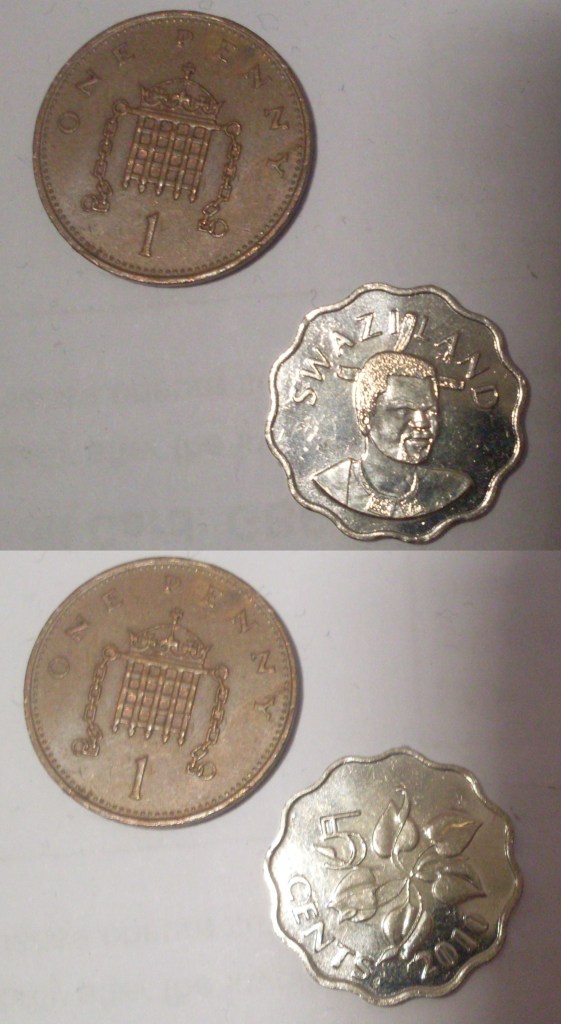
We return to Africa on the 15th day of the calendar run, and this time the little known enclave country of Swaziland (Now officially known as Eswatini since 2018).

On the obverse of the coin we have a portrait of the current king of Swaziland, Mswati III. On the reverse we have the value of the coin as well as a depiction of the arum lily plant.

The arum lily is a plant native to the southern part of the African continent, most notably South Africa, Lesotho, Mozambique, and Swaziland. It has been naturalised in other countries further north in Africa, as well as Madeira, New Zealand, coastal California, and Australia. In Australia it has been classified as an invasive species and therefore a toxic weed and pest.

The flower of the plant is the national flower of Saint Helena where it now grows widely. The flower is also a symbol of Irish republicanism and nationalism as it is used in commemorate those who died in the 1916 Easter uprising and afterwards.

Day 14

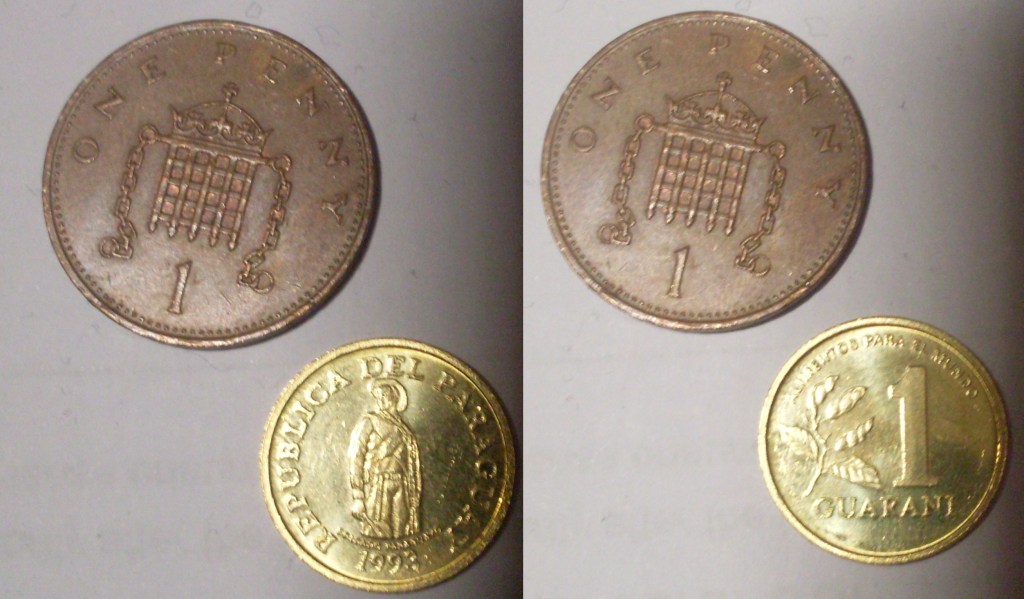
Day 14 and we are heading back to South America, this time to Paraguay.

Today we have a tiny brass 1 guarani coin from 1993. On the obverse we have a depiction of a Paraguayan soldier, whilst on the reverse we have the value of the coin and a tobacco plant. Along the top we have an inscription, which when translated into English says ‘Food for the World’.

This coin is a FAO (United Nations Food and Agriculture Organisation) issue, as part of a program initiated worldwide to raise awareness of the work the organisation does, as well as galvanise people to help eliminate food scarcity in the developing world. Seignorage and profits from the sale of the coins would also be used to help fund these programs.

FAO coins were first struck in 1968 when the initiative was first started. Around 20 different countries participated, with many different designs being minted. The US, and many of the other NATO states did not participate, but mints such as the San Francisco mint, the Royal mint, several mints in Germany amongst others helped strike coins for nations which did.

The program would run for 40 years until it was ended by the FAO itself in 2008.

Day 13

Returning for more sun today, behind door number 13 was a 10 cents coin from the Bahamas.

Featuring the coat of arms of the country on the obverse, on the reverse there is the value of the coin followed by a small scene featuring several bonefish.

Bonefish have nine different distinct species, with six inhabiting the Pacific and three in the Atlantic. The bonefish on the coin is of the Albula Vulpes species which is the largest and most widespread of the Atlantic species.

Bonefish tend to live inshore in tropical climes, mainly in shallow waters and mudflats. This has caused them to become one of the prime fly and tackle game fish. A popular sport has developed in the Bahamas, Puerto Rico, and Southern Florida called bonefishing. Despite it’s popularity, many just do it for the sport, and many of the caught bonefish are released back into the sea, although there are some recipes which use bonefish as a main ingredient.

Day 12

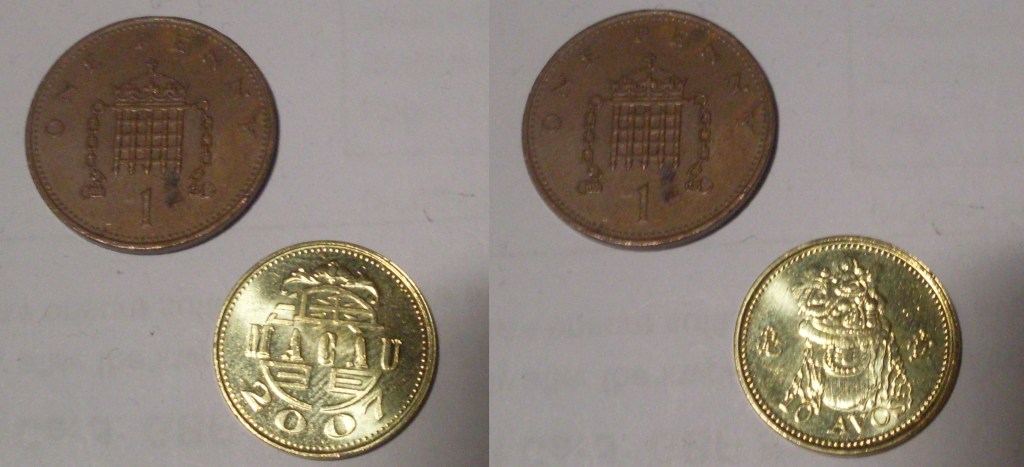
Half way through the calendar and we are arriving back in Asia, fully rounding out the number of coins from each continent (except Antartica) to two each. This time we are heading to Macao.

Dating from 2007 and made out of brass, on the obverse of the coin is the name of the territory in Portuguese with the date below it. The Portuguese name is surrounded by Chinese characters which spell out Macao in Chinese. The design of the Chinese characters are positioned in such a way that they also symbolise “shou” or longevity in Chinese. Finally, at the top, is a bat with it’s wings stretched out in flight. In Chinese customs bats are the harbingers of 5 blessings: Life, Wealth, Health, Love of virtue, and death after achieving one’s destiny.

On the reverse of the coin is a depiction of a lion headdress often used in the traditional lion dance throughout China. The lion dance is often performed at Chinese New Year as well as other important Chinese festivals and celebrations. The lion dance is distinguishable from the well known dragon dance due to the fact it is operated by just two dancers compared to teams of people holding poles representing the snaking body of the dragon.

Day 11

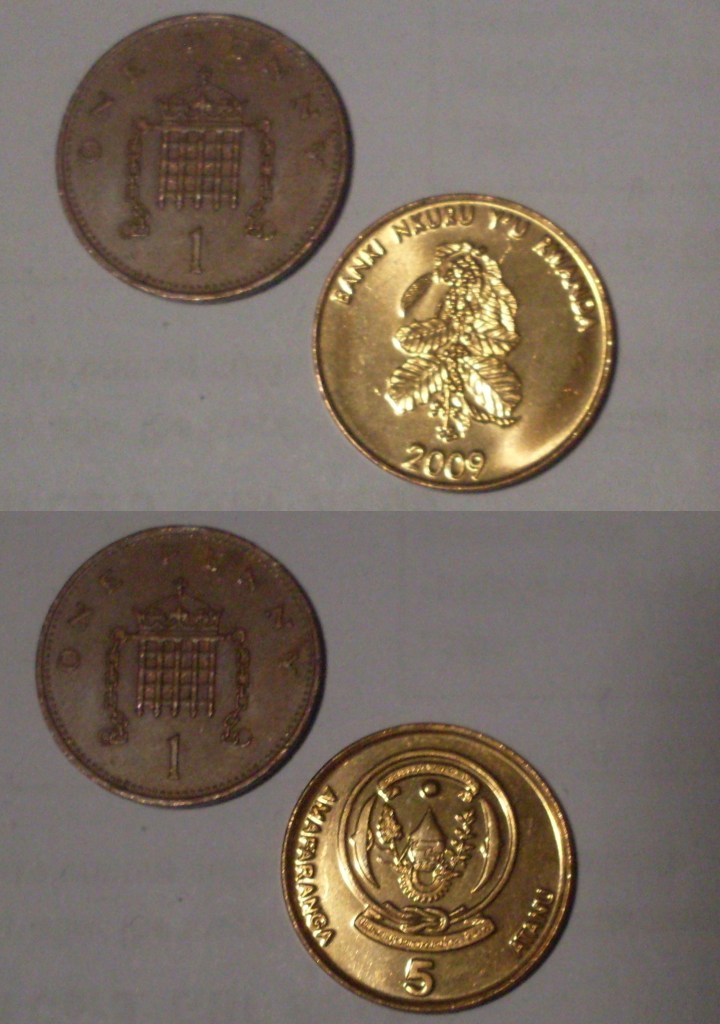
We head much further south today after our showing in Malta yesterday. Today’s coin comes from the sunny country of Rwanda.

Today’s coin is a 5 atanu coin, also known as a 5 Rwandan Franc. On the obverse of the coin is the national coat of arms of Rwanda, whilst on the reverse is a depiction of a coffee plant with coffee beans.

The coffee bean itself is an important part of the Rwandan economy. This landlocked country has few natural resources, so 90% of the country’s working adult population work in the agriculture industry due to Rwanda’s fertile soil. Apart from crops grown for local consumption, Rwanda grows tea and coffee mainly for export.

Coffee was first introduced and grown in Rwanda during the 1930’s when it was a Belgian colony. Belgium imposed the planting of coffee trees on the natives of Rwanda, which became a yoke for the country for much of the 20th century. Partly due to the main source of income for the country being so reliant on and vulnerable to the shift in prices of the commodity. However, due to outward investment in the production of coffee, quality of beans produced in Rwanda has increased exponentially causing it to become one of the more sought after coffees in the world.

Day 10

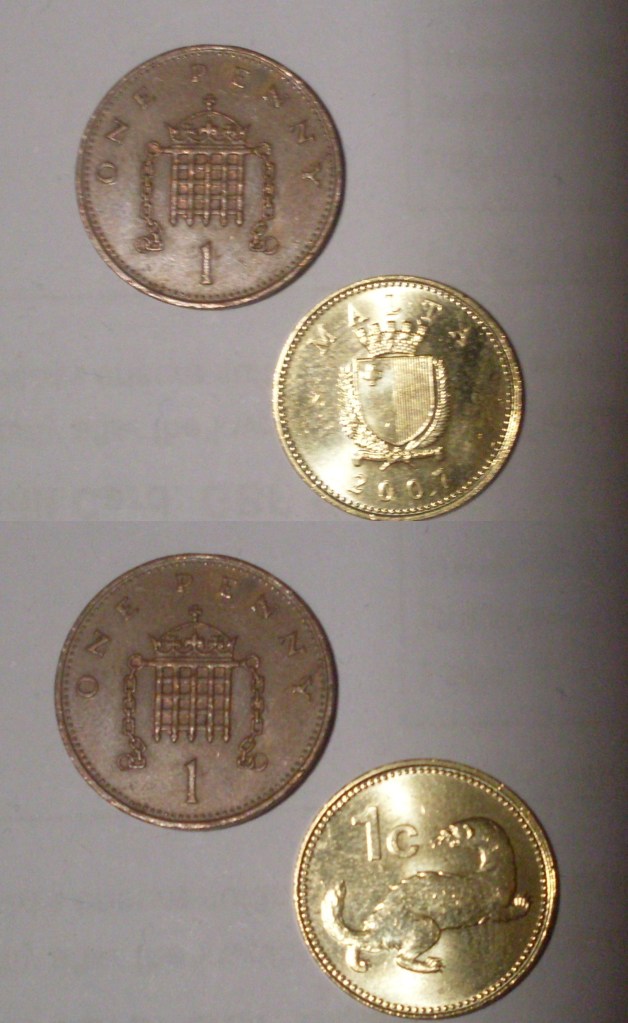
Another trip to Europe on the 10th day of the calendar. This time we travel to the small sunny Mediterranean island of Malta.

There is not much to say about the coin today. On the obverse there is a stylised coat of arms design of Malta’s flag, whilst on the reverse there is a depiction of a weasel just below the coins value.

Malta originally used the pre-decimal pound sterling from 1825 until 1972 when it was replaced by the Maltese Lira. The first run of the Lira showed many designs indicative of Maltese life and culture, with the 25 cent coin of 1975 being designed to commemorate Malta becoming a republic within the Commonwealth of Nations.

In 1986 a new design run was issued depicting many flora and fauna native to Malta, and would continue to be minted until 2007, when eventually in January 2008 they were withdrawn from circulation as Malta had joined the Euro. They were finally demonetised in 2010.

Day 9

Behind door 9 we have an aluminium coin from 1965, Uruguay.

On the reverse we have the value of the coin surrounded by a laurel wreath, whilst on the obverse we have the full name of Uruguay surrounded a profile etch of Jose Artigas.

Artigas is a national hero of Uruguay, sometimes called “the father of Uruguayan nationhood.” In his early life he fought successfully against the British in Buenos Aires, and later unsuccessfully in Montevideo. Escaping capture, he raised an army of gauchos and conducted a successful guerrilla campaign against the British. After the British capitulation after the second failed attempt to capture Buenos Aires, Artigas was promoted to captain in 1809.

During the outbreak of the Peninsula War, the Spanish-American wars erupted across South America. During this period, what is now Uruguay was part of the territory belonging to Argentina, and many natives grew resentful of this. Artigas used this resentment to create popular support, and would fight against control of Argentina.

In 1814, Artigas created the League of the Free Peoples of which he was declared protector. The following year he would liberate Montevideo from Argentinian control. Shortly after he would attend the Congress of Oriente and declare independence for the regions which would make up Uruguay, calling themselves the Federal League.

Portugal and Buenos Aires however feared the influence of the League, and in 1816 both countries would declare war and invade. Artigas would be captured, along with Montevideo, in 1817, but League forces would continue to resist for a further 3 years out in the countryside. Losing the war, Artigas would spend the rest of his life in exile in Paraguay until his death in 1850. His remains were repatriated in 1977 and interred in a mausoleum in the central plaza in Montevideo.

Uruguay would eventually gain it’s independence in 1828 under the Treaty of Montevideo. It would gain it’s first constitution a few years later in 1830.

Day 8

Day 8 and we return to the Pacific today, this time to the Solomon Islands. Plus another visit by Lizzie herself.

A small 1 cent coin from the Solomon islands, roughly 17.5mm in diameter and made from bronze coated steel. On the obverse we yet again find a portrait of Queen Elizabeth, and on the reverse we fin the value of the coin along with a ceremonial food bowl.

The one cent coin was first introduced to the Solomon islands in 1977 after the country left the Australian dollar shortly after gaining independence. However, by 2008, due to the high rate of inflation both the one and two cent coins have been removed from general circulation and prices in the country are now rounded to the nearest 5.

The food bowl found on the reverse of the coin is an important ritual object used in the initiation ceremonies of the bonito fish society. A high ranking group of men and boys within the community. The bowls were often filled with food and offered up to the spirits as part of the initiation. The bowl itself is carved into the shape of the frigate bird which is native to the islands, and is valued for some of it’s characteristics. Characteristics such as it’s agility and speed, as well as it’s fierce and aggressive hunting skills.

Day 7

The smallest coin so far from the calendar today. The tiny coin hails from the southern African country of Mozambique.

This one centavo coin features the main logo of the central bank of Mozambique on the obverse, whilst on the reverse is a engraving of a rhinoceros standing between the value of the coin.

Gaining it’s independence from Portugal in 1975, Mozambique would finally replace the Portuguese escudo in 1980 with their own currency, the metical. Mozambique would continue to use the metical until the early 2000’s when severe inflation would hit the currency. When the Romanian leu was re-evaluated on the 1st July 2005, the metical would become the least valued currency in the world. However, it would not last long, as a month later Zimbabwean dollar would far outstrip it by late August that year.

In 2006, Mozambique forced itself to re-evaluate it’s currency, and the new redenominated coins were issued from July that year.