Day 6

We are officially a quarter the way through our calendar run, and today we make a trip to Europe. Queen Lizzie, yet again, makes an appearance as today we got a 5p coin from Gibraltar.

Featuring Queen Elizabeth on the obverse with the date below, the reverse has the coins value displayed below a representation of the Da de Noche flower, also known as the Night Blooming Jessamine.

The flower is native to the West Indies, but has become naturalised in other parts of the world. Mainly in tropical and sub-tropical regions. It releases a sweet perfume like aroma at night, which is very good at attracting moths and bats to the flower. In some countries it is seen as an invasive species and classed as a weed, New Zealand being the forefront of this thought.

Day 5

We are still in the New World for today’s coin, but this time we head to South America. Behind today’s door was a 2 pence piece from the Falkland Islands.

Featuring Queen Elizabeth on the obverse (the second time so far, I wonder how many times she will feature in this calendar), the reverse has the more interesting subject.

On the reverse is a depiction of the Upland goose, also known as the Magellan goose, a bird indigenous to the Falkland islands. A member of the same family branch as other ducks, geese, and swans. Native to the Falklands, they have also been introduced to both Argentina and South Georgia islands. They feed primarily on seeds, leaves, and stems of plants they are often seen as pests by local ranchers as they eat on pastures often used for cattle and sheep.

Day 4

Another trip to the New World behind door number 4 today. Also another central American country to boot. This time from the calendar I received a 1 centesimo coin from Panama.

On the obverse is a very lacklustre design showing the value of the coin and the country of origin. Whilst the reverse displays a profile of Urraca who was a tribal chieftain in the region of what is now modern day Panama.

Urraca gained his fame in Panama by bravely resisting the expansion of the Spanish conquistadors in central America. After capturing the region where Urraca’s village was, he led stiff resistance against the Spanish. Successfully uniting various tribes in the area who were once enemies, he created a united from against Spanish expansionism.

He was successful to a point, that the Spanish were forced to trick Urraca in a feigned meeting to sue for peace. Captured, he was sent to the town of Nombre de Dios to be sent to Spain via ship. However, Urraca was able to escape and return to his tribe to continue the resistance. This would continue for several more years until his death in battle in 1531.

Day 3

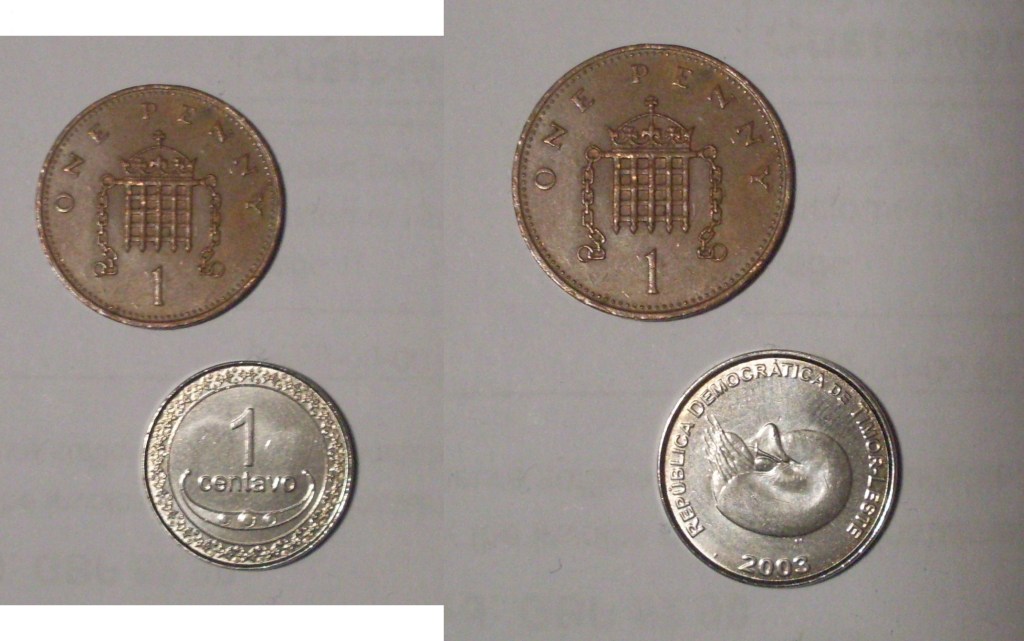
It is the third day of our advent countdown and the coin behind the door today was a centavo coin from the Asian nation of Timor-Leste.

Timor-Leste (formerly known as East Timor) is a relatively new country in the world gaining it’s independence in 2002 from Indonesia and becoming the worlds first sovereign state of the 21st century. Originally colonised by Portugal in the 16th century it was known as Portuguese Timor until it declared it’s independence from Portugal in 1975. Nine days after this declaration, Indonesian troops invaded the territory and declared it to be the new 27th province of Indonesia. The next 20 years would be characterised by violence between those who wanted independence and the Indonesian government, until through work conducted by the UN sponsored act of self-determination the situation was de-escalated in 1999.

On the obverse of the coin itself is an image of a nautilus. A marine creature often indigenous to the Indo-Pacific seas which Timor-Leste finds itself in. On the Reverse, below the value of the coin, is a representation of a Kaibuk. A Kaibuk is a type of head dress native to those who are indigenous to the islands of Timor and traditionally made from solid silver. It shape is to represent the horns of the water buffalo, an animal important to the daily lives of those who live on the islands. The buffalo horns is often used as a symbol by the people of Timor-Leste as they represent strength, security, and protection.

Finally, around the edge of the reverse is a pattern bordering the coins value and the Kaibuk. This pattern is called Tais and is a traditional design used in weavings throughout the Timor islands, and is seen as an essential part of the peoples cultural heritage. It is used from ceremonial garments, signs of respect, and appreciation towards guests, family, and friends. The Catholic Church within Timor-Leste has adopted the use of the pattern within religious ceremonies on the islands, as Timor-Leste is one of only two Christian majority countries in Asia. The other being the Philippines.

Day 2

Behind door number 2 today was a small coin from the central American country of Belize.

A 1 cent coin dating from 2010, it is the lowest denomination coin that Belize circulates. Struck in aluminium, it features a portrait of Queen Elizabeth on the obverse, and the denomination on the reverse. There was a small presentation set which was struck by the Franklin mint in the US which replaces the bust of Elizabeth with the coat of arms of Belize. These coins however never entered circulation and were primarily made for the US collector market.

Formerly known as British Honduras, Belize would change it’s name and gain independence in 1981. Many of it’s coins are still struck by the Royal Mint and still retain the shape and design on it’s coins which were present when it was known as British Honduras.

Calendar Run 2020

So I am sure for everybody reading this post can agree, 2020 has been a difficult year for many. To lighten the mood as to what will be the final month of this year and as a personal treat for myself I decided to purchase an advent calendar. A coin company which goes by the name of the London Mint Office (https://www.londonmintoffice.org/) releases a coin calendar each year and this year I decided to take the bait and buy one.

Each day of the calendar you receive a different coin sourced from all over the world. Now personally I don’t expect any of the coins to hold any magnificent value. I think it is just the novelty of it you pay for. So for the next 24 days, leading up to Christmas, I will share which coins I will get from the calendar.

Since it is also the 1st today, I guess I better get started!

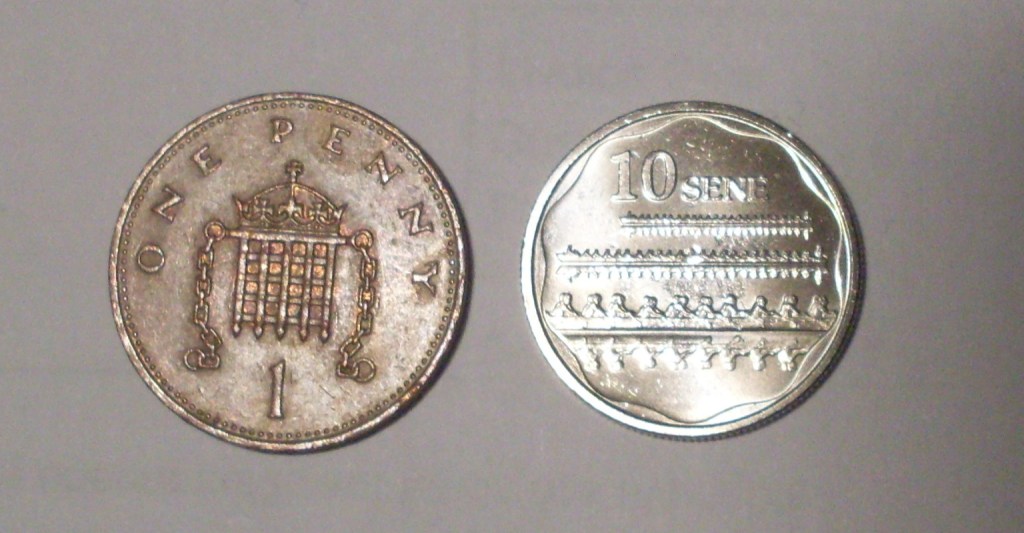
The first coin out of the calendar is a 10 sene coin from the small Pacific island country of Samoa. Dating from 2011 it is a single issue coin which was part of a five coin set to celebrate the history and culture of Samoa. On the 10 sene coin there is a representation of the Fautasi boat race which takes place every June as part of Samoa’s independence day celebrations. Fautasi (meaning “to build as one”) boat racing acts as a cultural connection between American Samoa and the other Samoan islands, and the boat design itself can trace it’s origins back to 1895. Although since it’s original inception, it’s functions from warboats and passenger vessels have slowly disappeared over the years due to government regulations and the adoption of motorised vessels.

Each Fautasi boat are around 30 metres in length and are traditionally carved from the whole trunks of trees. Each boat has a captain, and a coxswain beats a tempo with a drum in order to keep the rowers in sync. Typically each boat would have around 50 crew.

Getting the measure

We are returning to Russia again this month and with something slightly different from the norm. Now in the picture above we see a perfect copper replica of the Russian half-poltinnik which originally was minted in silver during the reign of Czar Alexei Mikhailovich (1645-1676). However, it is not a forgery. It is actually a coin weight used to measure the quality of the afore-mentioned half-poltinnik.

Coin weights themselves were often made of a variety of materials, ranging from metals to glass. Most often bore an inscription of the coin they were supposed to represent, or were straight up copies like the one I have acquired.

Not limited to the medieval period, the history of coin weights date back to ancient Ptolemaic and Byzantine times, and there is significant evidence that they were also used in ancient China.

(The inscription reads: “Czar and Grand Prince Feodor Alexeyevich of all Rus”)

This coin weight was minted during a period of monetary reform in Russia. In the middle of the 17th century there was signs of a strengthening of monetary currency, growth of the Russian internal market, reinforcement of Russian state power, and the annexation of the Ukraine in 1654 made monetary reform a necessity. These reforms were carried out in 1654 with the aim of introducing a new set of small and large denomination coins to replace the silver wire kopecks previously in circulation. Inspiration was drawn from Western currencies, with the new silver Rouble taking it’s ideas from the West European thaler. Many of the new silver roubles were made by simply counter-marking existing thalers (or other coins of the same weight and value). Half-poltinniks were made by simply cutting these Western thalers into quarters.

However, there was much public mistrust over this new coinage due in part to unfamiliarity and the way the coins were issued to the population. Thus, just a year later in 1655, the reforms were abandoned. This was shortly followed by a mass striking of new copper coins using the old denga and kopeck system, with many of the designs modelled on the old familiar silver wire kopecks.

Ironically the mass striking of the new coins led to inflation quite quickly, and with the sharp rising of prices, the economy in disruption, the Copper Riot of 1662 happened in Moscow. This led to the eventual nullification of all copper coins in 1663 and would not see a reintroduction until much later.

Daikokuten pays a visit

Back in early 2018 I had a two week long trip to Japan.  Whilst there I managed to pick up a wide variety of different types of coins and banknotes to add to my collection.  Within the post I wrote at the time I mentioned that I added a unique Japanese banknote called a Hansatsu to my collection (the post can be found here).  The Hansatsu I acquired back then it turns out was on the small side of what was produced in Japan at the time.  This month I have managed to acquire another Hansatsu note, one which dwarfs the size of the ones I got during my trip.

The Hansatsu itself measures 19.5cm tall and 4.7cm wide. It dates from the mid 18th century and was made from thick card stock. The feel of it is very similar to rough cardboard. The value of the banknote is 1 silver momne, and was produced in Amagasaki Han which is now a part of modern day Hyogo Prefecture.

The Han system is the historical term for the estate of the Daimyo who were powerful Japanese feudal lords. Differing from Western style of feudalism, the Japanese feudal domain was based on projected annual income rather than geographical size. The value of the Han itself was based on the Kokuda system, which determined how much rice could be produced for one person for one year. This unit of measurement was called a ‘koku’ and would form the basis of taxation for each Han. The value obviously varied from Han to Han, with the richest Han in the Edo period being the Kanazawa Han owned by the Tokugawa Shogunate. The value of which was estimated to be just over 1 million koku in 1690.

On the front of the Hansatsu, a large figure takes prominence at the top. This figure is the Japanese god Daikokuten, one of the seven Japanese gods of fortune within the Buddhist faith. As the value of much of Japan was tied to the production of rice, Daikokuten is often depicted on Hansatsu sat astride several rice bails. Furthermore, this is reinforced, as Daikokuten is also one of the deities tied to agriculture. As mentioned in my previous blog post, he is also tied to wealth, good fortune, and happiness, which has led him to be a popular God amongst the Japanese.

The price of war

A fairly short post this month.  Mainly because I got something I have already talked about before.  In this post I wrote back in 2017 I talked about my favourite numismatic material I like to collect.  Well this month I got myself several notgeld coins to add to my collection.


Two of them are 5 pfennig coins, and the other is 10 pfennig.  They were made in two different towns within Germany, with the coins from Düren being of boring design.  Both coins feature the value of the coin, and the city name on both faces.  The last coin, a 5 pfennig, was made in Bonn and shows a design of one of the bridges which stretch over the Rhine in the city.  Both cities are found in the Rhine area of Germany, although Bonn actually straddles the river.  The 5 pfennig coins seem to be made from iron, whilst the 10 is made from zinc.

The coins date from the last few years of WWI, when war critical supplies are running low within Germany.  As explained in my linked blog post, notgeld were issued by local administrations to help bridge the void left by a failing central government at the time.  Although most forms of notgeld often seen are in the form of banknotes, as you can see coins were also issued.

The Khanate Can-can

SDC13429

After last months trip to China we are heading back further west this month.  This time to the Ilkhanid Khanate.

From the pictures you can see I got my hands on three silver coins from the Ilkhanid Khanate this month.  All three are hammered coins, and date from the mid-14th century.  Minted under the Sultan Abu Sa’id Khan, he reigned the Ilkhanate from 1316 until 1335.

The Ilkhanid Khanate primarily occupied the region what we now call Iran, Azerbaijan, and most of Turkey, but it’s borders at it’s peak also stretched into Iraq, Afghanistan, Turkmenistan, Georgia, Pakistan, and parts of Tajikistan.  The first Khan of the Ilkhanate was Hulagu Khan, who was the great grandson of Genghis Khan, and brother of Kublai Khan.

The Ilkhanate itself was not a stable entity, and would spend the majority of it’s existence fighting conflicts outside and inside itself.  The first 50 years after it’s founding would see the Ilkhanate at constant odds with the Golden Horde and the Mamluks.

SDC13430

During it’s brief existence, the Ilkhanate would convert to Islam in 1295, but the majority of the Khans, and eventually, Sultans took little to no effort at all to proselytise the new religion.  In fact, Christianity, Buddhism, and even Shamanism would be tolerated.  However, despite the Ilkhanate’s conversion to Islam it would maintain hostile relationships with many of it’s neighbours.

In 1316 Abu Sa’id Khan would succeed to the throne, and immediately would foster rebellions within the Khanate in 1318.  He would also subsequently be invaded by the Golden horde.  Stability was eventually hard fought and won, but it was soon proven fragile as an outbreak of the Black Death in the 1330’s ravaged the Khanate.  Abu Sa’id and his sons would die of the Plague in 1335.  He was followed by a very quick succession of succeeding Khans until 1338.  ‘Little’ Hassan who survived this quick succession would prove to be the final Khan of the Ilkhanate when it was finally overrun and conquered by Jani Beg of the Golden Horde in 1357.