A coin this month from a country I have very few pieces from will be the topic this time. Once again we step to Asia, but this time a small country sandwiched between two others who both have had multiple articles on here talking about them. That country, although small, has managed to keep it’s independence despite many wars with both India and China, and a war against the British Empire. Famous for producing some of the worlds most ferocious and stalwart fighting men. I am of course, speaking about Nepal.
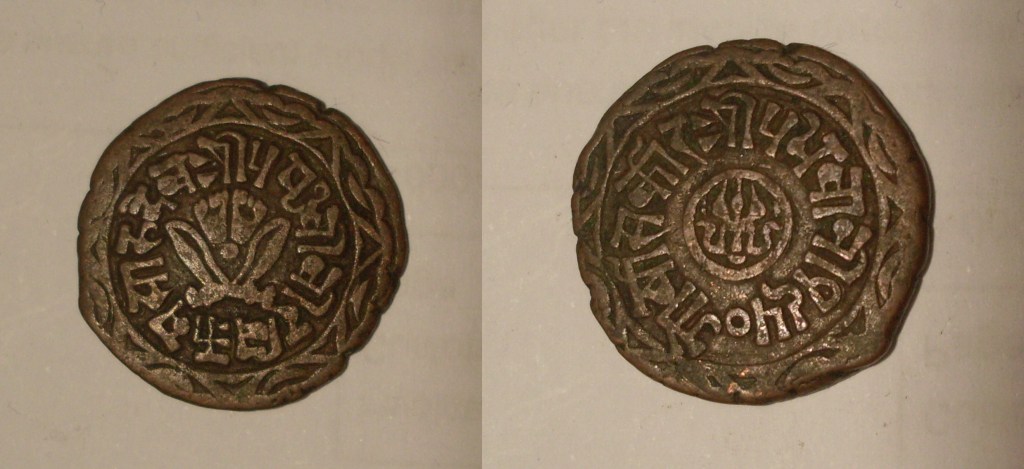
A small copper coin roughly 23mm in diameter it is around the same size as a British 10 pence piece, or an American quarter. It dates from the year 1892, and was minted during the reign of King Prithvi Bir Bikram Shah. Valued at 1 paisa, it is the smallest denomination available in circulation at the time.
On the obverse of the coin are a pair of feet with crossed kukris (a blade synonymous with the Nepalese Ghurkha) beneath then. These are surrounded with letters written in Nagari script spelling out the kings name.
The reverse shows a stylised trishul, a trident like weapon, which is one of the principally used symbols within Hinduism; and the favoured weapon of the Hindu god Shiva. Surrounding the trishul is more Nagari script showing the name of the Nepalese prime minister, the date, and the name of the country.
King Prithvi Bir Bikram Shah during his reign was nothing more than a puppet ruler. Much of the power held within the kingdom of Nepal during this period was held by the prime minister which was made a hereditary position after a coup de tat in 1847. This position would be held by the Rana dynasty until 1951 when a revolution caused power to be returned to the king when a new constitution was written.
Prithvi Bir Bikram Shah would reign as king until 1911 when he died under suspicious circumstances. It is suspected he was poisoned, but no evidence was found to make it clear who had done it. He was succeeded by his only son, Tribhuvan Bir Bikram Shah, at the age of 5.






 Numismatic Exploits