Cash in hand

Back in January during my usual aims for the year I mentioned that I would like to pursue attaining more Asian coins for my collection.  Well this month I have finally achieved what I set myself.  Grabbing myself 12 Chinese cash coins to add to my growing hoard.

SDC13425SDC13426

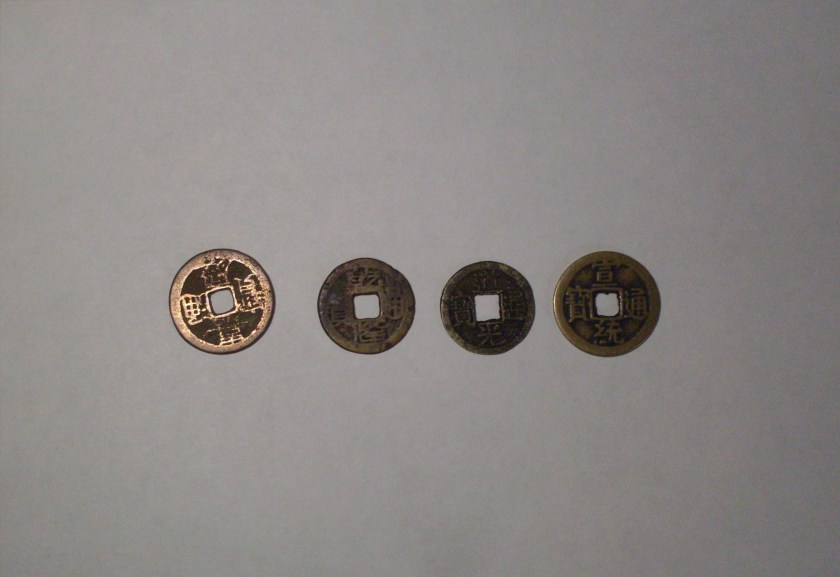
The first four coins from the group I have were identified by the person I purchased them from.  From the pictures, going from left to right, they are in date order.

1st – Dating from the Emperor Jiaqing of the Qing dynasty, this coin was cast from between 1796-1820.

2nd – Another coin from the Emperor Jiaqing, and dating from the same period as the first.  This coin however is known as a Boo Jin.

3rd – From the Emperor Daoguang of the Qing dynasty, this coin was cast between 1821-45

4th – From the Emperor Puyi (also known as Xuantong) who was the last emperor of China.  This coin was struck around 1908-09.

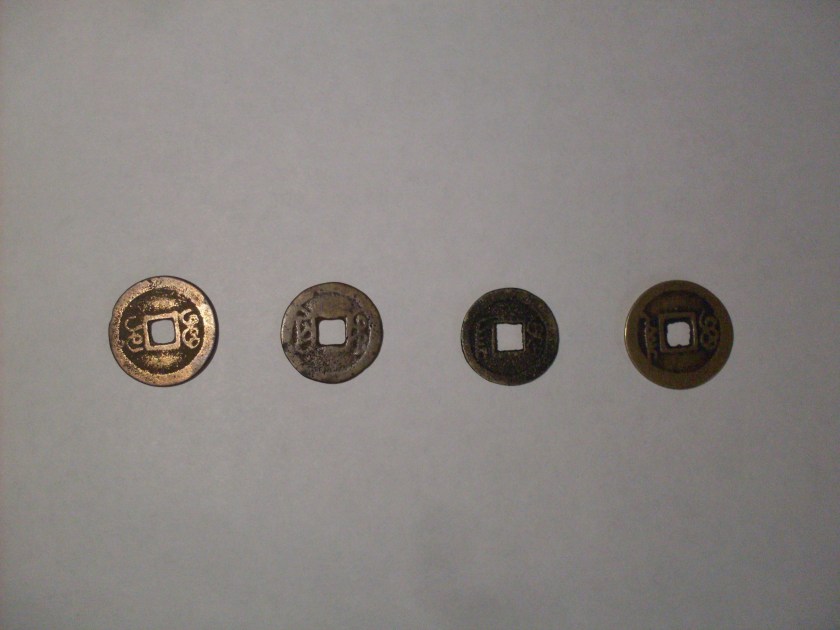
The other coins I acquired sadly are difficult to identify.  Mainly because I have no idea how to translate the Chinese characters on the coins themselves.

SDC13427SDC13428

I did however learn a few new things about Chinese cash coins during my attempts at researching them.  They were first made during the 4th century BC, and were in use continuously until their final casting in the first year of the Republic of China in 1912.  During this period the design remained pretty much the same, with the round shape and square hole most of us known them for.  This meant that many coins which had been struck during the Northern Song Dynasty (AD960-1279) were equally valid and in circulation up until the early 20th century!

Finally, despite the majority of the cash coins being manufactured through the process of casting.  During the latter periods of the Chinese Empire, it was also known for several of the coins to be machine milled similar to most coins are today.  Two of which can be seen in the bottom row of the last set of pictures above.  You can easily tell them apart from the ones which have been created via casting due to the crisper edges and lettering.

Hungry, Hungry, Hungarians

A new blog post finally after a month absence due to some difficulty in getting some new additions to my collection.  Particularly due to the vents happening globally right now.  However, this month I have managed to attain some new medieval coins to add to my display case.SDC13418

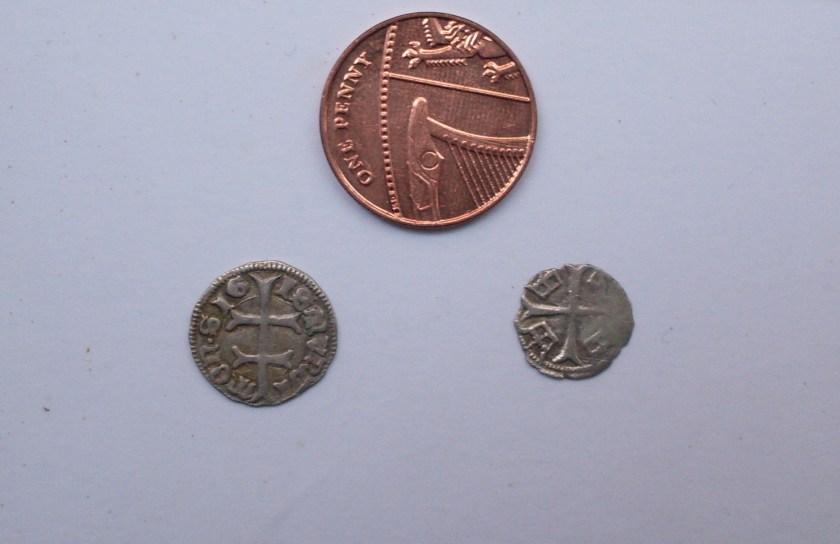
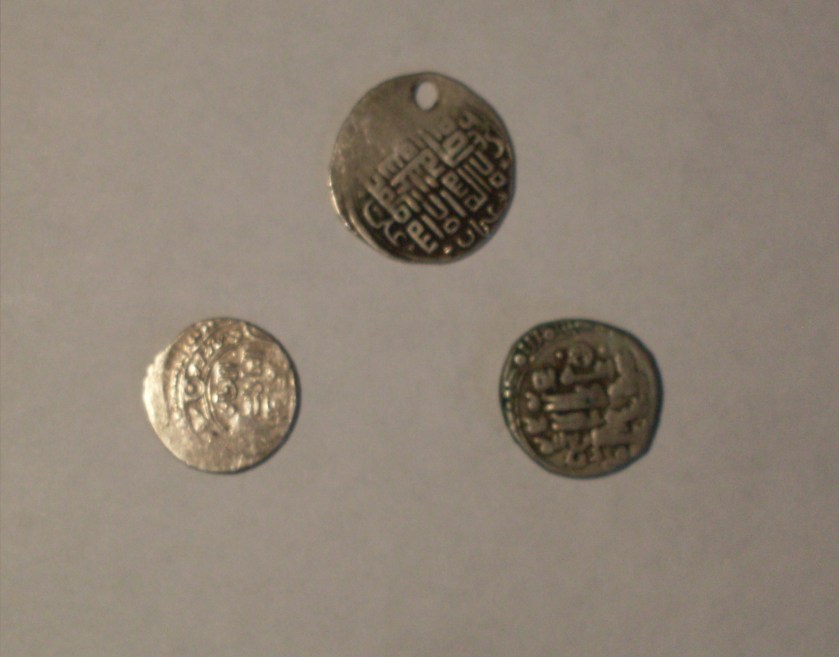
From the picture you can see two small silver coins from the Kingdom of Hungary.  Both were minted under the King Sigismund I, who ruled Hungary from 1387 – 1437.  There are no actual dates on the coins themselves, so the closest I can get is the reign of Sigismund himself.  The coin on the left is a Dinar and weighs 0.17g, whilst the coin on the right is a Parvus and weighs just a measly 0.23g.  You may also notice that the coins are quite small, especially when put in comparison to a penny.  The dinar measures 13.5mm and the parvus is 11mm.  Both are roughly 1mm thick.

Now Sigismund was not just the ruler of Hungary, but was also the King of Croatia (which was incorporated into the Kingdom of Hungary at this time), King of Germany, King of Bohemia, King of Italy, and Holy Roman Emperor.  But since the coins I got this month are from Hungary, I will just discuss a little history in regards to that part of his life.

Sigismund became king of Hungary in 1387 when his betrothed, Mary, on the death of her father, became Queen of Hungary.  His kingship of Hungary was not peaceful, as he would spend the first nine years after his coronation in a ceaseless struggle to keep hold of the title as the Kingdom itself was very unstable.

Much of the struggle came from trying arrest power back from the local elite who had been administering much of Hungary.  Sigismund had paid over much of the power the Kingship held to the local nobility to keep them loyal when he ascended the throne.  The restoration of the authority of the central administration took decades of work. The bulk of the nation headed by the House of Garai was with him; but in the southern provinces between the Sava and the Drava rivers, the Horvathys with the support of King Tvrtko I of Bosnia, Mary’s maternal uncle, proclaimed as their king Ladislaus, King of Naples, son of the murdered Charles II of Hungary.  It was not until 1395, that the pressure from these nobles had been suppressed

SDC13417

Slumming with Royalty

SDC13398

Earlier this month it was my birthday, and normally I try to visit somewhere new and maybe add some interesting foreign coins to my collection.  This year I instead went back to my old university town for a couple of days in an attempt to save money for an event which unfortunately fell through due to the current global crisis.

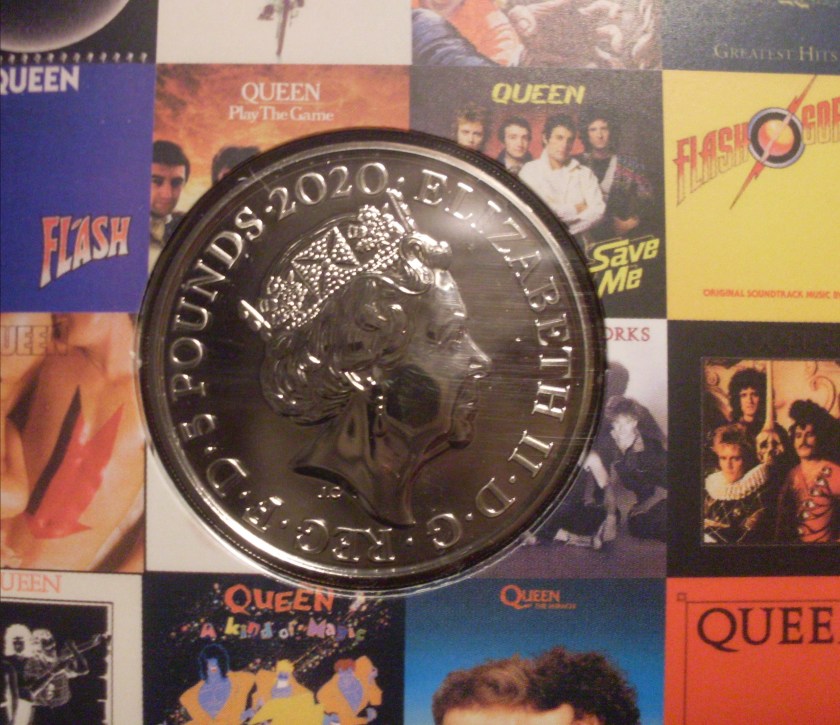
However, I still did manage to add something new though.  As a present, I received a proof £5 coin celebrating my favourite band of all time.  There is very little I can say which most people don’t know about the band Queen, but I can safely say I was quite chuffed receiving this coin for my birthday.

SDC13404

New Year, New Decade

2020 is now upon us, and this being my first post of the year, and the first post of the decade I have decided to start off with another first.  For Christmas a family member bought me a coin as a present, a novelty item, but something which I can say is unique (for now).


Roughly about the same size as a £1 coin, I got a copy of the world’s first silver sovereign.  Minted by the Royal Mint for Gibraltar this coin is limited to a strike of only 100,000 and is composed entire of pure silver.  Now I am sure in the future many more of these will be minted, and the novelty of a silver sovereign will quickly wear off.  But I can say at least I have one of the very first batch that has been minted.

So what about my intentions for the new year?  Since it is a fresh year and a new decade I have decided to focus my efforts on areas of numismatics I know very little about.  The coins of Asia and the Middle East I will have to admit I have very cursory knowledge of, as for Africa I can say my knowledge would be equivalent to the average man on the street.  So this year I have decided to try and obtain and learn about coins from these areas of the world.  A departure from Europe and N. America for a change.
I will however attempt to obtain more ancient coins as it is always an interest to learn something interesting from over a thousand years ago.  There is also a quirk of holding something used and made by people who lived during that time.  A weird disconnect for want of better words.

Finally, I will always try and seek out further unusual coins and numismatic materials.  My love for what I like to term as ‘Funny money’ hasn’t diminished (such as the ancient Greek dolphin coins, or German notgeld).  Despite my aims to focus on new areas of the globe.  Perhaps I can marry the two objectives, I would love to add more Chinese spade coins to my collection, let alone dagger or money trees.  There are also the outlandish currency of the Pacific islands which may be a challenge and worthy goal to try and get.  Either way, it is still January, so I still have an entire year to discover and explore new areas of numismatics.

From Russia with love…

SDC13326

This month I guess I have to make up for not posting an update at the end of October.  There was a reason for this, and that was due to a trip to Moscow, which went from the 31st October till the 4th November.  It was my first time exploring Russia, and I will attest that the country did not disappoint.  However, this is not a travel blog, but one devoted to coins, so instead I will talk about what new additions I added to my collection and other numismatic things I saw.

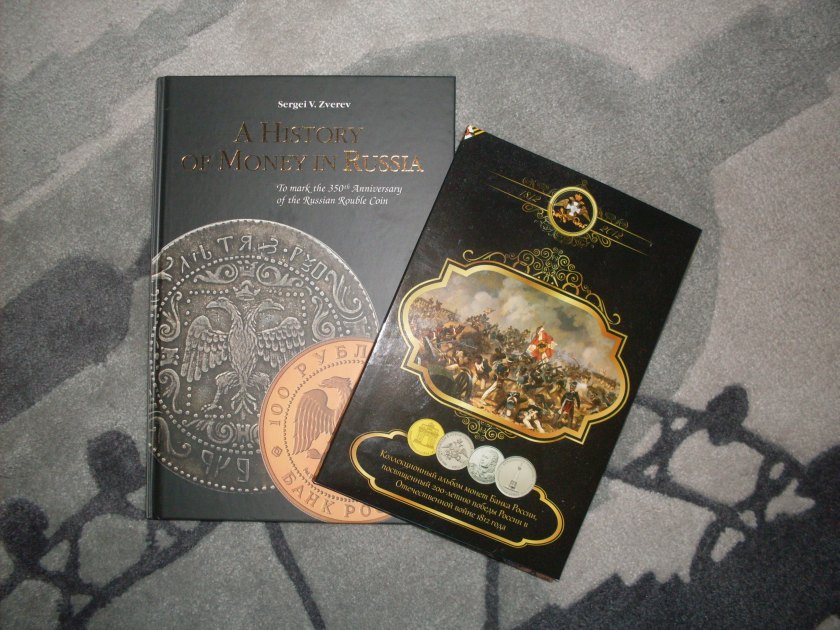
In the picture shown above I decided to buy a small book detailing the history of Russian coinage.  A nice little piece of interest which I picked up for roughly 500 roubles (~£6) in the Kremlin gift shop of all places.  Although not long, it does have a succinct run through of Russian coinage and pretty much does what it says on the front.  It does not go into too much detail, but the main allure was the comprehensive photo gallery which takes up roughly two thirds of the book.  Something I think that would come in very handy when trying to decipher any extremely worn Russian coins I may come across in future.

SDC13334

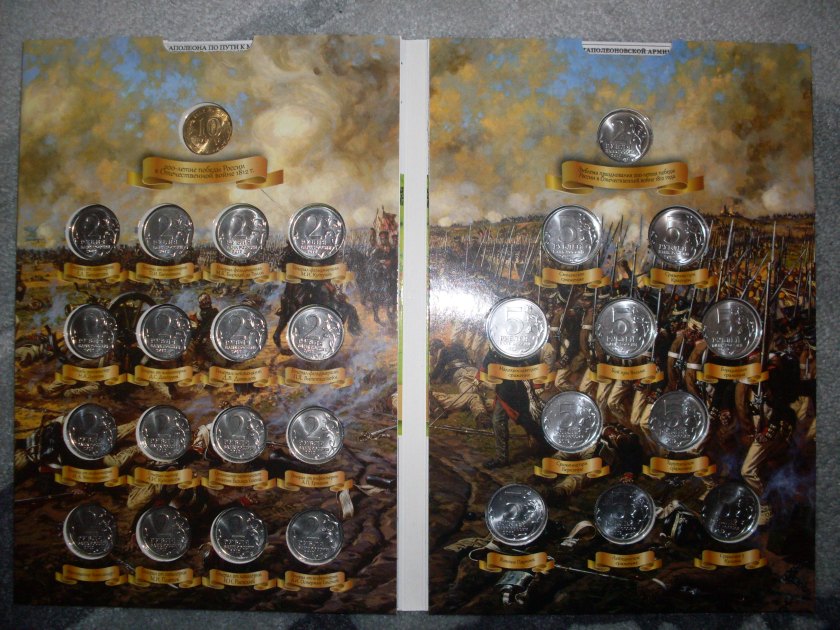
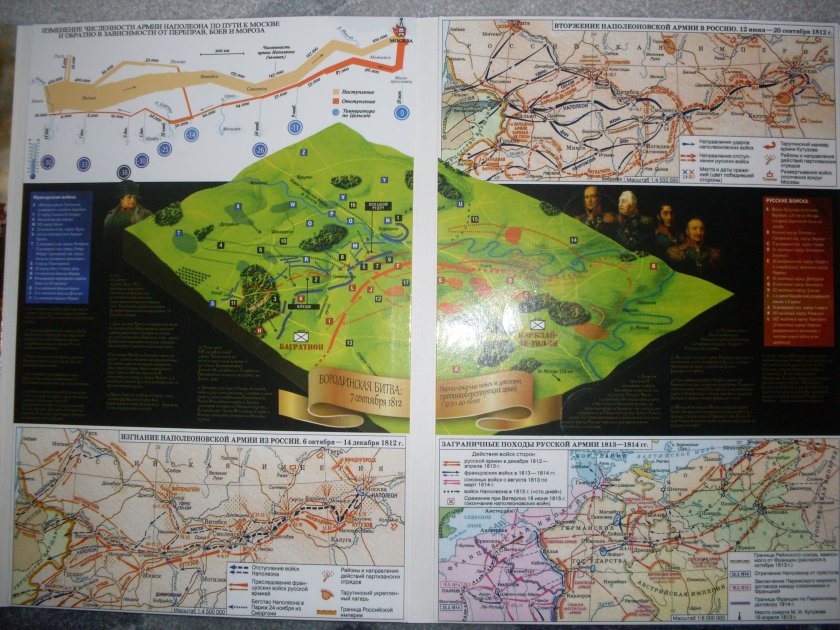
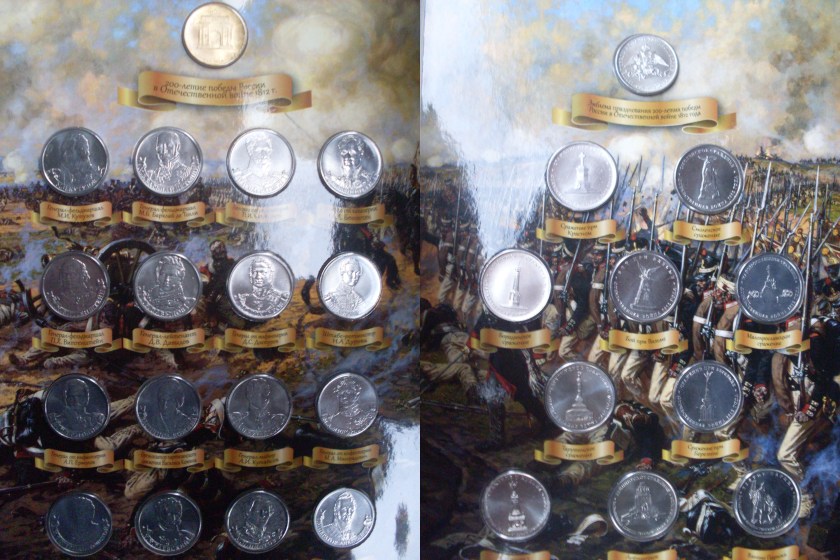
The next thing I bought was a 200th anniversary commemorative collection of 2 and 5 rouble coins which detail Russia’s victory over Napoleon in 1812.  Similar to some coins produced here in the UK in 2015 to celebrate victory over Napoleon at Waterloo, Russia’s commemorative set details Napoleons invasion of Russia, his march towards Moscow, the Pyrrhic victory at Borodino, and his eventual retreat from Russia itself.

SDC13335

imgonline-com-ua-twotoone-7braQwiiJz

The obverse side of the coins depict the generals who fought on the side of the Russia, and monuments to commemorate the eventual victory over Napoleon.

As for other numismatic items seen in Moscow, I must admit not to witnessing much.  In the Russian history museum there were a couple of cases showcasing gold coins from around the world as well as from Russia’s past.  It was interesting to see them up close, and how small such coins were.  And as ever, it always amuses me to see British coins on display in foreign lands.  Unfortunately, photo’s were almost impossible to attain as the museum curators were ever vigilant in stopping photography.

Moscow is also home to the Bank of Russia money museum, but sadly, I did not have time to visit.  Visits to the museum are by guided tour only, and have strict operating times.  Most of which clashed with other plans I had during my visit to the city.  So this is still on the list for when I next return to Moscow.

I also sadly did not get much chance to visit many coin sellers in the city.  Partly this was due to the location of many of them being away from the areas I would be frequenting.  Secondly, I read that it is difficult to transport items older than a certain age outside of Russia without the proper paperwork.  I can’t say for certain that this information is correct, as I got conflicting information pertaining to it.  Some places said it didn’t exist at all, whilst others placed a limit on it being items up to a 100 years old.  Some even went as far to suggest that items no older than 50 years could be taken!  So to save myself the trouble, I decided to settle on the commemorative coin set instead.  It wasn’t too expensive coming in around 2000 roubles (~£25), which to be honest is probably roughly the same price I would have paid for something similar here in the UK.  All in all, it was a fantastic trip, and I wholly recommend a visit.  A re-run of which I hope to achieve next year.

Icons of note

Something relatively different this month.  Every so often I receive e-mails from the Royal Mint with special commemorative medallions, coins etc.  Often I ignore them because to be quite frank they are usually out of my price range.  Sometimes though they send simple offers of a special commemorative (usually made from pure copper) for free with just the nominal cost of postage and packaging.

Over the years have taken up some of these offers, the most notable being the 200th anniversary of the battle of Waterloo, and the 950th anniversary of the battle of Hastings.  Recently I decided to buy their offer of the solid copper replica of the Isaac Newton £1 bank note for the princely sum of £2.50 to cover the postage.  Now usually these items form part of a larger set, often comprised of solid gold items.  Which as I mention, is way out of my price range.  This time however I, for once, decided to complete it.  Mainly because I was able to afford the price of each banknote to complete the set.

The theme of the set was Great British Icons, with icons all designed by the artist Henry Eccleston.  Apart from Newton, other figures featured are Wellington (on the £5), infamous for this campaign against Napoleon.  Florence Nightingale, famous for the reforming and founding the principles of modern nursing is on the £10.  Shakespeare graces the £20, and Christopher Wren, architect, takes position on the £50.

I won’t go into detail about the lives of these characters, as like last month, there is too much to talk about.  I would however like to discuss my thoughts on items such as this.

For a collector these little sets are fun, and can be seen as a present to oneself due to the limited nature of them.  Which immediately brings me to their major downside.  They can be expensive.  Not only constrained by the actual material of the product, the limited nature of them also seems to call for a premium price.  Which often leads to me just getting the introductory piece rather than the full set.  In a way these are marketed to those who have the money to spend on such a premium product rather than the general collector.  Do I recommend these for people?  Overall, not really.  Unless the theme of the collection is something you are particularly interested with, or you are taken by the sheer novelty of it (like I was with this set), I suggest you direct your efforts elsewhere.  Their immediate value is not comparable to the cost you pay for it, and it is a very long stretch you will match the amount you invested in it.

In short, only go out of your way for these if it something truly close to your heart, and you have the spare money floating around to meet the premium price.

Meeting the greats

Ave readers!

Today I will be talking abut one of the more famous Roman emperors.  His fame (or infamy) is on par with other emperors such as Augustus, Nero, Caligula, Aurelian, Hadrian, and Claudius.  He is well known as legitimising Christianity throughout the Roman empire, as well as founding the city of Constantinople (modern day Istanbul).  He reformed the Roman Empire, and reigned it as sole emperor after the dismantling of the Tetrarchy created by Diocletian to end the Third Century Crisis.

You have by now guessed the emperor I am talking about, so I guess I should get on with this months blog post about Constantine I, also known as the ‘Great’.

SDC13240

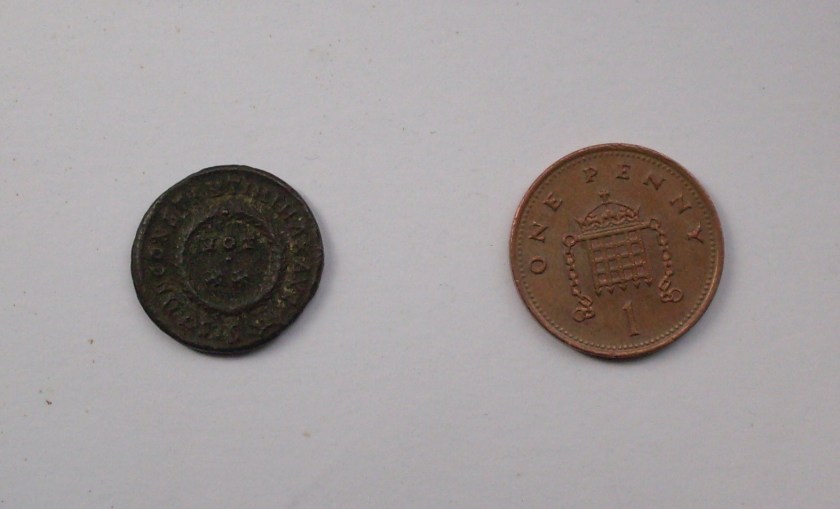
The coin I have added to my collection this month is a bronze Follis of Constantine I.  Dating from around 307 (when he became emperor of the Western Roman Empire) to 337 (when he died as emperor of the whole Roman Empire).  The mint mark on the reverse tells me it was minted in Siscia, which is now modern day Sisak in Croatia.  From the pictures you can see the coin itself is not very large, and due to the passage of time it about 1mm thick.

SDC13241

The life of Constantine the Great is too detailed and would require many blog posts to do it any justice.  So I will just have to suffice with a summary of the more notable events which occurred during his life.

Constantine was born in Naissus (which is the modern day city of Niš in Serbia) and would grow up in a military lifestyle.  He would rise up through the ranks during many campaigns in the Eastern empire, eventually reaching the title of Tribune.  The Emperor Galerius would bestow the title of ‘Augustus’ on him, and he would be sent to Britannia to campaign under his father, Flavius.  After his father’s death in 306, Constantine was proclaimed emperor by the army at Eboracum (York).  He would march south to claim his title, and after his victory over Maxentius at the Battle of the Milvian Bridge in 312, Constantine was proclaimed emperor of the Western Roman Empire.  Several years later he would wage campaigns against Licinius, who was the Emperor of the Eastern Roman Empire.  Constantine would emerge victorious in 324 after the Battle of Chrysopolis, and would become the sole emperor of the whole Roman Empire.

As emperor, Constantine reorganised much of the empire.  He enacted administrative, financial, social, and military reforms in attempts to strengthen the empire.  Restructuring the government by separating civil and military authorities.  To reduce inflation, which was endemic at the time, he introduced a new gold coin called the Solidus.  The coin itself would become a standard for Byzantine and European coinage for the next thousand years.

More famously though, Constantine was known as the emperor who legitimised the Christian faith throughout the Empire.  He is known as the first Christian emperor, converting on his deathbed to the religion.  During his reign he made life in the empire more palatable to Christians.  He was highly influential in the declaration of the Edict of Milan in 313 which declared religious tolerance for Christians and Christianity, and in 325 he called the First Council of Nicaea which produced the Nicene Creed.  Finally, upon his orders, he had the Church of the Holy Sepulchre built in Jerusalem upon the supposed resting place of Jesus Christ.

He reigned for 31 years, dying of illness in 337 in Nicomedia.  Combining his years as both co-ruler and sole ruler, Constantine was the second longest reigning ruler of the Roman Empire after Augustus.  His body was interred in the Church of the Holy Apostles in Constantinople.

The Octopus man cometh…

Well… Not actually an octopus man, but the design of this months coin certainly does fit the bill.  SDC13233

This small copper coin, dating from around the beginning of the 11th century, hails from the Chola empire which dominated the southern part of the Indian sub-continent for centuries.  The Chola dynasty is known as the longest recorded dynasty in history, with written records dating as far back to the 3rd century BC.  It survived and thrived until it’s eventual decline and collapse in the 13th century.

The chola empire had much influence within SE Asia, with the majority centred around what is now modern day Malaysia.  It was further extended north, when strong trade links were established with China.

The Cholas left a lasting legacy after their long rule. Their patronage of literature and their zeal in the building of temples has resulted in some great works of Tamil literature and architecture. The Chola kings were avid builders and envisioned the temples in their kingdoms not only as places of worship but also as centres of economic activity. They pioneered a centralised form of government and established a disciplined bureaucracy. The Chola school of art spread to SE Asia and influenced the architecture and art of the region.

SDC13234

The image on the coin itself shows the king Raja Raja I standing with the traditional garment called a ‘dhoti’.  The garment depicted is when gives the design it’s unique look and the apparent appearance of extra appendages.  The other side of the coin shows the king sat upon his throne surrounded by dancers.

After the empires decline, there is an oral tradition that a rebel branch of the dynasty fled and thrived in the Philippines until the 16th century.  It created a small ‘Indianised’ kingdom in the region until Spanish conquistadors under the command of Miguel Lopez de Legaspi conquered the region after sailing from Mexico.

Of Greeks and Dolphins.

We are heading back to ancient civilisations this month, but rather than greeting the Romans, we are heading a bit further east to their Greek neighbours.

SDC13232

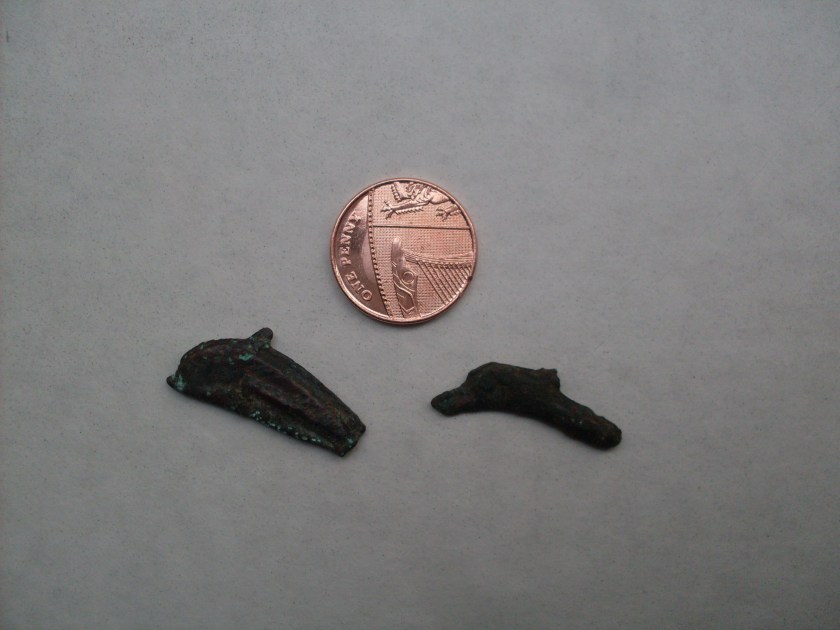
The coins I have gained this month fall into the weird shaped and unusual category which I am so fond of.  In the picture above you can see two bronze ‘Dolphin’ coins from the city state of Olbia, which was part of the Greek Sarmatian area of the Black Sea.

Olbia is located in what is now known as Parutyne, in Ukraine on the northern shore of the Black sea.  The Black sea is known for it’s large population of bottle-nose dolphins.  This may be why the Greek city state decided to cast their coins in the distinctive shape of the creature.

The coins are unusual in that most Greek city states would often mint their coins in the distinctive round shape many of us are familiar with today, whereas Olbia would instead cast these dolphin shaped coins.  Archaeologists are led to believe that the coins originated as sacrificial tokens used in the temple of Apollo Delphinios.  The dolphin itself is known as a divine creature in Greek mythology, and with a large presence of the creatures in the Black sea, it doesn’t take a far leap of the imagination to make a possible connection.

The coins themselves date from around the 5th-4th century BC, and were made using a casting method often used by the ancient Celts in France and which originated in this area.  Many of the dolphins themselves had their tails removed during the process of removing the coins from the ‘trees’ they were attached to during the casting process.  Probably due to speed over efficiency to move onto the next batch.  Quality of the coins varied wildly, as can be seen in the photo, and variations of the coins do exist.  Some have the dolphins distinctive fin, and some will also have the eye moulded onto them.  In some very rare cases, there are known examples of the coins to feature words or inscriptions.

Revolution is in the air…

Bonjour mes amis.

This month for my collection update we travel to revolutionary France of the late 18th century.  Dating from 1793, the piece I have recently acquired is a 2 Sol coin.  Made out of bronze, and highly worn.

SDC12952

Now the more historically knowledgeable of you are asking “Wait, why is Louis’ portrait on the coin when he was executed in 1793?”  And that is a very good question.  Although Louis was beheaded in January 1793, the revolutionary government would still issue coins with the king’s portrait on them.  Along with keeping the same weight and value of the coins.  They would also keep Louis’ titles such as ‘king of the French’ but they would be featured alongside revolutionary mottos on the reverse.
Towards the end of 1793, there would be a continuation of the monetary system of the old regime but the portrait of Louis would be removed, along with his titles, and be replaced by a stylised figure along with the value of the coin.

SDC12951

Eventually by 1795 the Republican authorities replaced the old monetary units that were in use (which were almost identical to the pounds, shilling, and pence of the UK) with a more rationalised decimal system.  Gone were the livres, sols, and deniers.  They were succeeded by centimes, decimes, and francs.  The original franc in 1795 was set as 5g of 90% silver, which was similar to the old livre.  However, the struggling republic was unable to ensure such a quality for it’s coinage, and instead was reduced to issuing paper ‘Assignats’ at a much depreciated value.

Assignats were a sort of paper bond issued by the revolutionary government backed by precious metals they had in the treasury.  It was an effort to reduce cost and keep the economy going during the subsequent crises which befell France in the following years.

Assignats themselves were issued during 1791-97 when Revolutionary France found itself attacked on all sides by the other European powers.  Forced to use what precious metal it had to fund the ongoing wars, the reliance on the paper assignats increased where eventually they became compulsory paper money.  By 1796, the number of assignats were twenty times that of the current value of precious metals the government had to back up the value of the issues.  This led to an increase in prices, with many items seeing a 500% price rise compared to what they were in 1790.

The financial situation would not stabilise until Napoleon would start winning conquests in neighbouring countries and send the captured loot back to France.