Collection Update Feb ’19

We are heading back to Asia this month for my latest addition to my collection.  China more specifically.

The piece I got this month is something I have only ever managed to see in museums or in books.  However, I got lucky and through some of my contacts found someone willing to sell on an example from their own collection.

SDC12846

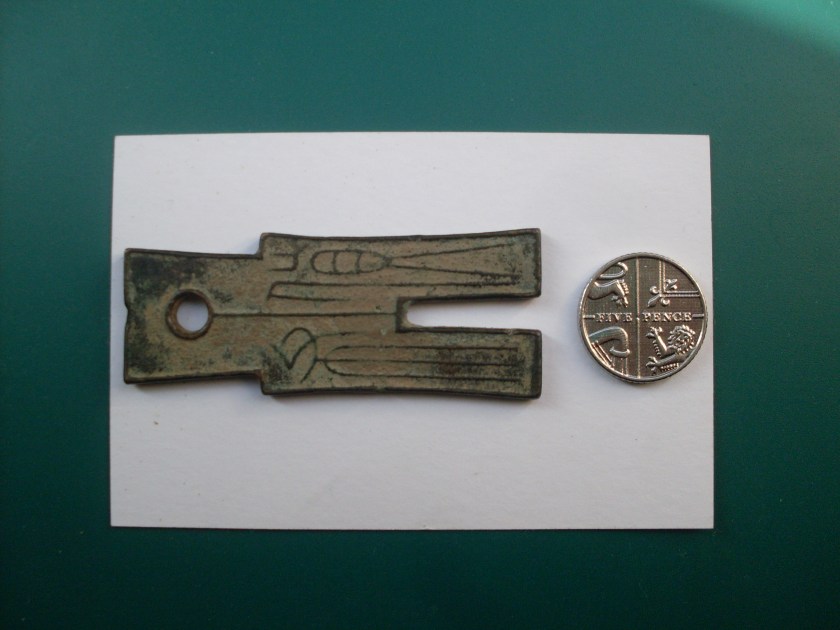
From the picture above you can see a Huo Bu (money spade) from the reign of the emperor Wang Mang (9-23AD).  Now, this is not the first time I have acquired a coin from this Chinese emperor, and I have written briefly about his reign in a previous blog post back in January last year (Here).  So I won’t regurgitate anything in this post.  So I would like to explore spade coins in general.

Chinese spade coins were first made during the Zhou dynasty (~1045 – 256 BC) and resembled a small spade or weeding tool often used by the people as an alternative form of currency.  The original spade coins would have a hollow handle at the top of the coin, representative of the wooden handle you would insert.

Towards the later period of the Zhou dynasty, the legs would be less pointed and early forms of Chinese characters would start to appear on the coins.  Further changes would happen during the warring states period (475- 221 BC).  Each of the individual states would start producing their own spade coins, and they would become much smaller and would no longer have the hollow handle at the top.  Different shapes would also begin to be produced, with examples known to exist including arched feet, rounded feet, and coins with three holes (Pictures and examples of which cane be found here).

After Emperor Qin Shi Huang has conquered the warring states in 221 BC he replaced spade coins with the titular round coins with square holes many of us are familiar with and associate with in regards to ancient Chinese coins.  This would continue until we reach our reoccurring blog favourite, Wang Mang.  When he became emperor he reissued spade coins, in an attempt to impose some legitimacy to his dynasty after he usurped the throne and forge a link with previous dynasties.  The spade coins by this time had proven to be unpopular however despite several different types being cast and issued.  Round coins were ultimately reintroduced shortly afterwards, and the spade coin was resigned to it’s place in Chinese numismatic history.

SDC12847

A New Year and a Collection Update

So it is now the end of January 2019, and I honestly can’t believe I have still managed to keep updating with this blog (I thought I would get bored after the first year).  I am now entering my third year of writing, and despite missing a few months, I feel I can keep going for many years more.

So what did I learn last year in regards to numismatics?  Honestly, I feel I learnt more about different country’s histories more than the hobby itself.  But the one major thing which has stuck with me was during my trip to Japan early in 2018.  Discovering Hansatsu notes was a novelty in itself and I felt an instant interest due to my love of unusual forms of currency (as can be seen about my post a few years ago in regards to German Notgeld).  Furthermore, as was seen in the series of posts I made about that trip, I was actually able to procure one for my collection.  Which I will happily admit is now sitting pride of place amongst other unusual items from my collection in a glass cabinet.  Hopefully this year I will be able to match it with something equally unusual and interesting.

Now despite not updating the blog at the end of December (Christmas got all my budgetary attention), I decided to get something a little more expensive than I usually go for to make up for it.

sdc12841

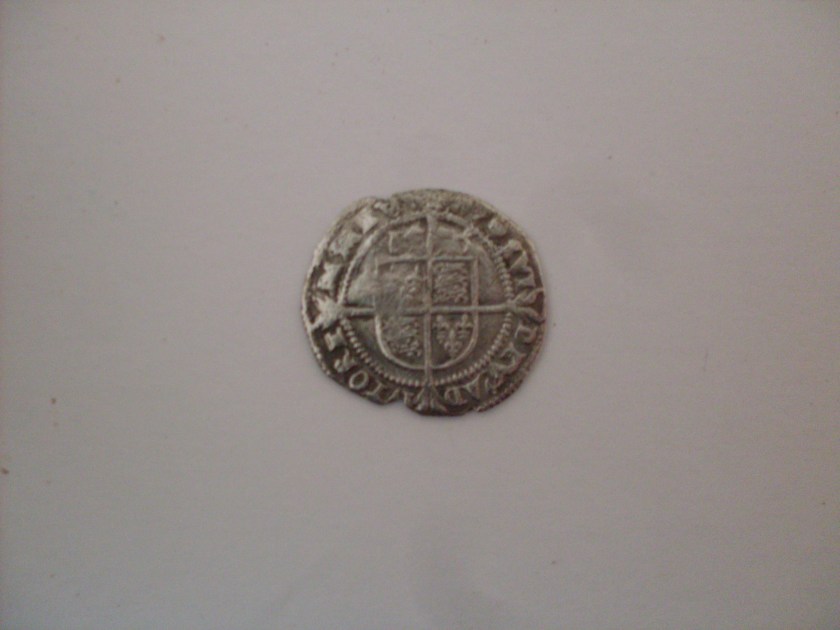
So in the picture above, and the one below, we have a silver sixpence from the reign of the well known Elizabeth I.  Measuring 19mm diameter at it’s widest point and only 1mm thick, it is not a particularly large coin.  Minted in 1575, it has the rose mint mark to the right of the portrait which denotes it was struck at the Tower of London.
sdc12843

Elizabeth’s reign has commanded libraries worth of literature.  With many Tudor historians writing reams about her.  Along with her father Henry VIII, she has typified the Tudor dynasty, especially after the short and brutal reign of her sister Mary I.

Her 44 year reign added much needed stability after the two short reigns of her brother and sister, and the political chaos surrounding the reformation in England put into motion by her father.  I could go into much detail about her reign, but the amount of information out there is too much for such a small blog post as this one.  But in short, her reign was one of precarious balance.  Defending England against the Catholic powers on the continent, whilst balancing society back at home.  The upheaval caused by the protestant reformation would cause no end of headaches for Elizabeth, with the threat of the Spanish armada in 1588 (and the equally catastrophic English armada the following year) and the Nine Years War from 1594-1603 in Ireland to name just a few.

She would survive these problems until her death in 1603, when the crown would pass to her cousin, James VI, King of Scotland (ironically the son of Mary Queen of Scots who Elizabeth had executed in 1587).  Thus ending the Tudor dynasty, and starting the Stuart one.

Collection Update Sept’ 18

SDC12759

In the picture above we have this months newest addition to my collection.  Being relatively small and thin (16mm in diameter and only 1mm thick), the coin itself is relatively unremarkable.  It dates from the late 12th century, and is a joint issue Denaro from the Kingdom of Sicily.  Issued by the then Holy Roman Emperor, Henry VI, and his infant son Frederick who was crowned King of Sicily in 1198 at the age of 3.

Henry VI conquered Sicily in 1194 after successfully ransoming off the English king Richard the Lionheart after his capture and arrest whilst returning from the Third Crusade.  Using the ransom money of 150,000 silver marks ($18.5 million or £14.2 million today) to pay for the expedition.  After rooting out the Norman nobles who opposed his rule or fought him prior to the conquest Henry made his wife, Constance, Queen regnant.

SDC12760

Henry’s son, Frederick, would not however succeed to his father’s position as Holy Roman Emperor after Henry’s death in 1198.  It would not be until 1220 that Frederick would attain the crown of the Holy Roman Empire after the current incumbent, Otto of Brunswick (Otto IV), would be overthrown after his defeat at the Battle of Bouvines, a conclusive battle of the 1213-14 Anglo-French war.  Already recognised as Emperor a year and a half prior to the battle by the Southern states of the Empire, it didn’t take much for him to ascend to the throne.

Striking gold in Italy

Recently there has been news of an exciting new find in northern Italy.  In the small town of Como, workers working on the abandoned theatre there discovered a small amphora dating roughly from the 5th century AD.  What is more interesting is that the amphora was filled with roughly 300 gold coins in relatively good condition.  It was the presence of these coins which allowed archaeologists to determine the rough date when the amphora was deposited.  News of the find was issued by the Italian Ministry of Culture.

The official statement, along with many of the issued photo’s can be found here. All in the original Italian.

The Roman Empire during this period was facing a series of crises, a lot more dire than those which happened two centuries earlier.  By this point the empire had split into two.  With the thriving Eastern half of the empire being centred on Constantinople (modern day Istanbul), and historians often referring to it as the Byzantine empire.  The Western half instead was collapsing and centred on Rome, and would face several invasions by Germanic tribes in the 5th century.  Rome would be sacked by the Goths in 410AD, and again in 455AD by the Vandals.  The Western half of the empire officially came to an end in 476AD when the then emperor, Romulus Augustulus, abdicated.

Justinian I, of the Byzantine empire, attempted to reclaim some of the lands in Italy during the 6th century, but his successors were unable to keep a hold onto them, as raids and invasions by the Lombards (another Germanic tribe) increased significantly after Justinian’s death in 565AD. The Lombards eventually gradually asserted their own control over Italy until 774AD when Charlemagne conquered the area and integrated Italy into the Frankish empire.

Collection Update Aug’ 18

SDC12754

I fear that this month’s update will be quite lengthy as I recently acquired a large number of German coins stretching through just over 200 years of history.  During that time Germany went from a collection of individual states disguised as the Holy Roman Empire, to eventual unity.  Two world wars, being split again, and another eventual reunification requires me to be very scant on details otherwise it would turn into a very lengthy essay!

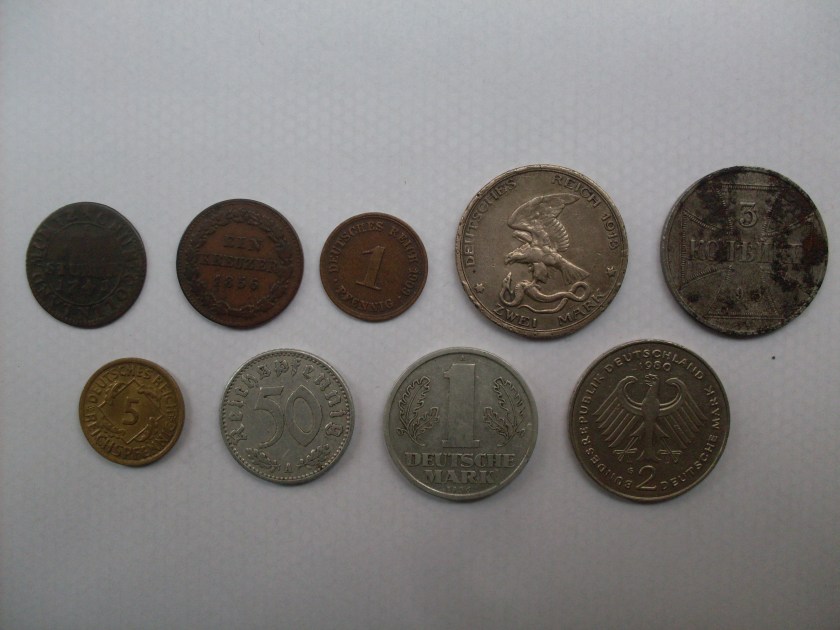
Our delve into Germany’s past starts with the first coin, which is a 1/4 Stuber from the German state of Cologne (dated 1741).  Cologne at this time was an archbishopric and was issued under the name of Archbishop Clemens August (his stylised monogram taking up the obverse side of the coin).

The beginnings of the Holy Roman Empire are unsure, and many scholars cannot agree whether it was Charlemagne who became the first emperor in 800AD, or Otto I in 962AD.  However, by the middle of the 18th century when the 1/4 Stuber was minted, the state of Prussia had come to dominate the Empire in it’s politics with the accession of Frederick I (the Great) to the throne of Prussia.  Frederick would eventually spark the War of the Austrian Succession (1740-48) and more importantly the Seven Years Wars (1756-63) which would sow the seeds for the American Revolutionary War, and add further fuel to the fire which caused the French Revolution.

By the time of the minting of the next coin (1 Kreuzer, 1856, Duchy of Nassau), the Empire had been dissolved 50 years previously in 1806.  This happened when Emperor Francis II’s armies were defeated by the French under Napoleon at the battle of Austerlitz.  The Emperor abdicated after signing the Treaty of Pressburg, where many of the Empire’s western territories were organised into a French satellite state called The Confederation of the Rhine.  After the end of the Napoleonic wars in 1815, the Confederation was replaced by the German confederation until 1866 when it became part of the North German Confederation founded by Prussia.  A forerunner of the German Empire which would be formed under Prussian leadership in 1871.

The unification of Germany occurred under the leadership of the Iron Chancellor, Otto von Bismarck.  The desire for a unified Germany was borne out of the revolutions which occurred in 1848-9, with the idea of pan-Germanism and the discontent felt with the traditional autocratic political structure of the current individual German states.  Bismarck desired a unified Germany, but with Prussia at the helm, not Austria.  So a series of wars were initiated to establish dominance.  The first is known as the Second Schleswig War (1864), in which Prussia and Austria attacked Denmark.  Achieving victory, both Austria and Prussia were ceded territory from Denmark, and the northern frontier of the future German Empire would be established.  However, due to collusion with Austria, the outcome of this war led to the Austro-Prussian War (1866).  The result of this war allowed Prussia to assert control over what would be the empires future southern provinces.  It also ended the idea of forming a German empire which included Austria, as this would weaken any Prussian control.

Finally, in 1870, the French declared war on Prussia starting the Franco-Prussian War (1870-1).  The French Emperor, Napoleon III, was worried about being encircled by two family members of the same house (A candidate of the Hohenzollerns was in line for the throne of Spain).  Some clever politicking by Bismarck and the infamous Ems Dispatch caused conflict to be started.  Prussia, with assistance from the Southern German states, easily defeated France. With the chief adversary to German unification being defeated, the new German empire was proclaimed in 1871 in the Hall of Mirrors in the Palace of Versailles with the Prussian King Wilhelm I becoming emperor.

SDC12753

The next few coins come from the German Empire, with the large 2 Mark (1913) being a special anniversary coin commemorating Prussia re-entering the Napoleonic Wars a century prior.  The last in the top row is a 3 Kopeks (1916) made from solid iron.  These would be issued by occupying German forces on the Eastern front in the Russian territories they had captured during WWI.

After Germany’s loss in WWI the Weimar republic was created in 1919.  The first coin on the second row is a 5 Reichpfennig (1926) from the Republic.  The Republic suffered many problems from it’s inception, ranging from hyperinflation during the Great Depression of 1929, political paramilitaries from both the Left and Right, and a contentious relationship with the victors of WWI, most notably France.  The people of Germany blamed the Republic for the loss in WWI and the humiliating requirements of the Treaty of Versailles rather than the wartime government.  This created the perfect condition for Hitler and the Nazi party to rise to power, which as everyone knows, led to WWII and the horrors committed within.  The next coin is a 50 Reichpfennig from this period, dated 1940 below the eagle and swastika.

After Nazi Germany’s defeat in WWII, Germany was split in half between the Western Allies and Soviet Russia.  The part controlled by the West was called the Federal Republic of Germany, whilst the part under Soviet control was called the German Democratic Republic.  The last two coins each come from both parts of Germany.  The 1 Deutsche Mark (1956) comes from East Germany, and it is testament to the conditions at the time under Soviet rule as the material the coin is made out of is aluminium.  Compared to the 2 Mark (1979) coin from the West which is a much more solid cupro-nickel coin.

With the fall of the Berlin Wall in November 1989, it paved the way for Germany to be reunited again after 45 years of separation in October 1990 with the Treaty on the Final Settlement with Respect to Germany.  This was further reinforced by the collapse of the Soviet Union the following year, and Germany was able to become fully sovereign in March 1991.
Collection Update Feb ’18

So after the last few months of exploring the coins of Asia, we return westwards to more familiar grounds and explore some coins from Italy.  The coins I have acquired date from the early 19th century during the tumultuous phase when Italy underwent several social and political revolutions which culminated in the unification of the disparate Italian states into the Kingdom of Italy in 1871, when Rome was made the capital of the new country.

imgonline-com-ua-twotoone-YMF3bM9Q3iE

Going from left to right in the picture there is a 6 Tornesi piece (1801) from the Kingdom of Naples (a much clearer picture can be found here).  In the middle is a 5 Quattrini (1826) from the Grand Duchy of Tuscany.  Finally on the far right, we have a 1 Soldo (1866) from the Papal States.

Since the fall of Rome, the Italian peninsula was divided amongst a lot of independent states which despite their close geographic position, it is often debated whether they really shared a similar culture.  Thus there was no real calls for unification.  That however changed when Napoleon invaded Italy and created the Kingdom of Italy in the North.  This quickly reverted back in 1815 after the Congress of Vienna when Napoleon was defeated.  Overall,  Italy could be split into five geographical areas.  The ultra-conservative Kingdom of Naples in the South, the theocratic Papal states in the centre.  The Austrian Empire controlled much of the North-East, and exerted control over the remaining central states of Tuscany, Parma and Modena, whilst in the North West was the only truely independent state of Sardinia, also known as Piedmont.

In 1848, there were a series of revolutions across Europe.  In Italy, revolutionaries in Milan and Venice rose up against the Austrians, Sicilians fought for independence from Naples, and in Rome they declared a Republic.  The Roman Republic was led by Giuseppe Mazzini who had founded a revolutionary group called the Young Italians and had been launching insurrections for years.

Unfortunately, in a short time the rebellions had been crushed.  Austrian’s defeated the uprisings, Neapolitans crushed the Sicilians, and French troops were sent to Rome to reinstate the Pope (they would remain in the city for some time).  This period was known as the First Italian war for Independence, and it ultimately failed.  However, it allowed the King of Sardinia, Victor Emmanuel II to position himself to lead the unification movement.

To try and gain powerful allies, in the 1850’s, he sent troops to the Crimea to fight alongside the British and the French against the Russians.  Eventually Napoleon III of France came to their aid for two reasons.  First to gain prestige and hopefully weaken the Austrian Empire, and second, in 1858 he survived an assassination attempt by an Italian revolutionary, and by allying with the Kingdom of Sardinia, hoped to curb this sort of activity.  Piedmont ceded the regions of Nice and Savoy to France, and the alliance was cemented.  They both attacked Austria in April 1858, starting the Second War of Italian Independence.  They were victorious against the Austrians, and gained further help from the central states of Tuscany, Parma and Modena who had subsequently ousted their pro-Austrian leaders.  Piedmont annexed Lombardy, and the central states that helped in the war voted to join the Kingdom.

Shortly after this victory, Guiseppe Garibaldi (a famed revolutionary who had fought in Europe and South America) was persuaded by other revolutionaries to launch the invasion Sicily.  He managed to gather a thousand volunteers, and limited support from the British.  In the 1860’s he sailed for Sicily and slowly fought his way North.  He entered Naples to much celebration and hoped to push on further to Rome.  He was further pursuaded by Victor Emmanuel to stop, because French troops were still stationed in the city.  So Garibaldi handed over his southern conquests to Victor Emmanuel, and the Kingdom of Italy was proclaimed in 1861 (minus the cities of Venice and Rome).  Italy would gain Venice in 1866 when it was handed over to France to keep them neutral during the brief war Austria fought against Germany during Bismarck’s attempts to make Germany the greater German power.  France quickly turned the city over to Italy.

Italy would not gain the city of Rome until 1870.  During this year Germany invaded France kick-starting the Franco-Prussian war.  Germany’s speedy gains in the war forced the French to withdraw the troops they had stationed in Rome, allowing the Italians to simply march in.  In 1871, Rome was declared the capital of the new Kingdom of Italy, and the unification of the country was complete.  Although joined together politically; culturally and economically, the new kingdom had many problems to overcome.


Collection Update Jan ’18

This month I am presenting the last installment of my Asia focus in regards to additions to my collection.  It is safe to say that no foray into Asia would be complete without at least touching upon China.  It dominates the region, and would be extremely hard not to at least acquire several coins from it’s extremely long history.  I have also attained another Japanese copper coin (2 Sen, Meiji Era), as well as another silver Indian coin (1 Jital, 1210-1235) from the Dehli Sultanate.

imgonline-com-ua-twotoone-ZmFusHpunV

I will start off with the rather worn and virdigrised coins on the piece of card.  Both are clearly Chinese, and the one on the left dates from the year 7-14AD.  It is a 1 Wu Shi coin from the ‘Emperor’ Wang Mang.  I use the term emperor in quotes as Wang Mang was a court official during the Han dynasty who overthrew the Emperor of the Liu family and started the new Xin dynasty (which means ‘renewed’ in Chinese) under his control.  Wang Mang was killed when the capital Chang’an (called Xi’an today) was attacked by forces loyal to the previous Han dynasty in 23AD.  The Han dynasty was restored a few years later in 25AD and would continue to rule China until the start of the Three Kingdoms period in 220AD.

The coin on the right dates from 1094-98AD, and is a 1 cash coin from the Emperor Zhe Zong of the Song dynasty.  Not much happened during Zhe Zong’s reign.  He inherited the throne at the age of nine, and was under control of his grandmother until her death in 1093.  He attempted reforms to gain further control on the empire, but due to political infighting amongst his courtiers, many of the reforms were not fully implemented.  This would eventually lead to the collapse of the Song dynasty in the 12th century.  Zhe Zong himself would die at the age of 24 in 1100.

The final two Chinese coins date from the early 20th century when China underwent massive political change and upheval.  Following the turn of the 20th century, China was in the grips of the Boxer Rebellion (1899-1901), a movement which was anti-foreign, anti-colonial, and anti-Christian.  A pro-nationalist movement which had risen up in response to meddling from foreign powers in Chinese affairs, and aggressive Christian missionaries infiltrating all aspects of Chinese life.  Chinese government officials were split on how to deal with the movement as some held sympathies due to harsh demands and exploitation inflicted by the Western Colonial powers during the previous decades.  The attitude of the Empress changed in favour of the Boxers in 1900, when international intervention was beaten back at the Battle of the Taku Forts. Eight different foreign powers sent troops to China to deal with the rebellion, and the now hostile Qing government. In 1901 the rebellion was quelled and ultimately the ruling dynasty’s control of the country.  With defeat and the apparent weakness of the ruling Qing dynasty(not just in the Boxer Rebellion, but the previous Sino-Japanese war), many military officers, students and court officials advocated a change of government to that of a Republic.  The Wuchang uprising sprung up in 1911.  Several months later, other provinces in China followed suit after receiving appeals from rebel forces, and by March 1912 the Empress of the Qing dynasty abdicated, leaving China to become a Republic.

Collection update October ’17

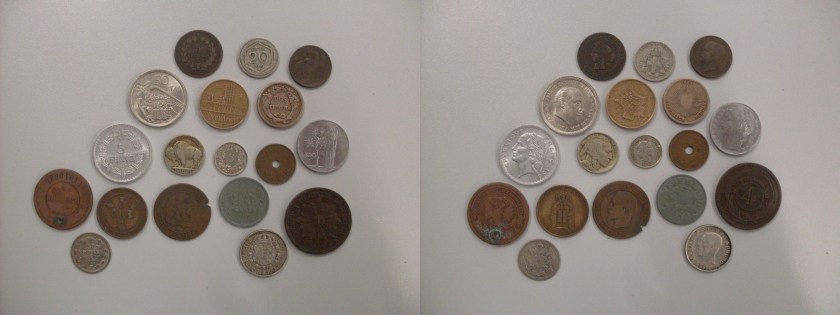
My acquisitions this month hail mainly from Europe and the Americas.  There is also a strong theme of colonialism and empire as many of the coins I have gotten date from the 19th and early 20th centuries.

imgonline-com-ua-twotoone-wibPS52IzBkPlr

Several of the coins were in very good condition, like the Uruguayan 4 Centesimos, and the Swedish krona in the bottom right corner of the pictures.  I was also pleased with silver Russian coin on the bottom left as it is the first non-copper Imperial Russian coin I now own.  However, a couple of the coins in the next picture are what I wish to focus on this month:

imgonline-com-ua-twotoone-SlSlq9mi3COZzz0U

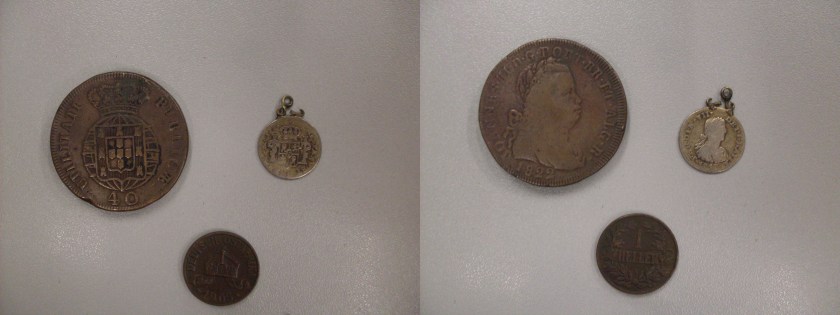
Starting from the top left we have a Portuguese 40 reis, a Mexican 1/2 real, and a German East African heller.  The Portuguese coin dates from 1822, and is a significant date in the history of Portugal.  During the previous year (1821) the current king, John VI, had previously returned from exile in Brazil due to the Napoleonic Wars and subsequent revolt and revolution.  He was invited back to Portugal to reign as king, but due to a shift in political thinking and demands made during the previous revolution, John was forced to sign a new constitution handing over several key royal perogatives to the newly formed government.  He did, but his wife refused resulting in her being stripped of all royal and political powers.  The following year, Brazil declared herself independent from Portugal, and John’s son Pedro crowned himself emperor of the newly independent empire.  It is said that whilst in exile in Brazil, John showed a hint of prescience and told his son that Brazil would soon become independent and he should declare himself as ruler before another adventurer does.

The Mexican coin also has it’s roots in colonial empire, and also can be linked to another struggle for independence.  The coin dates from 1813 when Mexico was still a colony of Spain.  However, three years prior to the minting of this coin unrest spilled into violence as a revolt led by a priest called Hidalgo rose up against the injustices suffered by the poor of Mexico.  This resulted in protracted fighting and violence between Mexican revolutionaries and the Spanish imperial administration.  In 1811 Hidalgo is captured by the Spanish army and executed, and is succeeded by José María Morelos.  Who in 1813 convened the Congress of Chilpancingo which issued the first formal declaration of independence for Mexico.  Fighting would continue for a further 8 years until on the 27th September 1821 Mexico would gain her independence as a new empire under the name of New Spain.

Finally we have the German East African Heller.  There is nothing special in regards to this coin, but I wanted to include it as it is the only coin from Africa I received in this small collection.  It also fits the over-arching theme of colonialism and imperial powers this blog post has decided to explore.  Sadly, this coin does not have ties to any independence movement.  In 1909, German East Africa comprised of Burundi, Rwanda and parts of mainland Tanzania.  These regions under German control suffered much like the rest of Africa under the colonial powers, with harsh regimes and indifference to the native populations.  Several revolts were put down during the German administration with the last in 1907. Control of the colony was sunsequently split between the British and Belgians after Germany’s loss in WWI.  The regions themselves would not gain independence from imperial administration until several decades after WWII.

Evading the law!

Another talk about token coinage again this time.  Today I would like to focus on a British token coinage issued during the late 18th century called ‘evasion tokens’.

imgonline-com-ua-twotoone-chQoJCLLAU

Now the picture above (although blurry, and the token itself quite worn), shows one of the many different types of evasion tokens which were minted during this period.  So why do these things exist?

During the late 18th century in Britain counterfeiting was rampant, with some reports saying that only 2/5th’s of the coins in general circulation were actually genuine.  These figures come from around 1753, by 1771 it was getting out of control, and magistrates were applying more and more pressure to find the counterfeiters and destroy the minting machines.  It was then that the counterfeiters found a loophole in the law which allowed them to continue making the fake coinage.

The laws at the time stated that only ‘Regal’ coinage was covered by the counterfeiting laws.  Thus, if a coin was not an ‘exact’ copy of one issued by the government, then the law is technically not being broken, and thus any punishment is evaded.  They were not coins, but tokens.  Hence the name ‘evasion tokens’.  Most of these tokens were thus changed to suit the work-around in the law.  So a large number of figures replaced King George, such as Isaac Newton, William Shakespeare, and even George Washington (the example in the photo shows Pope Gregory II).  George III wasn’t completely removed either, with his facing changed, or the legend around his bust altered.  The legends themselves were often nonesense or humourous in nature.  With some saying ‘Brittania Rules’, ‘These Bonny Isles’, ‘Bonny Girls’ and so on.  There were some instances of company names being included on the reverse of some tokens too.  Speaking of the reverse, these were also a target for changes, with Britannia being slightly altered, or replaced with the Irish harp entirely.  The legend was also subject to change, with similar epithets to those placed on the obverse, often more outlandish with examples of ‘Englands Glory’ and ‘Hilarias’ being used.

The tokens themselves were often widely accepted by the populace at the time for a couple of reasons.  First and foremost, there was a dire need of small change at the time, due to indifference by the government towards a copper coinage.  It was a widely held belief that copper was not a fit enough metal to strike a ‘regal’ coinage, and thus striking copper coins was not an especially important activity for the Royal Mint to pursue.  Secondly, many of the native provincial Britons were illiterate and if the ‘coin’ on offer looked somewhat genuine and something they were used to, they were happy to accept it.

The earliest examples of evasion tokens date from the mid-1770’s, but the majority seem to come from between 1795 and 1800.  There are thousands of different designs out there, and were first started to be catalogued in 1892 by Atkins, which then wasn’t updated until in 1987 by Cobwright, with a further revision in 1993 (A walk in the Monkolokian Forest in search of the Spiny Fubbaduck – yes, that is the title of the work by Cobwright).