Ave readers!
Today I will be talking abut one of the more famous Roman emperors. His fame (or infamy) is on par with other emperors such as Augustus, Nero, Caligula, Aurelian, Hadrian, and Claudius. He is well known as legitimising Christianity throughout the Roman empire, as well as founding the city of Constantinople (modern day Istanbul). He reformed the Roman Empire, and reigned it as sole emperor after the dismantling of the Tetrarchy created by Diocletian to end the Third Century Crisis.
You have by now guessed the emperor I am talking about, so I guess I should get on with this months blog post about Constantine I, also known as the ‘Great’.

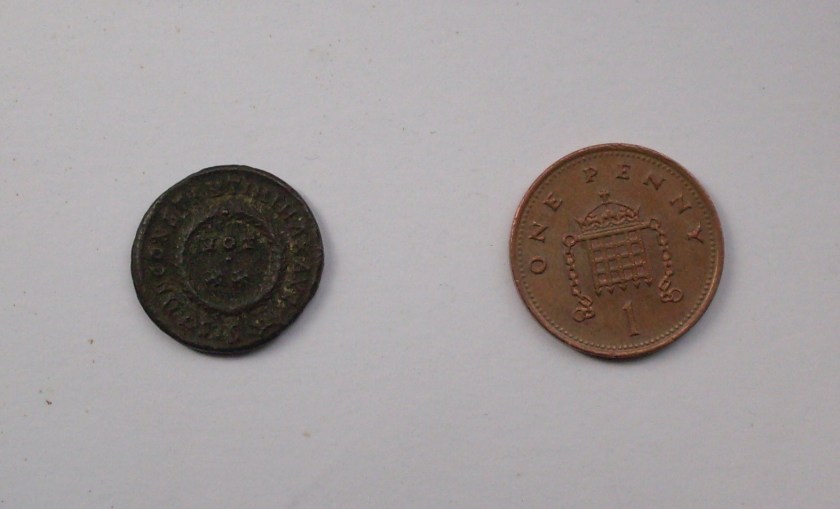
The coin I have added to my collection this month is a bronze Follis of Constantine I. Dating from around 307 (when he became emperor of the Western Roman Empire) to 337 (when he died as emperor of the whole Roman Empire). The mint mark on the reverse tells me it was minted in Siscia, which is now modern day Sisak in Croatia. From the pictures you can see the coin itself is not very large, and due to the passage of time it about 1mm thick.
The life of Constantine the Great is too detailed and would require many blog posts to do it any justice. So I will just have to suffice with a summary of the more notable events which occurred during his life.
Constantine was born in Naissus (which is the modern day city of Niš in Serbia) and would grow up in a military lifestyle. He would rise up through the ranks during many campaigns in the Eastern empire, eventually reaching the title of Tribune. The Emperor Galerius would bestow the title of ‘Augustus’ on him, and he would be sent to Britannia to campaign under his father, Flavius. After his father’s death in 306, Constantine was proclaimed emperor by the army at Eboracum (York). He would march south to claim his title, and after his victory over Maxentius at the Battle of the Milvian Bridge in 312, Constantine was proclaimed emperor of the Western Roman Empire. Several years later he would wage campaigns against Licinius, who was the Emperor of the Eastern Roman Empire. Constantine would emerge victorious in 324 after the Battle of Chrysopolis, and would become the sole emperor of the whole Roman Empire.
As emperor, Constantine reorganised much of the empire. He enacted administrative, financial, social, and military reforms in attempts to strengthen the empire. Restructuring the government by separating civil and military authorities. To reduce inflation, which was endemic at the time, he introduced a new gold coin called the Solidus. The coin itself would become a standard for Byzantine and European coinage for the next thousand years.
More famously though, Constantine was known as the emperor who legitimised the Christian faith throughout the Empire. He is known as the first Christian emperor, converting on his deathbed to the religion. During his reign he made life in the empire more palatable to Christians. He was highly influential in the declaration of the Edict of Milan in 313 which declared religious tolerance for Christians and Christianity, and in 325 he called the First Council of Nicaea which produced the Nicene Creed. Finally, upon his orders, he had the Church of the Holy Sepulchre built in Jerusalem upon the supposed resting place of Jesus Christ.
He reigned for 31 years, dying of illness in 337 in Nicomedia. Combining his years as both co-ruler and sole ruler, Constantine was the second longest reigning ruler of the Roman Empire after Augustus. His body was interred in the Church of the Holy Apostles in Constantinople.
 Numismatic Exploits