This month I will be writing about a new addition much closer to home than the last few updates I have written about.
The subject of my post this month is an English banknote issued in 1809
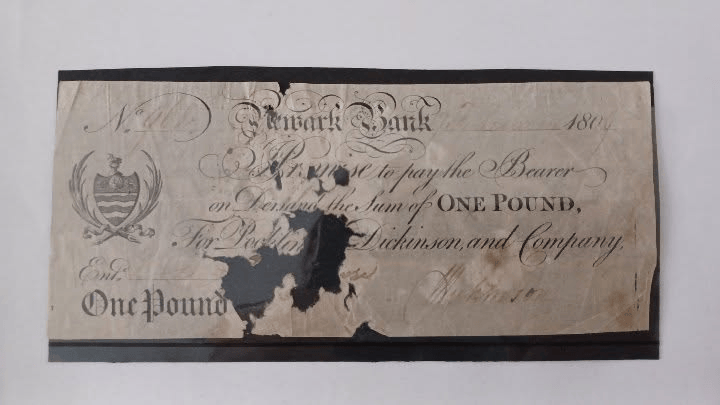
In the picture above you can see that this bank note has seen better days.
However, it is a £1 bank note issued with the date 17th February 1809. Issued by the Pocklington, Dickinson and Company for the Newark bank, it is one of many provincial banknotes which were in circulation within the United Kingdom from the late 18th century until the early 20th century (although in Scotland and N. Ireland they are still a feature of some banks).
Issued originally due to the Bank of England not have full monopoly over the currency within the United Kingdom, many local banks would issue handwritten banknotes (with some being printed, although not coming into commonality until the mid to late 19th century) to keep local economies going.
The note I have in my collection was issued for the Newark bank in Nottinghamshire by Pocklington, Dickinson and Company who also supplied another local bank at the time, the Retford Bank. Historically over time, many of these provincial banks would be amalgamated, bought out by larger banks, or face bankruptcy and close. Newark Bank would unfortunately fall under the last category and would close it’s doors a month after this note was issued in 1809.
By 1844, with the passing of the Bank Charter Act, the Bank of England would gain more control over the issuing of currency within the United Kingdom, and over the proceeding decades the rules for issuing currency within the country would be tightened and changed. The main feature would be that many provincial banks would have to back the issuing of their own currency with either physical gold or with the equal amount of currency issued by the Bank of England. With there being a shortage of gold at the time in the 19th century, many banks were forced to stop the process, with the last provincial bank in England and Wales ceasing the practice in 1921.
In Scotland and Northern Ireland however, the restrictions for the 1844 Act did not apply, and many provincial banks continued the practice. Today there are still three bank in Scotland which issue their own banknotes, and four in Northern Ireland. Though modern laws have been passed to state that these banknotes must be backed by the equivalent value of Bank of England banknotes, who issue notes on behalf of the entirety of the United Kingdom.

