Revolution is in the air…

Bonjour mes amis.

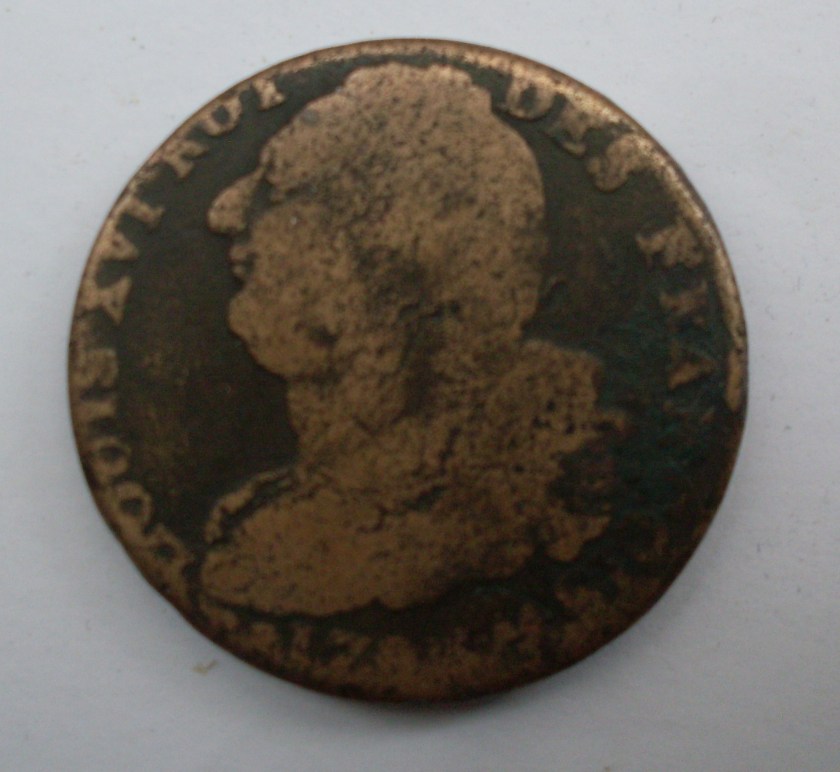
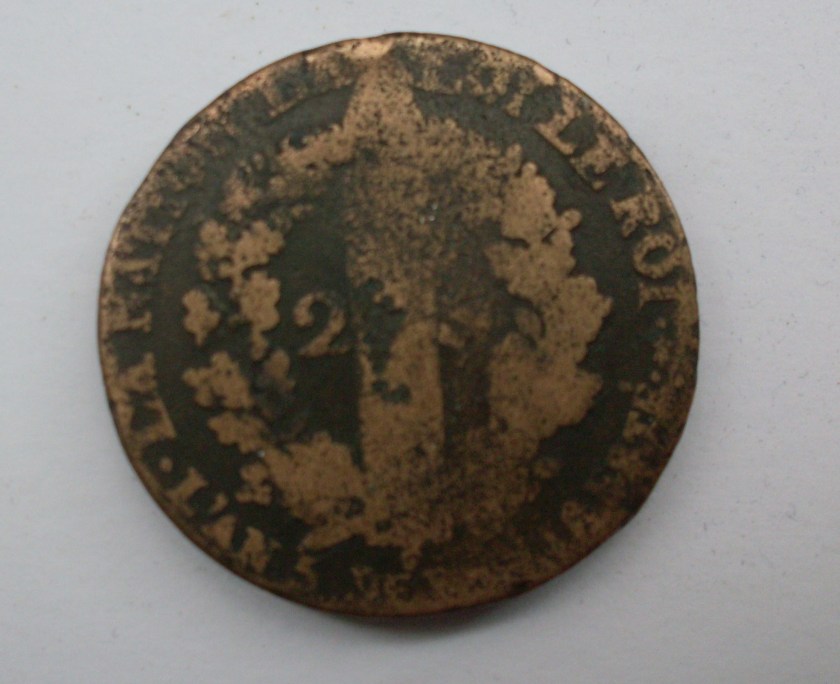
This month for my collection update we travel to revolutionary France of the late 18th century.  Dating from 1793, the piece I have recently acquired is a 2 Sol coin.  Made out of bronze, and highly worn.

SDC12952

Now the more historically knowledgeable of you are asking “Wait, why is Louis’ portrait on the coin when he was executed in 1793?”  And that is a very good question.  Although Louis was beheaded in January 1793, the revolutionary government would still issue coins with the king’s portrait on them.  Along with keeping the same weight and value of the coins.  They would also keep Louis’ titles such as ‘king of the French’ but they would be featured alongside revolutionary mottos on the reverse.
Towards the end of 1793, there would be a continuation of the monetary system of the old regime but the portrait of Louis would be removed, along with his titles, and be replaced by a stylised figure along with the value of the coin.

SDC12951

Eventually by 1795 the Republican authorities replaced the old monetary units that were in use (which were almost identical to the pounds, shilling, and pence of the UK) with a more rationalised decimal system.  Gone were the livres, sols, and deniers.  They were succeeded by centimes, decimes, and francs.  The original franc in 1795 was set as 5g of 90% silver, which was similar to the old livre.  However, the struggling republic was unable to ensure such a quality for it’s coinage, and instead was reduced to issuing paper ‘Assignats’ at a much depreciated value.

Assignats were a sort of paper bond issued by the revolutionary government backed by precious metals they had in the treasury.  It was an effort to reduce cost and keep the economy going during the subsequent crises which befell France in the following years.

Assignats themselves were issued during 1791-97 when Revolutionary France found itself attacked on all sides by the other European powers.  Forced to use what precious metal it had to fund the ongoing wars, the reliance on the paper assignats increased where eventually they became compulsory paper money.  By 1796, the number of assignats were twenty times that of the current value of precious metals the government had to back up the value of the issues.  This led to an increase in prices, with many items seeing a 500% price rise compared to what they were in 1790.

The financial situation would not stabilise until Napoleon would start winning conquests in neighbouring countries and send the captured loot back to France.

Collection Update Apr’ 2019

imgonline-com-ua-twotoone-yqDmi2GbQpibmcd


We are heading out West this month to the US.  From the picture above it can be clearly seen that I have managed to get a hold for myself two US one dollar coins.  Dating 1921 and 1922 respectively.

Dollars in the US date back to just after the Revolutionary War with their basis on the then silver Spanish Dollar which was freely accepted as circulating currency in the US until 1857.  The dollar on the left in the picture is an example of the infamous ‘Morgan’ dollar, so named after the engraver who created the design for the coin George T. Morgan.    The Morgan dollar would start life in 1878 and initially end in 1904.  However, in 1921, there was a need to melt and re-mint new silver dollar coins to be put into general circulation.  New die designs had not been completed by this point, so it was decided to resurrect the old ‘Morgan’ design until the new one could be finished.  Thus there was one further striking of the design in 1921.

On 26 December that year the new design dies were completed, and became to be known as the ‘Peace dollar’ (an example of which is on the right of the picture).  The design itself was to commemorate the “lasting” peace after WWI and originally had a sword being broken by the eagle on the reverse of the coin.  It was however interpreted than the broken sword could symbolise defeat, so an olive branch instead was quickly swapped in to be a better representation.  The design would continue to be used until 1928 when silver in domestic mines would run out.  The following year, the Great Depression would strike and production would be halted until 1934.  It would last for a further two more years until being stopped completely in 1936.  New dollar coins would not be minted in the US again until 1971 with the arrival of the Eisenhower dollar.

Collection Update Mar’ 2019

Ave Imperator!  Another ancient coin added to my collection this month, this time of the Roman variety.

SDC12928

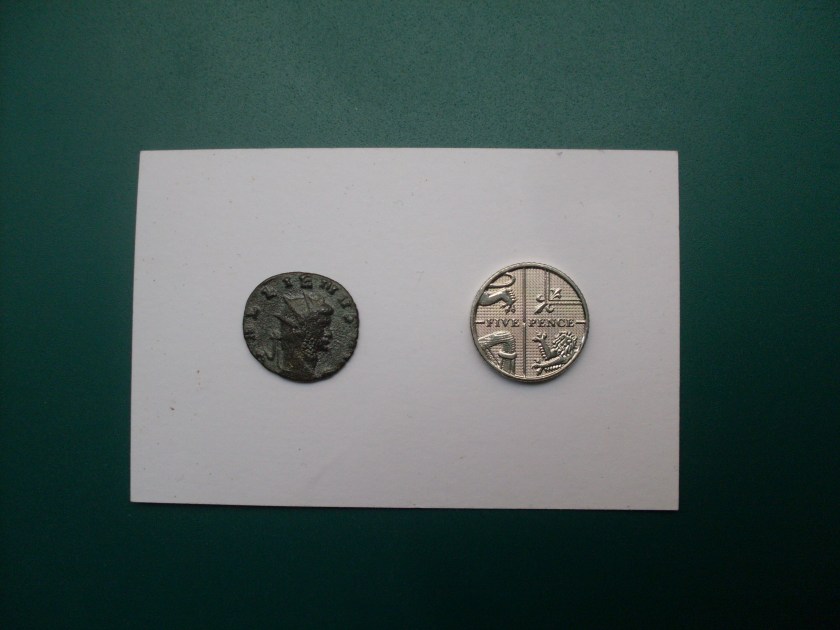
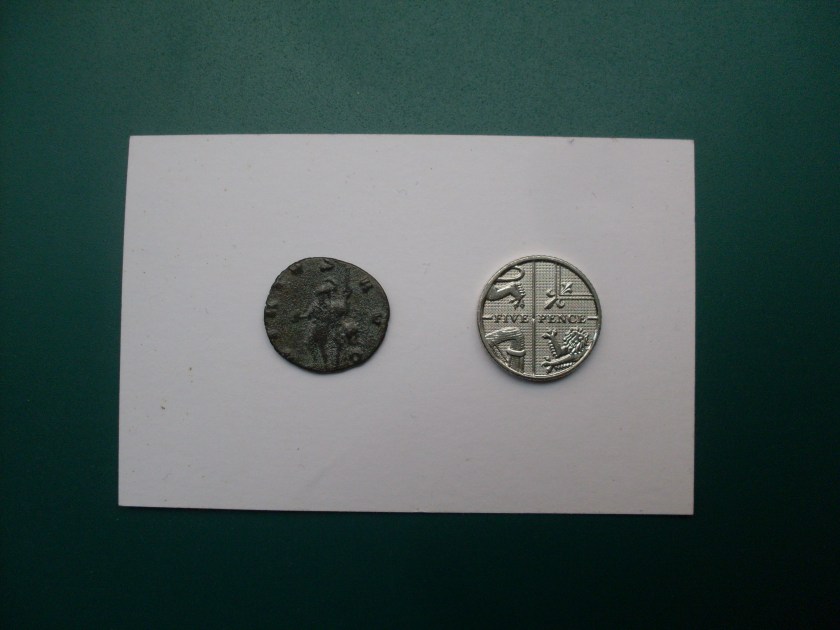
The coin showcased this month is a billon antoninianus from the Roman emperor Gallienus, who reigned as Roman Emperor from 253-268AD.  For the first seven years of his reign he ruled jointly with his father Valerian, who split the empire in half.  With Valerian ruling in the east, and his son Gallienus ruling in the West.  Gallienus would become sole ruler in 260 when his father was defeated and captured by the Sasanian Empire at the battle of Edessa (Now known as Urfa in the South-eastern part of Turkey).  After Valerian’s capture several usurpers to the imperial throne would rise up and declare themselves independent from Rome.  Civil war soon broke out.

Gallienus would have some success in defeating the usurpers, most notably the ones who arose in the eastern parts of the Empire.  He would fail however to put down those in the West, which would later form the Gallic empire under the Roman general Postumus.  Gallienus would die in 268 whilst being besieged in Mediolanum (modern day Milan) when one of his soldiers would stab him to death as part of a conspiracy.

Gallienus reigned during what is known as the ‘Crisis of the Third Century’ when barbarian migrations, political turmoil, civil wars, and peasant revolts would almost cause the collapse of the Roman empire.  The period would start in 235 with the assassination of the emperor Severus Alexander by his own troops.  With many claimants to the title of Emperor (around 26) during the next half century, many of whom were Roman army generals.  The Crisis would culminate in the Empire splitting into three distinct competing provinces.  With the Gallic Empire in the west, the Roman Empire centred on Rome in the centre, and the Palmyrene Empire in the east.

The emperor Aurelian would unite the fractured empire in the early 270’s, and the crisis would end under the rule of Diocletian in 284 with many much needed political, social and economic reforms.

SDC12927

During this period, due to the increased military activity, the coinage of the Empire grew more and more debased.  As can be clearly seen with the acquisition I got this month.  The antoninianus is thought to have the nominal value of two denarii and was initially silver.  But over time more and more copper would find itself into the coin (which of course caused hording of the older and more pure denarii and inflation in line with the decreased perceived value of the new issues) leading to an almost doubling in size of the coin during the reign of emperor Aurelian in an attempt to arrest inflation.  The debasement would continue till the coin itself would be wholly copper.  The coin I have seems to be towards the end of this transition as it still has a very faint silvery sheen to it, unfortunately not seen clearly in the photo’s.  The term to describe coins with this type of debasement are known as ‘billon’, and would not be limited to the Romans.  Examples of billon coins can be found starting from the ancient Greeks right through to the Middles Ages.

German Bundesbank Money Museum

SDC12921

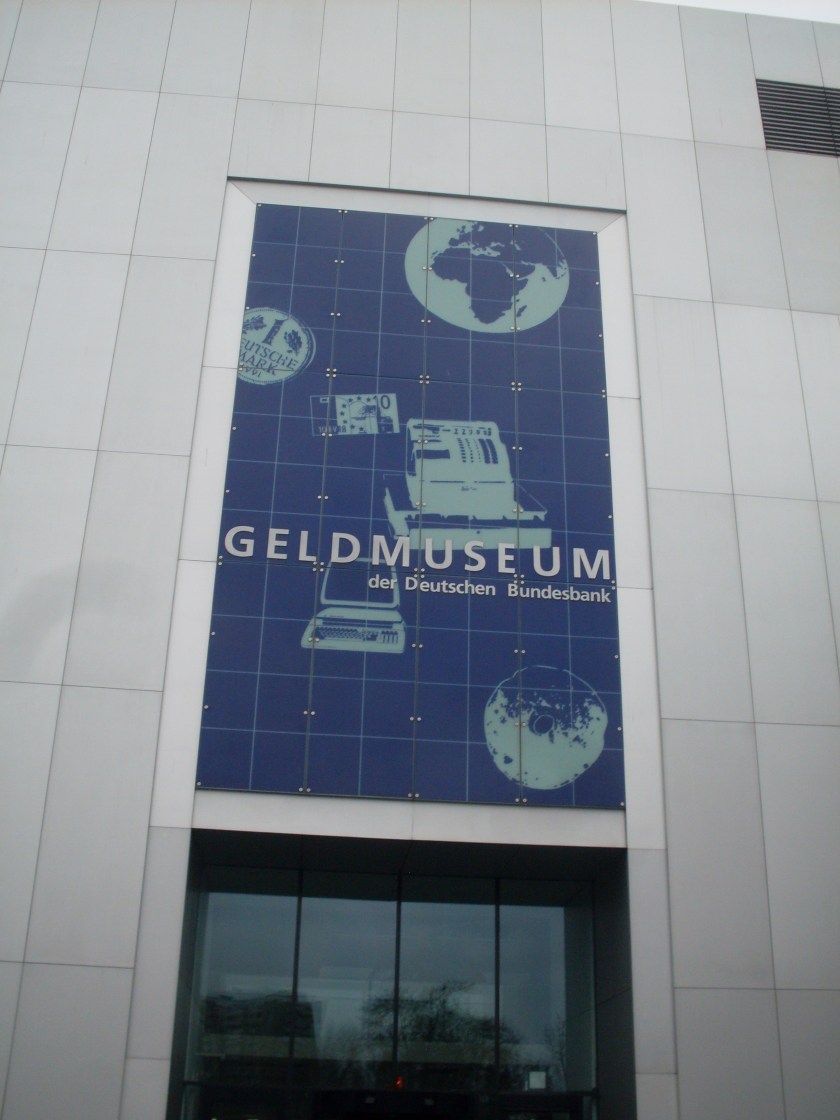
At the start of this month I recently went to Germany to visit some friends for my birthday.  Whilst there I finally had a chance to visit the Bundesbank Money museum in Frankfurt.

I should start off by saying how great this museum actually is.  It is far larger than any other money museum I have visited so far, although I will admit that the number of items on display are far fewer than others I have been to, in terms of actual historical items.

The museum is split into 4 general areas.  Two of which actually showcase the variety of coins and banknotes globally and within Germany itself, drawing examples out from monetary history.  The other two sections of the museum deal with finance itself and the role money has in society as well as how the banking sector works.


These last two sections were completely new to me.  Well, to be more honest, new in the sense that the information presented was a lot more wide-ranging and complete compared to other museums.  Often monetary policy and economic theory is just a small afterthought in most money museums.  The sections start by showing how money had evolved from the simple exchange of goods to precious metals, to the more modern equivalents of balance transfers and electronic accounts.  It goes through the history of banks, and how many ideas still used today in modern financial institutions were started back in medieval Italy and Venice.

Once through this section, visitors then get to come to grips to the more heady topics of inflation, printing of money, price exchanges between different currencies etc.  Quite heavy topics to the uninitiated, and to most quite boring (one of the main complaints from a friend who visited the museum with me).  I will admit, although have some interest in the area of economics, I did gloss over a lot of it (But to those with a keen interest, I do wholly recommend a visit).

Of course, sprinkled throughout the museum, including the economic sections on monetary policy, Germany’s financial history is explored.  With the hyperinflation of the early 20th century being a great showcase into understanding some of the more heavier topics discussed in the later sections.

SDC12918

Overall, I fully enjoyed the museum.  There was a dearth of information (written in both English and German) explaining a wide range of topics within the hobby itself.  Of course most relating to Germany and the Eurozone.  A definite must see if you happen to be in the Frankfurt area, with the added incentive being that it is completely free to enter!

SDC12924

Collection Update Feb ’19

We are heading back to Asia this month for my latest addition to my collection.  China more specifically.

The piece I got this month is something I have only ever managed to see in museums or in books.  However, I got lucky and through some of my contacts found someone willing to sell on an example from their own collection.

SDC12846

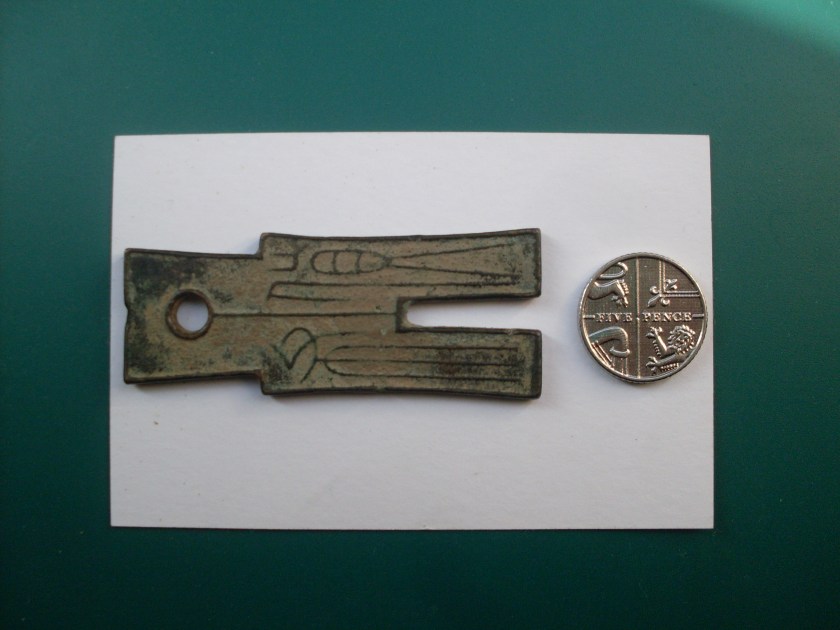
From the picture above you can see a Huo Bu (money spade) from the reign of the emperor Wang Mang (9-23AD).  Now, this is not the first time I have acquired a coin from this Chinese emperor, and I have written briefly about his reign in a previous blog post back in January last year (Here).  So I won’t regurgitate anything in this post.  So I would like to explore spade coins in general.

Chinese spade coins were first made during the Zhou dynasty (~1045 – 256 BC) and resembled a small spade or weeding tool often used by the people as an alternative form of currency.  The original spade coins would have a hollow handle at the top of the coin, representative of the wooden handle you would insert.

Towards the later period of the Zhou dynasty, the legs would be less pointed and early forms of Chinese characters would start to appear on the coins.  Further changes would happen during the warring states period (475- 221 BC).  Each of the individual states would start producing their own spade coins, and they would become much smaller and would no longer have the hollow handle at the top.  Different shapes would also begin to be produced, with examples known to exist including arched feet, rounded feet, and coins with three holes (Pictures and examples of which cane be found here).

After Emperor Qin Shi Huang has conquered the warring states in 221 BC he replaced spade coins with the titular round coins with square holes many of us are familiar with and associate with in regards to ancient Chinese coins.  This would continue until we reach our reoccurring blog favourite, Wang Mang.  When he became emperor he reissued spade coins, in an attempt to impose some legitimacy to his dynasty after he usurped the throne and forge a link with previous dynasties.  The spade coins by this time had proven to be unpopular however despite several different types being cast and issued.  Round coins were ultimately reintroduced shortly afterwards, and the spade coin was resigned to it’s place in Chinese numismatic history.

SDC12847

A New Year and a Collection Update

So it is now the end of January 2019, and I honestly can’t believe I have still managed to keep updating with this blog (I thought I would get bored after the first year).  I am now entering my third year of writing, and despite missing a few months, I feel I can keep going for many years more.

So what did I learn last year in regards to numismatics?  Honestly, I feel I learnt more about different country’s histories more than the hobby itself.  But the one major thing which has stuck with me was during my trip to Japan early in 2018.  Discovering Hansatsu notes was a novelty in itself and I felt an instant interest due to my love of unusual forms of currency (as can be seen about my post a few years ago in regards to German Notgeld).  Furthermore, as was seen in the series of posts I made about that trip, I was actually able to procure one for my collection.  Which I will happily admit is now sitting pride of place amongst other unusual items from my collection in a glass cabinet.  Hopefully this year I will be able to match it with something equally unusual and interesting.

Now despite not updating the blog at the end of December (Christmas got all my budgetary attention), I decided to get something a little more expensive than I usually go for to make up for it.

sdc12841

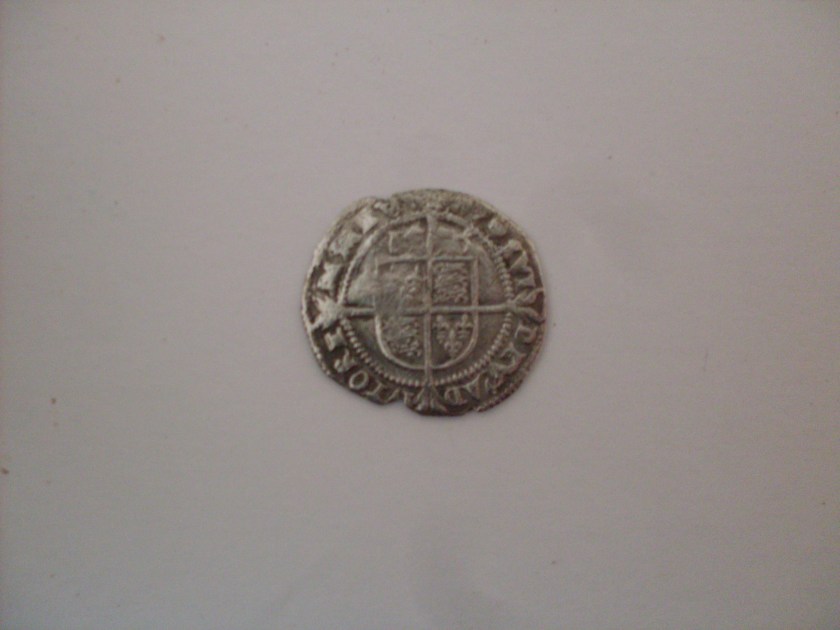
So in the picture above, and the one below, we have a silver sixpence from the reign of the well known Elizabeth I.  Measuring 19mm diameter at it’s widest point and only 1mm thick, it is not a particularly large coin.  Minted in 1575, it has the rose mint mark to the right of the portrait which denotes it was struck at the Tower of London.
sdc12843

Elizabeth’s reign has commanded libraries worth of literature.  With many Tudor historians writing reams about her.  Along with her father Henry VIII, she has typified the Tudor dynasty, especially after the short and brutal reign of her sister Mary I.

Her 44 year reign added much needed stability after the two short reigns of her brother and sister, and the political chaos surrounding the reformation in England put into motion by her father.  I could go into much detail about her reign, but the amount of information out there is too much for such a small blog post as this one.  But in short, her reign was one of precarious balance.  Defending England against the Catholic powers on the continent, whilst balancing society back at home.  The upheaval caused by the protestant reformation would cause no end of headaches for Elizabeth, with the threat of the Spanish armada in 1588 (and the equally catastrophic English armada the following year) and the Nine Years War from 1594-1603 in Ireland to name just a few.

She would survive these problems until her death in 1603, when the crown would pass to her cousin, James VI, King of Scotland (ironically the son of Mary Queen of Scots who Elizabeth had executed in 1587).  Thus ending the Tudor dynasty, and starting the Stuart one.

Collection Update Nov’ 18

SDC12829

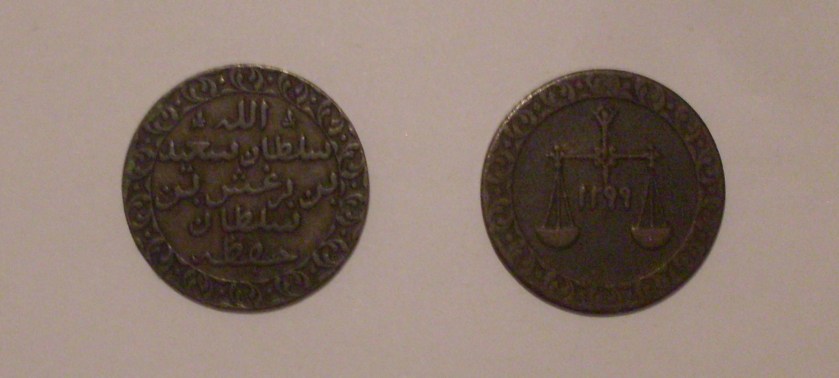
This month I have two small copper coins from the island of Zanzibar to talk about.

Minted in 1882 (1299 in the Arabic calendar) in Belgium, these two coins are from the small island of Zanzibar, now a part of Tanzania, off the coast of East Africa.  The script on the front of the coin in Arabic translates to ‘Sultan Sa’id ibn Barghash ibn
May Allah save him.”  The coin itself, is about the size of a British 10p coin, or a US quarter, with roughly the same thickness too.  The denomination is 1 pysa.

Vasco da Gama’s visit to the island in 1498 started the period of European influence on the island.  Prior to this, Zanzibar had been a small trading hub between Arabic and Indian traders in the east Indian Ocean.  Portuguese settlers would found several settlements on the island, with the main city of Stone Town being expanded.  However, Portuguese influence was very limited, much preferring to leave administrative control of the area to local leaders.  This would come to an end in 1631, when the local Sultan massacred the Portuguese inhabitants.  Direct control would occur until 1698 when Zanzibar would come under the control of the Sultan of Oman, who was invited by the local Swahili elites to remove the European presence.

Up until the late 19th century, Zanzibar would remain as a trading hub throughout the region, with many valuable goods, such as spices and ivory passing through.  It was also a major hub area for the slave trade, with as many as 50,000 slaves passing through the port each year.

This proliferation of the slave trade in Zanzibar was the root cause of British involvement on the island.  During the early 19th century, several treaties were signed between the Sultan of Zanzibar and the British to limit and eventually stop all slave trading ships passing through the territorial waters.  The Sultan, losing a key source of revenue, decided to make Zanzibar itself the centre of the slave trade in the region instead.  Finding it difficult to capture slave trading ships in the area during the 1850’s and 60’s, Britain informed the Sultanate in 1873 that a formal blockade of the island would occur unless the practice was stopped.  The pressure caused the Sultan to relent, and the Anglo-Zanzibari treaty was signed stopping the slave trade, banning slave markets and protecting the rights of freed slaves.

Eventually in 1890, Zanzibar became a protectorate of Britain.  Apart from a brief 38 minute war in 1896, the protectorate would last until 1963 when Britain passed the Zanzibar Act which ended the system.  Zanzibar did not gain independence as Britain did not officially have sovereignty over the island, but citizens of the island until that point had the right to be British citizens.  One of the most famous of these would be Freddie Mercury, who was born in Stone Town in 1946.

Museum of the National Bank of Belgium

So recently I had a small long weekend away to Brussels.  Whilst there I managed to have a chance to visit the National bank of Belgium currency museum just on the fringes of the city centre.

On first visiting the museum, the exterior is nothing too impressive.  In fact, it is quite easy to miss the entrance to the museum, as the building itself is rather nondescript.  The interior however more than makes up for a seemingly grey and lifeless building.

SDC12785

Once through the security checkpoint, you emerge out into a large hall separating both halves of the museum.  On the ground floor, you are taken through the history of coinage in Belgium, with a look at combating counterfeiting and how Belgian bankers fought to keep inflation in check during the late 19th and early 20th centuries.  It also explores the creation of the Belgian currency during the early parts of the 19th century, as the modern nation state as we now know it did not exist until 1830.  Alongside this exploration, a section is also devoted to the Euro (which Belgium adopted in 2002), which shows all the security measures featured on the current banknotes in circulation.

SDC12786

On the second floor, you are taken through a timeline of all the coins used throughout the region which would become Belgium from antiquity until modern times.  Detailed explanations, and the history of the period is given throughout in French, German, and English.  A small area is also dedicated to what I like to class as ‘funny money’, or items which have been used as coins but really don’t fit into how we traditionally see them.  These ranged from Native American shells, Chinese tea bricks, Swedish copper plates, bronze cannons from Brunei, and the infamous large stones from the islands of Yap.

Overall the museum was very good.  It certainly ranks amongst the top of all the numismatic museums I have visited so far.  What certainly puts it out ahead of some of the other museums I have visited would be the fact that information presented was translated into multiple languages so nothing was lost to any visitors regardless of triviality.  Despite the fact other museums have had much more items on display.  The fact this museum was also free to enter was simply just icing on the cake.

Collection Update Oct’ 18

This month I have gotten a coin from Britain’s only colony on the mainland of the South American continent.

SDC12761

In the picture above you can see a Stiver coin from the colony of Essequibo and Demarary, dated 1815.  These two regions now form parts of the larger state of Guyana which borders the states of Venezuela, Brazil and Suriname.

Guyana was first sighted by Columbus in the late 15th century, and an account was written down by Sir Walter Raleigh a century later.  The area was first settled by the Dutch in the early 17th and mid 18th centuries.   Britain took control of the colony in 1796 during hostilities with the French during the French Revolutionary Wars, who had at that time taken over control of the Netherlands.  The colonies were then returned to the Dutch in 1802 under the terms of the Treaty of Amiens, but were then retaken by the British a year later when hostilities in the Napoleonic Wars broke out.

The colonies were officially ceded to Britain in the Anglo-Dutch Treaty of 1814, and in 1831 the territories were consolidated into the single colony of British Guiana.

SDC12763

The British mainly developed the colony for sugarcane plantations, with many African slaves being brought here to work on them.  The process of resource exploitation would continue throughout the 19th century, with some minor diversification to exploit the bauxite deposits in the latter half, and early 20th century.  The territory would gain it’s independence from Britain in 1966, changing it’s name to Guyana.

Collection Update Sept’ 18

SDC12759

In the picture above we have this months newest addition to my collection.  Being relatively small and thin (16mm in diameter and only 1mm thick), the coin itself is relatively unremarkable.  It dates from the late 12th century, and is a joint issue Denaro from the Kingdom of Sicily.  Issued by the then Holy Roman Emperor, Henry VI, and his infant son Frederick who was crowned King of Sicily in 1198 at the age of 3.

Henry VI conquered Sicily in 1194 after successfully ransoming off the English king Richard the Lionheart after his capture and arrest whilst returning from the Third Crusade.  Using the ransom money of 150,000 silver marks ($18.5 million or £14.2 million today) to pay for the expedition.  After rooting out the Norman nobles who opposed his rule or fought him prior to the conquest Henry made his wife, Constance, Queen regnant.

SDC12760

Henry’s son, Frederick, would not however succeed to his father’s position as Holy Roman Emperor after Henry’s death in 1198.  It would not be until 1220 that Frederick would attain the crown of the Holy Roman Empire after the current incumbent, Otto of Brunswick (Otto IV), would be overthrown after his defeat at the Battle of Bouvines, a conclusive battle of the 1213-14 Anglo-French war.  Already recognised as Emperor a year and a half prior to the battle by the Southern states of the Empire, it didn’t take much for him to ascend to the throne.