Museum of the National Bank of Belgium

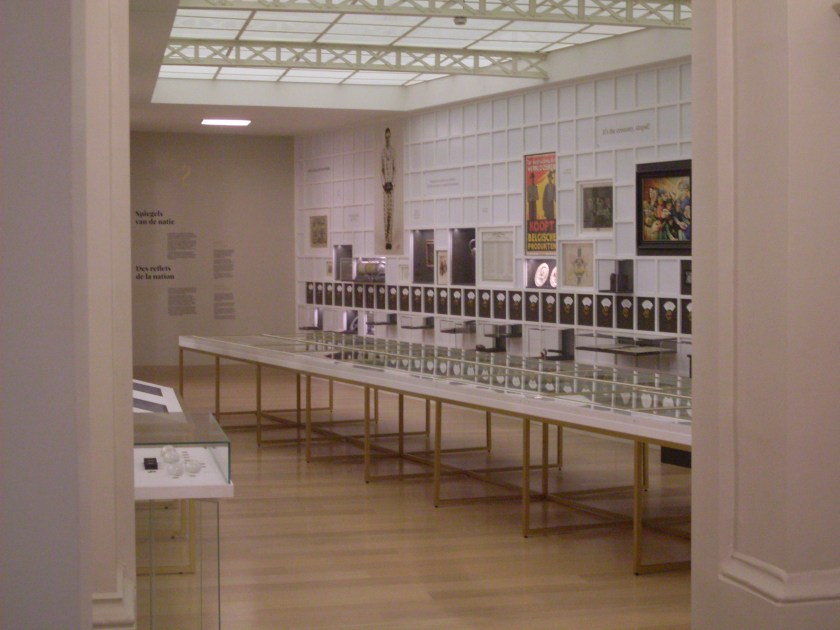
So recently I had a small long weekend away to Brussels.  Whilst there I managed to have a chance to visit the National bank of Belgium currency museum just on the fringes of the city centre.

On first visiting the museum, the exterior is nothing too impressive.  In fact, it is quite easy to miss the entrance to the museum, as the building itself is rather nondescript.  The interior however more than makes up for a seemingly grey and lifeless building.

SDC12785

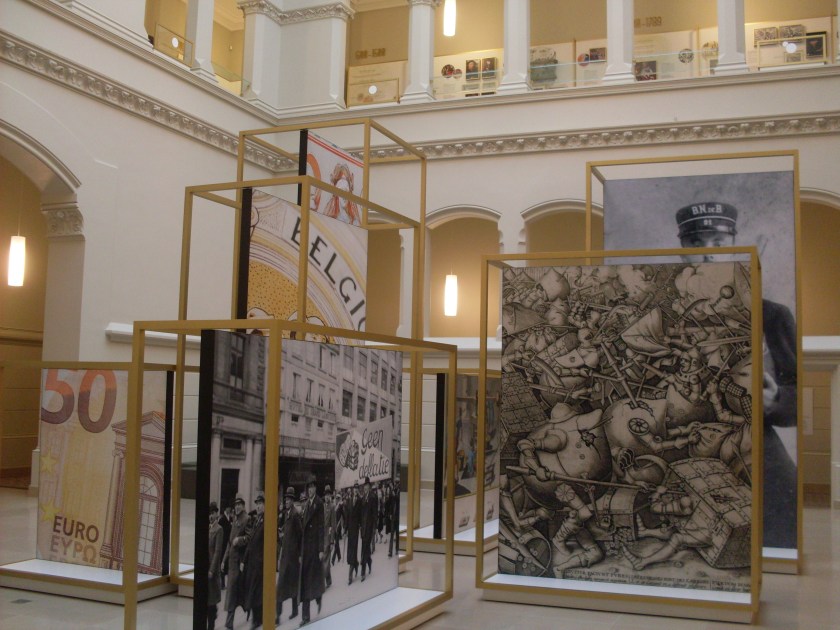
Once through the security checkpoint, you emerge out into a large hall separating both halves of the museum.  On the ground floor, you are taken through the history of coinage in Belgium, with a look at combating counterfeiting and how Belgian bankers fought to keep inflation in check during the late 19th and early 20th centuries.  It also explores the creation of the Belgian currency during the early parts of the 19th century, as the modern nation state as we now know it did not exist until 1830.  Alongside this exploration, a section is also devoted to the Euro (which Belgium adopted in 2002), which shows all the security measures featured on the current banknotes in circulation.

SDC12786

On the second floor, you are taken through a timeline of all the coins used throughout the region which would become Belgium from antiquity until modern times.  Detailed explanations, and the history of the period is given throughout in French, German, and English.  A small area is also dedicated to what I like to class as ‘funny money’, or items which have been used as coins but really don’t fit into how we traditionally see them.  These ranged from Native American shells, Chinese tea bricks, Swedish copper plates, bronze cannons from Brunei, and the infamous large stones from the islands of Yap.

Overall the museum was very good.  It certainly ranks amongst the top of all the numismatic museums I have visited so far.  What certainly puts it out ahead of some of the other museums I have visited would be the fact that information presented was translated into multiple languages so nothing was lost to any visitors regardless of triviality.  Despite the fact other museums have had much more items on display.  The fact this museum was also free to enter was simply just icing on the cake.

Collection Update Oct’ 18

This month I have gotten a coin from Britain’s only colony on the mainland of the South American continent.

SDC12761

In the picture above you can see a Stiver coin from the colony of Essequibo and Demarary, dated 1815.  These two regions now form parts of the larger state of Guyana which borders the states of Venezuela, Brazil and Suriname.

Guyana was first sighted by Columbus in the late 15th century, and an account was written down by Sir Walter Raleigh a century later.  The area was first settled by the Dutch in the early 17th and mid 18th centuries.   Britain took control of the colony in 1796 during hostilities with the French during the French Revolutionary Wars, who had at that time taken over control of the Netherlands.  The colonies were then returned to the Dutch in 1802 under the terms of the Treaty of Amiens, but were then retaken by the British a year later when hostilities in the Napoleonic Wars broke out.

The colonies were officially ceded to Britain in the Anglo-Dutch Treaty of 1814, and in 1831 the territories were consolidated into the single colony of British Guiana.

SDC12763

The British mainly developed the colony for sugarcane plantations, with many African slaves being brought here to work on them.  The process of resource exploitation would continue throughout the 19th century, with some minor diversification to exploit the bauxite deposits in the latter half, and early 20th century.  The territory would gain it’s independence from Britain in 1966, changing it’s name to Guyana.

Collection Update Sept’ 18

SDC12759

In the picture above we have this months newest addition to my collection.  Being relatively small and thin (16mm in diameter and only 1mm thick), the coin itself is relatively unremarkable.  It dates from the late 12th century, and is a joint issue Denaro from the Kingdom of Sicily.  Issued by the then Holy Roman Emperor, Henry VI, and his infant son Frederick who was crowned King of Sicily in 1198 at the age of 3.

Henry VI conquered Sicily in 1194 after successfully ransoming off the English king Richard the Lionheart after his capture and arrest whilst returning from the Third Crusade.  Using the ransom money of 150,000 silver marks ($18.5 million or £14.2 million today) to pay for the expedition.  After rooting out the Norman nobles who opposed his rule or fought him prior to the conquest Henry made his wife, Constance, Queen regnant.

SDC12760

Henry’s son, Frederick, would not however succeed to his father’s position as Holy Roman Emperor after Henry’s death in 1198.  It would not be until 1220 that Frederick would attain the crown of the Holy Roman Empire after the current incumbent, Otto of Brunswick (Otto IV), would be overthrown after his defeat at the Battle of Bouvines, a conclusive battle of the 1213-14 Anglo-French war.  Already recognised as Emperor a year and a half prior to the battle by the Southern states of the Empire, it didn’t take much for him to ascend to the throne.

Striking gold in Italy

Recently there has been news of an exciting new find in northern Italy.  In the small town of Como, workers working on the abandoned theatre there discovered a small amphora dating roughly from the 5th century AD.  What is more interesting is that the amphora was filled with roughly 300 gold coins in relatively good condition.  It was the presence of these coins which allowed archaeologists to determine the rough date when the amphora was deposited.  News of the find was issued by the Italian Ministry of Culture.

The official statement, along with many of the issued photo’s can be found here. All in the original Italian.

The Roman Empire during this period was facing a series of crises, a lot more dire than those which happened two centuries earlier.  By this point the empire had split into two.  With the thriving Eastern half of the empire being centred on Constantinople (modern day Istanbul), and historians often referring to it as the Byzantine empire.  The Western half instead was collapsing and centred on Rome, and would face several invasions by Germanic tribes in the 5th century.  Rome would be sacked by the Goths in 410AD, and again in 455AD by the Vandals.  The Western half of the empire officially came to an end in 476AD when the then emperor, Romulus Augustulus, abdicated.

Justinian I, of the Byzantine empire, attempted to reclaim some of the lands in Italy during the 6th century, but his successors were unable to keep a hold onto them, as raids and invasions by the Lombards (another Germanic tribe) increased significantly after Justinian’s death in 565AD. The Lombards eventually gradually asserted their own control over Italy until 774AD when Charlemagne conquered the area and integrated Italy into the Frankish empire.

Collection Update Aug’ 18

SDC12754

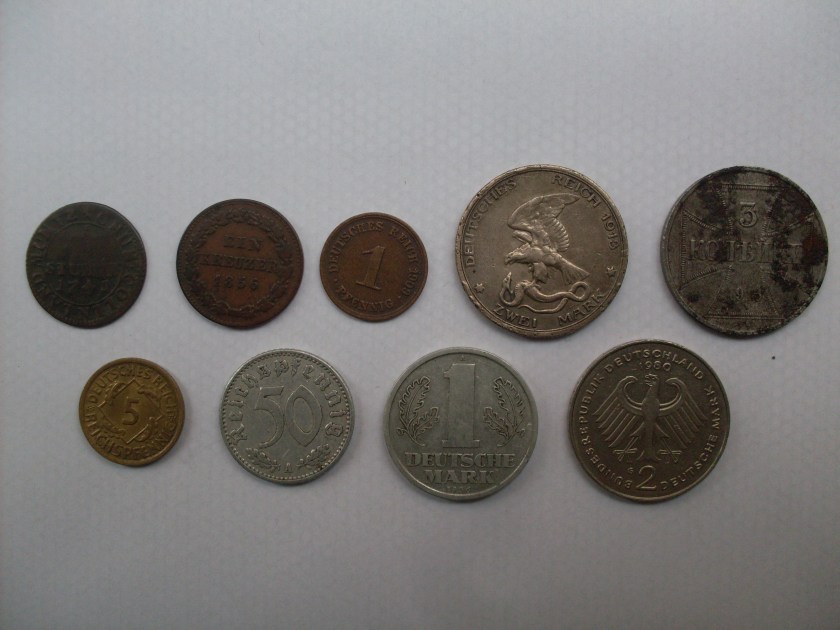
I fear that this month’s update will be quite lengthy as I recently acquired a large number of German coins stretching through just over 200 years of history.  During that time Germany went from a collection of individual states disguised as the Holy Roman Empire, to eventual unity.  Two world wars, being split again, and another eventual reunification requires me to be very scant on details otherwise it would turn into a very lengthy essay!

Our delve into Germany’s past starts with the first coin, which is a 1/4 Stuber from the German state of Cologne (dated 1741).  Cologne at this time was an archbishopric and was issued under the name of Archbishop Clemens August (his stylised monogram taking up the obverse side of the coin).

The beginnings of the Holy Roman Empire are unsure, and many scholars cannot agree whether it was Charlemagne who became the first emperor in 800AD, or Otto I in 962AD.  However, by the middle of the 18th century when the 1/4 Stuber was minted, the state of Prussia had come to dominate the Empire in it’s politics with the accession of Frederick I (the Great) to the throne of Prussia.  Frederick would eventually spark the War of the Austrian Succession (1740-48) and more importantly the Seven Years Wars (1756-63) which would sow the seeds for the American Revolutionary War, and add further fuel to the fire which caused the French Revolution.

By the time of the minting of the next coin (1 Kreuzer, 1856, Duchy of Nassau), the Empire had been dissolved 50 years previously in 1806.  This happened when Emperor Francis II’s armies were defeated by the French under Napoleon at the battle of Austerlitz.  The Emperor abdicated after signing the Treaty of Pressburg, where many of the Empire’s western territories were organised into a French satellite state called The Confederation of the Rhine.  After the end of the Napoleonic wars in 1815, the Confederation was replaced by the German confederation until 1866 when it became part of the North German Confederation founded by Prussia.  A forerunner of the German Empire which would be formed under Prussian leadership in 1871.

The unification of Germany occurred under the leadership of the Iron Chancellor, Otto von Bismarck.  The desire for a unified Germany was borne out of the revolutions which occurred in 1848-9, with the idea of pan-Germanism and the discontent felt with the traditional autocratic political structure of the current individual German states.  Bismarck desired a unified Germany, but with Prussia at the helm, not Austria.  So a series of wars were initiated to establish dominance.  The first is known as the Second Schleswig War (1864), in which Prussia and Austria attacked Denmark.  Achieving victory, both Austria and Prussia were ceded territory from Denmark, and the northern frontier of the future German Empire would be established.  However, due to collusion with Austria, the outcome of this war led to the Austro-Prussian War (1866).  The result of this war allowed Prussia to assert control over what would be the empires future southern provinces.  It also ended the idea of forming a German empire which included Austria, as this would weaken any Prussian control.

Finally, in 1870, the French declared war on Prussia starting the Franco-Prussian War (1870-1).  The French Emperor, Napoleon III, was worried about being encircled by two family members of the same house (A candidate of the Hohenzollerns was in line for the throne of Spain).  Some clever politicking by Bismarck and the infamous Ems Dispatch caused conflict to be started.  Prussia, with assistance from the Southern German states, easily defeated France. With the chief adversary to German unification being defeated, the new German empire was proclaimed in 1871 in the Hall of Mirrors in the Palace of Versailles with the Prussian King Wilhelm I becoming emperor.

SDC12753

The next few coins come from the German Empire, with the large 2 Mark (1913) being a special anniversary coin commemorating Prussia re-entering the Napoleonic Wars a century prior.  The last in the top row is a 3 Kopeks (1916) made from solid iron.  These would be issued by occupying German forces on the Eastern front in the Russian territories they had captured during WWI.

After Germany’s loss in WWI the Weimar republic was created in 1919.  The first coin on the second row is a 5 Reichpfennig (1926) from the Republic.  The Republic suffered many problems from it’s inception, ranging from hyperinflation during the Great Depression of 1929, political paramilitaries from both the Left and Right, and a contentious relationship with the victors of WWI, most notably France.  The people of Germany blamed the Republic for the loss in WWI and the humiliating requirements of the Treaty of Versailles rather than the wartime government.  This created the perfect condition for Hitler and the Nazi party to rise to power, which as everyone knows, led to WWII and the horrors committed within.  The next coin is a 50 Reichpfennig from this period, dated 1940 below the eagle and swastika.

After Nazi Germany’s defeat in WWII, Germany was split in half between the Western Allies and Soviet Russia.  The part controlled by the West was called the Federal Republic of Germany, whilst the part under Soviet control was called the German Democratic Republic.  The last two coins each come from both parts of Germany.  The 1 Deutsche Mark (1956) comes from East Germany, and it is testament to the conditions at the time under Soviet rule as the material the coin is made out of is aluminium.  Compared to the 2 Mark (1979) coin from the West which is a much more solid cupro-nickel coin.

With the fall of the Berlin Wall in November 1989, it paved the way for Germany to be reunited again after 45 years of separation in October 1990 with the Treaty on the Final Settlement with Respect to Germany.  This was further reinforced by the collapse of the Soviet Union the following year, and Germany was able to become fully sovereign in March 1991.
Collection Update Jul’ 18

imgonline-com-ua-twotoone-dSgLXQxpfDmbSiz

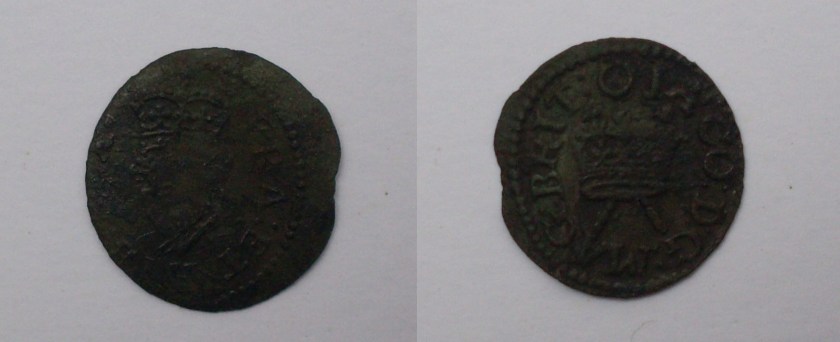
This month, I am going to talk about a small coin (about 16mm in diameter) from James I of England.  This coin is known as a ‘Lennox’ farthing, taking it’s namesake from the man who minted them.  Originally the patent to strike these coins was given to Lord Harrington by James I in 1613, due to their being an extreme shortage of small change in the country at the time (a problem which would persist until the late 18th century).  Harrington died the following year in 1614, followed shortly by his son.  The patent went to his wife who either sold it or gave it to Ludovic Stewart 2nd Duke of Lennox on June 28th 1614.

Ludovic would go on to mint five different variations of this coin.  With only one of these actually being authorised to be circulated in Ireland.  Despite a harp featuring prominently on the reverse of the coin, it was not until the fifth variation when it was allowed in Ireland.  This fifth variation is markedly different from the others, as the flan was more oval shaped than round.

The coin shown in the picture above is the third variation minted sometime between 1622-24.  This can be identified by the privy mark shown at 12 o’clock on the obverse side of the coin (above the crown and sceptres).  The privy mark shown is called an ‘annulet’ (represented by a full circle), and with this third variation a total of 22 different privy marks were used.  All in an attempt to stop forgeries.

The Duke of Lennox would die in 1624, a year before James I.  The patent to strike the coin would pass on to his widow Frances Duchess of Richmond.  The patent would be reaffirmed by James’ son Charles I, and the coins themselves would later be known as ‘Richmond’ farthings.

The Great British Coin Hunt 10p

So being a bit late to the party on this, these coins were revealed back in March of this year.  However, it is not until recently I actually managed to get my hands on some.  Released by the Royal Mint as an attempt to get younger people more interested in collecting coins, this is the first time the 10p has been used to showcase a variety of designs (usually reserved for denominations 50p and higher).  Previously the design of the 10p has been altered a few times, with the more drastic changes coming in 1992 when it was reduced in size and weight, and in 2008 when the design was changed form the crowned lion to the more common coat of arms puzzle piece.

SDC12747

The designs themselves go through each letter of the alphabet and represent a facet of British life or culture.  So in the picture above I have the coins for ‘I’, ‘Q’, and ‘W’.  The full list of them can be found here with detailed explanations about the design choice for each one.  I wonder how long it will take for me to get all 26…

Collection Update Jun ’18

SDC12745

This month I have acquired two coins from the Dutch East Indies, what is now known as Indonesia.  Both coins are relatively small, about the same size as a 10c euro piece, or a British 20p coin.  Both are relatively well worn, and thus are thin, about 1mm in thickness.  Both are valued at 1 duit, with 160 duits equalling 1 gulden.

The coins themselves date from the late 18th and early 19th centuries.  The one on the left being struck and issued by the Dutch East India Company (VoC), as seen by the companies logo on the reverse side (The logo was used in an attempt to stop smuggling in it’s Indonesian colony).  The VoC, first founded in 1602, functioned along the same lines as it’s British contemporary working to capitalise on trade in India and the Far East.  The VoC was influential in the early modern period as it pioneered the rise of corporate-led globalisation.  It became the first corporation to be listed on a formal stock exchange, and at it’s peak was the most valuable corporation ever.

The coin was struck in 1791 close to the end of the VoC’s existence as 7 years prior it had taken part in the financially disastrous Fourth Anglo-Dutch war (1780-84).  Which would eventually cause for it to be part nationalised 5 years later in 1796, and eventually completely nationalised by 1799.

SDC12746

After it was nationalised all VoC territories were taken over by the Dutch government, and all it’s assets seized.  This can be seen in the following coin on the right which was issued for the region in 1807.  The Latinised form of the name Batavia is the colonial name of what is now central Jakarta.  Indonesia declared it’s independence from colonial rule after the Japanese surrender in WWII.  However, the Dutch government refused to relinquish control and an armed and diplomatic struggle broke out.  This would last until December 1949, when the Dutch finally recognised Indonesian independence due to international pressure.  The last part of Dutch owned territory in the area would not be gained by Indonesia until 1962 when the province of Netherlands New Guinea was handed over to them following the New York Agreement.

Collection Update May ’18

Getting back into the swing of things, this month I have a few coins from Russia which have been added to my collection.

SDC12729

Starting from left to right, there is a 10 Pennia (1905) from the province of Finland, which was a part of Russia until it gained it’s independence in 1917.  In the middle is a 1/2 Kopek from 1747, also known as a Denga. Finally on the right is a Rouble proof from 1990 depicting the Russian composer Tchaikovsky.

The name Denga was the original name for Russian monetary units.  Starting back in the middle of the 14th century, denghi were originally made from silver wire which had been cut to a prescribed length and then beaten flat.  The flattened disks would then be placed between two coin dies and hammered.  Thus resulting in rather elongated oval shaped coins.  Due to poor Russian monetary policies, the denga coins were devalued constantly until the great coin reforms of Peter the Great in 1700.  Denghi were re-minted as much larger copper coins, as the previous silver coins had been reduced so much in size they weighed on average 0.14g.  The name denga was used until the middle of the 19th century when it was changed on the coins to Kopek, with a single denga equating to 1/2 Kopek.

The denga in the pictures shown dates from the reign of Tsarina Elizabeth (1741-62).  The daughter of Peter the Great, she is remembered fondly for being strongly opposed to Prussian policies and attempted German influences in the Russian court as well as not executing a single person throughout the entirety of her reign.  During her reign she led the country during the War of Austrian Succession and the Seven Years War.

SDC12728

Finland for most of it’s history was not an independent country.  It didn’t gain it’s independence until 1917 after a short and brutal civil war.  Prior to this Finland was an autonomous province of Russia which it gained in 1809 after the Finnish war against Sweden.  Prior to this Finland was part of the Swedish Empire, due to Swedish colonisation and expansion from the 13th century.  During the 20th century, Finland fought twice against the Soviet Union in the Winter War and the Continuation War to retain it’s independence.  Although gaining independence from Russia, Finland continued with the Markka as it’s currency and would eventually switch to the Euro in 2002 after joining the EU in 1995.

Now some technical information.  Proof coins are usually early samples of a coin issue, traditionally as sample coins to check dies and equipment.  Today they are struck in higher quantities for the numismatic collector market.

Most proof coins are double struck by highly polished dies.  This process allows the details to be much sharper in contrast to regular issue coins, as well as being highly polished to an almost mirror sheen.  Another difference between proof and regular issue is that proof coins are individually handled after being struck whereas regular issue are normally thrown into collection bins on mass.  The ‘proof’ moniker does not refer to the condition of the coin, but more in regards to it’s historical background and through the process in which they are made.

Tokyo coin sellers

Finishing off a small series of blog posts regarding my recent visit to Japan, I would like to close discussing my experiences with the sellers I encountered whilst visiting there.  I was hoping to visit some traders whilst in Kyoto, however due to ill weather and conflicting plans, I never had the chance, so this blog post will mainly be dealing with those sellers I interacted with in Tokyo.

The first seller I visited was Ginza Coins  (website in Japanese), funnily enough in the Ginza locale in Tokyo, south of the main train station.  I was surprised with the location of this shop, as it was located within a shopping centre (something which is deemed very unusual in the UK), and didn’t seem out of place at all with the expensive clothing boutiques surrounding it.  Many of the coins on display were behind glass cabinets, with some cheap lucky dip bins on top.  Most were Japanese, but there were some proof sets from the US and Australia for sale as well.  I think I remember seeing the odd proof Chinese coin too.  The prices themselves were not extortionate, although a little above actual catalogue price (I know most shops add extra for overheads etc).  What struck me the most was the fact that after asking to view a tray of coins the staff member quietly went back to her work and left me alone.  This was a pleasure in itself.  So often whilst perusing coins I have had staff members hovering nearby adding a subtle layer of pressure to speed up the process.  Despite being a small-ish counter top in a shopping centre I was fully relaxed and at ease.  I am not sure if this was regular Japanese business practice, or absolute trust in that I wouldn’t run away with the goods.  Either way colour me impressed.  Although….it could have been a clever sales tactic as I did buy more than I intended…

I had a somewhat similar experience at the next seller I visited.  Although further afield from downtown Tokyo, the antique shop Wasendo in Asakusa was definitely worth the walk.  Located in a small shopping arcade close to Senso-ji temple, it too had a casual atmosphere about it.  Items on offer ranged from the numismatic to the philately, as well as numerous postcards and other items accustomed to the antique.  Upon entering I was given a cheerful hello by the owner and then left to my own devices.  The shop is not very big, similar in size to Ginza Coins, but certainly has more on show and is a feast for the eyes.  Many of the items I bought during my visit were mixed in with most other items for sale, so it had an air of a treasure hunt about it.  Similarly to Ginza Coins, when asked to see if I could examine a tray of coins in one of the cabinets I was left alone without residual pressure from the shop owner to hurry up.

Items on offer were a lot more varied from those at Ginza Coins, as there were coins and banknotes stretching worldwide, so I had the feeling of being like a kid in a candy store more than I should have.  Prices were not far different from what I paid in Ginza either, but the added variety meant I had to be more choosy with my purchases.  I did end up going back after leaving as I spotted a large collection of notgeld for sale in the glass cabinet outside….  I am sure the owner thought I couldn’t stay away.

Overall, my experiences of the sellers in Tokyo was very positive, the only downside and a piece of advice I could give you is to know what you are looking for if you are searching for something specific.  Like most Japanese, communicating in English was very difficult, so resorting to gesticulating and basic phrases was a common occurrence.  Although they were extremely patient with me.  Furthermore, everything written down is in Japanese, so unless you know exactly what you are looking at, don’t expect any explanations from the staff, as again English is not really catered to.