Collection Update Apr’ 2019

imgonline-com-ua-twotoone-yqDmi2GbQpibmcd


We are heading out West this month to the US.  From the picture above it can be clearly seen that I have managed to get a hold for myself two US one dollar coins.  Dating 1921 and 1922 respectively.

Dollars in the US date back to just after the Revolutionary War with their basis on the then silver Spanish Dollar which was freely accepted as circulating currency in the US until 1857.  The dollar on the left in the picture is an example of the infamous ‘Morgan’ dollar, so named after the engraver who created the design for the coin George T. Morgan.    The Morgan dollar would start life in 1878 and initially end in 1904.  However, in 1921, there was a need to melt and re-mint new silver dollar coins to be put into general circulation.  New die designs had not been completed by this point, so it was decided to resurrect the old ‘Morgan’ design until the new one could be finished.  Thus there was one further striking of the design in 1921.

On 26 December that year the new design dies were completed, and became to be known as the ‘Peace dollar’ (an example of which is on the right of the picture).  The design itself was to commemorate the “lasting” peace after WWI and originally had a sword being broken by the eagle on the reverse of the coin.  It was however interpreted than the broken sword could symbolise defeat, so an olive branch instead was quickly swapped in to be a better representation.  The design would continue to be used until 1928 when silver in domestic mines would run out.  The following year, the Great Depression would strike and production would be halted until 1934.  It would last for a further two more years until being stopped completely in 1936.  New dollar coins would not be minted in the US again until 1971 with the arrival of the Eisenhower dollar.

Collection Update Mar’ 2019

Ave Imperator!  Another ancient coin added to my collection this month, this time of the Roman variety.

SDC12928

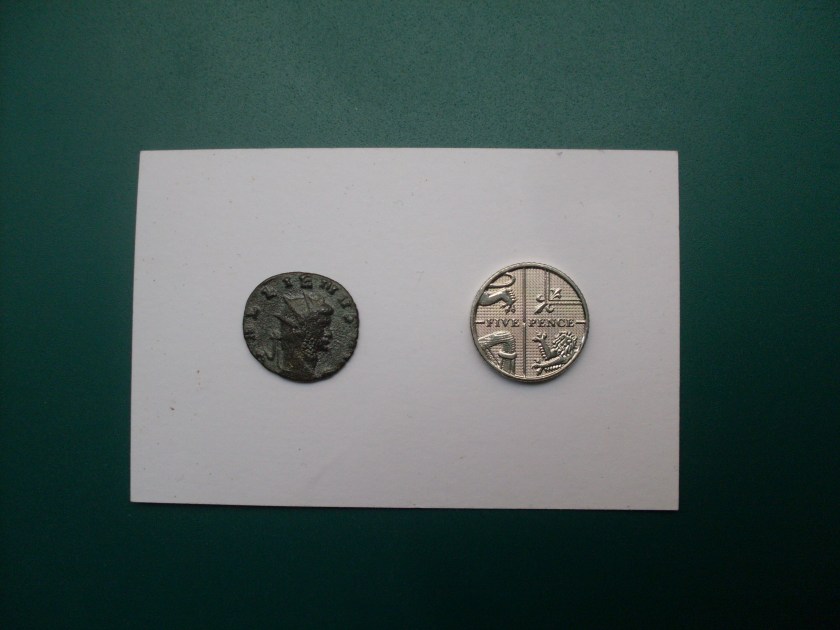
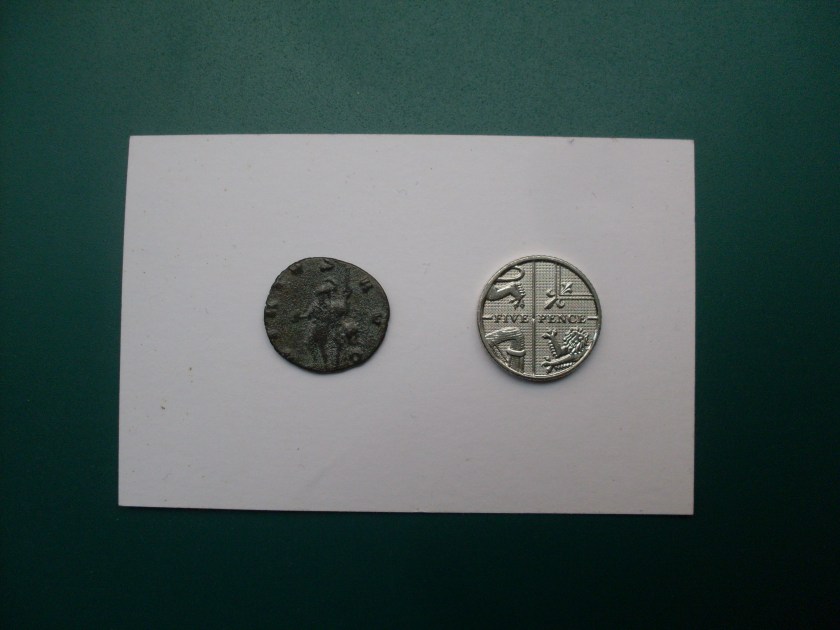
The coin showcased this month is a billon antoninianus from the Roman emperor Gallienus, who reigned as Roman Emperor from 253-268AD.  For the first seven years of his reign he ruled jointly with his father Valerian, who split the empire in half.  With Valerian ruling in the east, and his son Gallienus ruling in the West.  Gallienus would become sole ruler in 260 when his father was defeated and captured by the Sasanian Empire at the battle of Edessa (Now known as Urfa in the South-eastern part of Turkey).  After Valerian’s capture several usurpers to the imperial throne would rise up and declare themselves independent from Rome.  Civil war soon broke out.

Gallienus would have some success in defeating the usurpers, most notably the ones who arose in the eastern parts of the Empire.  He would fail however to put down those in the West, which would later form the Gallic empire under the Roman general Postumus.  Gallienus would die in 268 whilst being besieged in Mediolanum (modern day Milan) when one of his soldiers would stab him to death as part of a conspiracy.

Gallienus reigned during what is known as the ‘Crisis of the Third Century’ when barbarian migrations, political turmoil, civil wars, and peasant revolts would almost cause the collapse of the Roman empire.  The period would start in 235 with the assassination of the emperor Severus Alexander by his own troops.  With many claimants to the title of Emperor (around 26) during the next half century, many of whom were Roman army generals.  The Crisis would culminate in the Empire splitting into three distinct competing provinces.  With the Gallic Empire in the west, the Roman Empire centred on Rome in the centre, and the Palmyrene Empire in the east.

The emperor Aurelian would unite the fractured empire in the early 270’s, and the crisis would end under the rule of Diocletian in 284 with many much needed political, social and economic reforms.

SDC12927

During this period, due to the increased military activity, the coinage of the Empire grew more and more debased.  As can be clearly seen with the acquisition I got this month.  The antoninianus is thought to have the nominal value of two denarii and was initially silver.  But over time more and more copper would find itself into the coin (which of course caused hording of the older and more pure denarii and inflation in line with the decreased perceived value of the new issues) leading to an almost doubling in size of the coin during the reign of emperor Aurelian in an attempt to arrest inflation.  The debasement would continue till the coin itself would be wholly copper.  The coin I have seems to be towards the end of this transition as it still has a very faint silvery sheen to it, unfortunately not seen clearly in the photo’s.  The term to describe coins with this type of debasement are known as ‘billon’, and would not be limited to the Romans.  Examples of billon coins can be found starting from the ancient Greeks right through to the Middles Ages.

Collection Update Feb ’19

We are heading back to Asia this month for my latest addition to my collection.  China more specifically.

The piece I got this month is something I have only ever managed to see in museums or in books.  However, I got lucky and through some of my contacts found someone willing to sell on an example from their own collection.

SDC12846

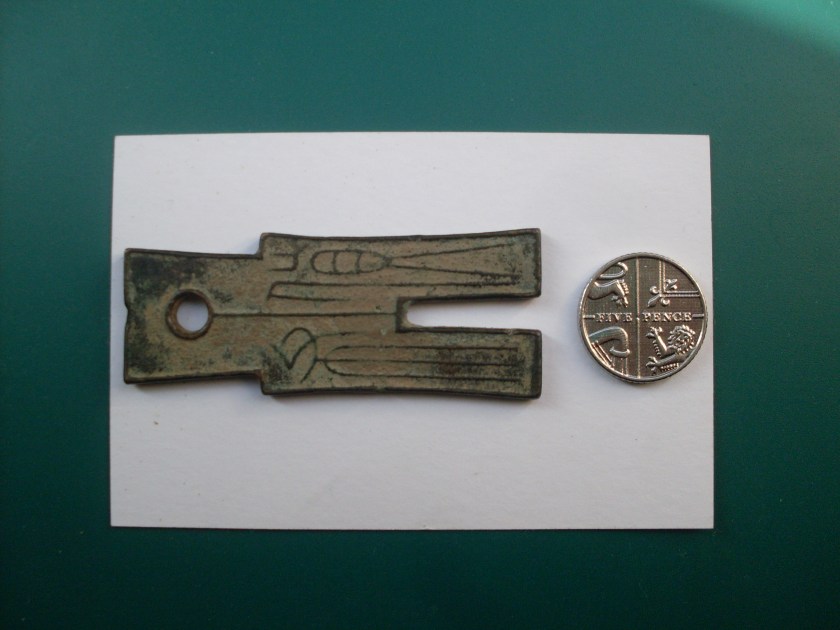
From the picture above you can see a Huo Bu (money spade) from the reign of the emperor Wang Mang (9-23AD).  Now, this is not the first time I have acquired a coin from this Chinese emperor, and I have written briefly about his reign in a previous blog post back in January last year (Here).  So I won’t regurgitate anything in this post.  So I would like to explore spade coins in general.

Chinese spade coins were first made during the Zhou dynasty (~1045 – 256 BC) and resembled a small spade or weeding tool often used by the people as an alternative form of currency.  The original spade coins would have a hollow handle at the top of the coin, representative of the wooden handle you would insert.

Towards the later period of the Zhou dynasty, the legs would be less pointed and early forms of Chinese characters would start to appear on the coins.  Further changes would happen during the warring states period (475- 221 BC).  Each of the individual states would start producing their own spade coins, and they would become much smaller and would no longer have the hollow handle at the top.  Different shapes would also begin to be produced, with examples known to exist including arched feet, rounded feet, and coins with three holes (Pictures and examples of which cane be found here).

After Emperor Qin Shi Huang has conquered the warring states in 221 BC he replaced spade coins with the titular round coins with square holes many of us are familiar with and associate with in regards to ancient Chinese coins.  This would continue until we reach our reoccurring blog favourite, Wang Mang.  When he became emperor he reissued spade coins, in an attempt to impose some legitimacy to his dynasty after he usurped the throne and forge a link with previous dynasties.  The spade coins by this time had proven to be unpopular however despite several different types being cast and issued.  Round coins were ultimately reintroduced shortly afterwards, and the spade coin was resigned to it’s place in Chinese numismatic history.

SDC12847

A New Year and a Collection Update

So it is now the end of January 2019, and I honestly can’t believe I have still managed to keep updating with this blog (I thought I would get bored after the first year).  I am now entering my third year of writing, and despite missing a few months, I feel I can keep going for many years more.

So what did I learn last year in regards to numismatics?  Honestly, I feel I learnt more about different country’s histories more than the hobby itself.  But the one major thing which has stuck with me was during my trip to Japan early in 2018.  Discovering Hansatsu notes was a novelty in itself and I felt an instant interest due to my love of unusual forms of currency (as can be seen about my post a few years ago in regards to German Notgeld).  Furthermore, as was seen in the series of posts I made about that trip, I was actually able to procure one for my collection.  Which I will happily admit is now sitting pride of place amongst other unusual items from my collection in a glass cabinet.  Hopefully this year I will be able to match it with something equally unusual and interesting.

Now despite not updating the blog at the end of December (Christmas got all my budgetary attention), I decided to get something a little more expensive than I usually go for to make up for it.

sdc12841

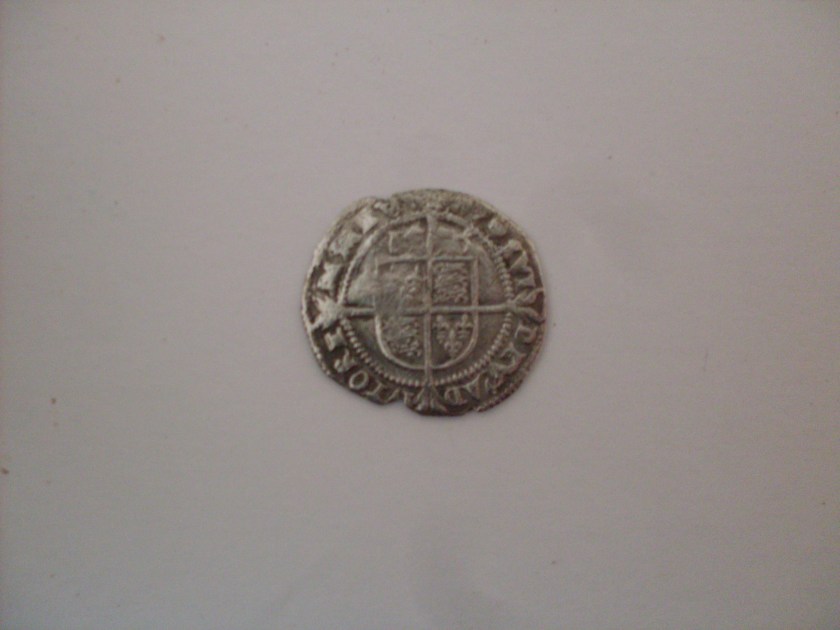
So in the picture above, and the one below, we have a silver sixpence from the reign of the well known Elizabeth I.  Measuring 19mm diameter at it’s widest point and only 1mm thick, it is not a particularly large coin.  Minted in 1575, it has the rose mint mark to the right of the portrait which denotes it was struck at the Tower of London.
sdc12843

Elizabeth’s reign has commanded libraries worth of literature.  With many Tudor historians writing reams about her.  Along with her father Henry VIII, she has typified the Tudor dynasty, especially after the short and brutal reign of her sister Mary I.

Her 44 year reign added much needed stability after the two short reigns of her brother and sister, and the political chaos surrounding the reformation in England put into motion by her father.  I could go into much detail about her reign, but the amount of information out there is too much for such a small blog post as this one.  But in short, her reign was one of precarious balance.  Defending England against the Catholic powers on the continent, whilst balancing society back at home.  The upheaval caused by the protestant reformation would cause no end of headaches for Elizabeth, with the threat of the Spanish armada in 1588 (and the equally catastrophic English armada the following year) and the Nine Years War from 1594-1603 in Ireland to name just a few.

She would survive these problems until her death in 1603, when the crown would pass to her cousin, James VI, King of Scotland (ironically the son of Mary Queen of Scots who Elizabeth had executed in 1587).  Thus ending the Tudor dynasty, and starting the Stuart one.

Collection Update Nov’ 18

SDC12829

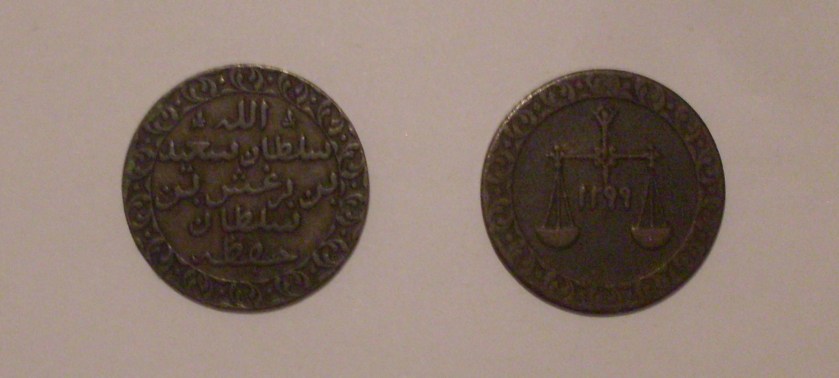
This month I have two small copper coins from the island of Zanzibar to talk about.

Minted in 1882 (1299 in the Arabic calendar) in Belgium, these two coins are from the small island of Zanzibar, now a part of Tanzania, off the coast of East Africa.  The script on the front of the coin in Arabic translates to ‘Sultan Sa’id ibn Barghash ibn
May Allah save him.”  The coin itself, is about the size of a British 10p coin, or a US quarter, with roughly the same thickness too.  The denomination is 1 pysa.

Vasco da Gama’s visit to the island in 1498 started the period of European influence on the island.  Prior to this, Zanzibar had been a small trading hub between Arabic and Indian traders in the east Indian Ocean.  Portuguese settlers would found several settlements on the island, with the main city of Stone Town being expanded.  However, Portuguese influence was very limited, much preferring to leave administrative control of the area to local leaders.  This would come to an end in 1631, when the local Sultan massacred the Portuguese inhabitants.  Direct control would occur until 1698 when Zanzibar would come under the control of the Sultan of Oman, who was invited by the local Swahili elites to remove the European presence.

Up until the late 19th century, Zanzibar would remain as a trading hub throughout the region, with many valuable goods, such as spices and ivory passing through.  It was also a major hub area for the slave trade, with as many as 50,000 slaves passing through the port each year.

This proliferation of the slave trade in Zanzibar was the root cause of British involvement on the island.  During the early 19th century, several treaties were signed between the Sultan of Zanzibar and the British to limit and eventually stop all slave trading ships passing through the territorial waters.  The Sultan, losing a key source of revenue, decided to make Zanzibar itself the centre of the slave trade in the region instead.  Finding it difficult to capture slave trading ships in the area during the 1850’s and 60’s, Britain informed the Sultanate in 1873 that a formal blockade of the island would occur unless the practice was stopped.  The pressure caused the Sultan to relent, and the Anglo-Zanzibari treaty was signed stopping the slave trade, banning slave markets and protecting the rights of freed slaves.

Eventually in 1890, Zanzibar became a protectorate of Britain.  Apart from a brief 38 minute war in 1896, the protectorate would last until 1963 when Britain passed the Zanzibar Act which ended the system.  Zanzibar did not gain independence as Britain did not officially have sovereignty over the island, but citizens of the island until that point had the right to be British citizens.  One of the most famous of these would be Freddie Mercury, who was born in Stone Town in 1946.

Collection Update Oct’ 18

This month I have gotten a coin from Britain’s only colony on the mainland of the South American continent.

SDC12761

In the picture above you can see a Stiver coin from the colony of Essequibo and Demarary, dated 1815.  These two regions now form parts of the larger state of Guyana which borders the states of Venezuela, Brazil and Suriname.

Guyana was first sighted by Columbus in the late 15th century, and an account was written down by Sir Walter Raleigh a century later.  The area was first settled by the Dutch in the early 17th and mid 18th centuries.   Britain took control of the colony in 1796 during hostilities with the French during the French Revolutionary Wars, who had at that time taken over control of the Netherlands.  The colonies were then returned to the Dutch in 1802 under the terms of the Treaty of Amiens, but were then retaken by the British a year later when hostilities in the Napoleonic Wars broke out.

The colonies were officially ceded to Britain in the Anglo-Dutch Treaty of 1814, and in 1831 the territories were consolidated into the single colony of British Guiana.

SDC12763

The British mainly developed the colony for sugarcane plantations, with many African slaves being brought here to work on them.  The process of resource exploitation would continue throughout the 19th century, with some minor diversification to exploit the bauxite deposits in the latter half, and early 20th century.  The territory would gain it’s independence from Britain in 1966, changing it’s name to Guyana.

Collection Update Sept’ 18

SDC12759

In the picture above we have this months newest addition to my collection.  Being relatively small and thin (16mm in diameter and only 1mm thick), the coin itself is relatively unremarkable.  It dates from the late 12th century, and is a joint issue Denaro from the Kingdom of Sicily.  Issued by the then Holy Roman Emperor, Henry VI, and his infant son Frederick who was crowned King of Sicily in 1198 at the age of 3.

Henry VI conquered Sicily in 1194 after successfully ransoming off the English king Richard the Lionheart after his capture and arrest whilst returning from the Third Crusade.  Using the ransom money of 150,000 silver marks ($18.5 million or £14.2 million today) to pay for the expedition.  After rooting out the Norman nobles who opposed his rule or fought him prior to the conquest Henry made his wife, Constance, Queen regnant.

SDC12760

Henry’s son, Frederick, would not however succeed to his father’s position as Holy Roman Emperor after Henry’s death in 1198.  It would not be until 1220 that Frederick would attain the crown of the Holy Roman Empire after the current incumbent, Otto of Brunswick (Otto IV), would be overthrown after his defeat at the Battle of Bouvines, a conclusive battle of the 1213-14 Anglo-French war.  Already recognised as Emperor a year and a half prior to the battle by the Southern states of the Empire, it didn’t take much for him to ascend to the throne.

Collection Update Aug’ 18

SDC12754

I fear that this month’s update will be quite lengthy as I recently acquired a large number of German coins stretching through just over 200 years of history.  During that time Germany went from a collection of individual states disguised as the Holy Roman Empire, to eventual unity.  Two world wars, being split again, and another eventual reunification requires me to be very scant on details otherwise it would turn into a very lengthy essay!

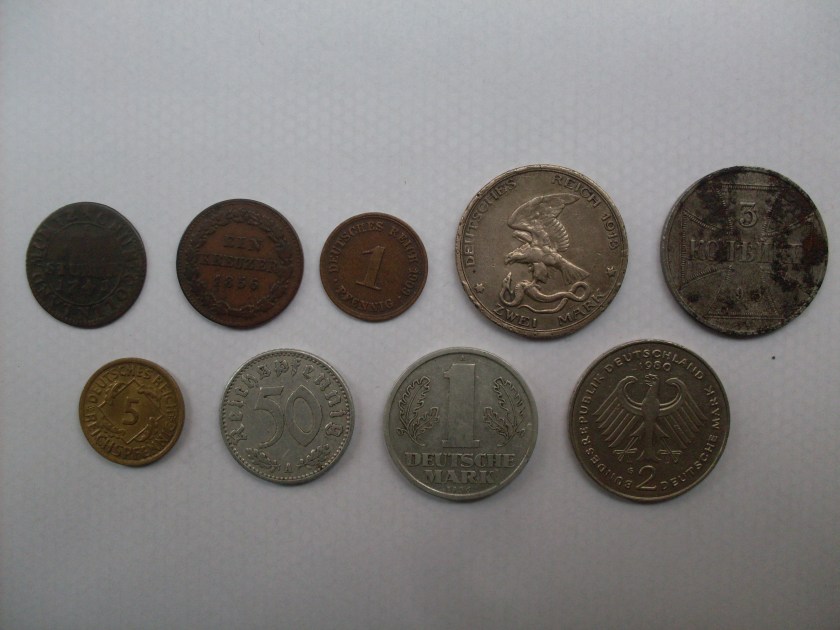
Our delve into Germany’s past starts with the first coin, which is a 1/4 Stuber from the German state of Cologne (dated 1741).  Cologne at this time was an archbishopric and was issued under the name of Archbishop Clemens August (his stylised monogram taking up the obverse side of the coin).

The beginnings of the Holy Roman Empire are unsure, and many scholars cannot agree whether it was Charlemagne who became the first emperor in 800AD, or Otto I in 962AD.  However, by the middle of the 18th century when the 1/4 Stuber was minted, the state of Prussia had come to dominate the Empire in it’s politics with the accession of Frederick I (the Great) to the throne of Prussia.  Frederick would eventually spark the War of the Austrian Succession (1740-48) and more importantly the Seven Years Wars (1756-63) which would sow the seeds for the American Revolutionary War, and add further fuel to the fire which caused the French Revolution.

By the time of the minting of the next coin (1 Kreuzer, 1856, Duchy of Nassau), the Empire had been dissolved 50 years previously in 1806.  This happened when Emperor Francis II’s armies were defeated by the French under Napoleon at the battle of Austerlitz.  The Emperor abdicated after signing the Treaty of Pressburg, where many of the Empire’s western territories were organised into a French satellite state called The Confederation of the Rhine.  After the end of the Napoleonic wars in 1815, the Confederation was replaced by the German confederation until 1866 when it became part of the North German Confederation founded by Prussia.  A forerunner of the German Empire which would be formed under Prussian leadership in 1871.

The unification of Germany occurred under the leadership of the Iron Chancellor, Otto von Bismarck.  The desire for a unified Germany was borne out of the revolutions which occurred in 1848-9, with the idea of pan-Germanism and the discontent felt with the traditional autocratic political structure of the current individual German states.  Bismarck desired a unified Germany, but with Prussia at the helm, not Austria.  So a series of wars were initiated to establish dominance.  The first is known as the Second Schleswig War (1864), in which Prussia and Austria attacked Denmark.  Achieving victory, both Austria and Prussia were ceded territory from Denmark, and the northern frontier of the future German Empire would be established.  However, due to collusion with Austria, the outcome of this war led to the Austro-Prussian War (1866).  The result of this war allowed Prussia to assert control over what would be the empires future southern provinces.  It also ended the idea of forming a German empire which included Austria, as this would weaken any Prussian control.

Finally, in 1870, the French declared war on Prussia starting the Franco-Prussian War (1870-1).  The French Emperor, Napoleon III, was worried about being encircled by two family members of the same house (A candidate of the Hohenzollerns was in line for the throne of Spain).  Some clever politicking by Bismarck and the infamous Ems Dispatch caused conflict to be started.  Prussia, with assistance from the Southern German states, easily defeated France. With the chief adversary to German unification being defeated, the new German empire was proclaimed in 1871 in the Hall of Mirrors in the Palace of Versailles with the Prussian King Wilhelm I becoming emperor.

SDC12753

The next few coins come from the German Empire, with the large 2 Mark (1913) being a special anniversary coin commemorating Prussia re-entering the Napoleonic Wars a century prior.  The last in the top row is a 3 Kopeks (1916) made from solid iron.  These would be issued by occupying German forces on the Eastern front in the Russian territories they had captured during WWI.

After Germany’s loss in WWI the Weimar republic was created in 1919.  The first coin on the second row is a 5 Reichpfennig (1926) from the Republic.  The Republic suffered many problems from it’s inception, ranging from hyperinflation during the Great Depression of 1929, political paramilitaries from both the Left and Right, and a contentious relationship with the victors of WWI, most notably France.  The people of Germany blamed the Republic for the loss in WWI and the humiliating requirements of the Treaty of Versailles rather than the wartime government.  This created the perfect condition for Hitler and the Nazi party to rise to power, which as everyone knows, led to WWII and the horrors committed within.  The next coin is a 50 Reichpfennig from this period, dated 1940 below the eagle and swastika.

After Nazi Germany’s defeat in WWII, Germany was split in half between the Western Allies and Soviet Russia.  The part controlled by the West was called the Federal Republic of Germany, whilst the part under Soviet control was called the German Democratic Republic.  The last two coins each come from both parts of Germany.  The 1 Deutsche Mark (1956) comes from East Germany, and it is testament to the conditions at the time under Soviet rule as the material the coin is made out of is aluminium.  Compared to the 2 Mark (1979) coin from the West which is a much more solid cupro-nickel coin.

With the fall of the Berlin Wall in November 1989, it paved the way for Germany to be reunited again after 45 years of separation in October 1990 with the Treaty on the Final Settlement with Respect to Germany.  This was further reinforced by the collapse of the Soviet Union the following year, and Germany was able to become fully sovereign in March 1991.
Collection Update Jul’ 18

imgonline-com-ua-twotoone-dSgLXQxpfDmbSiz

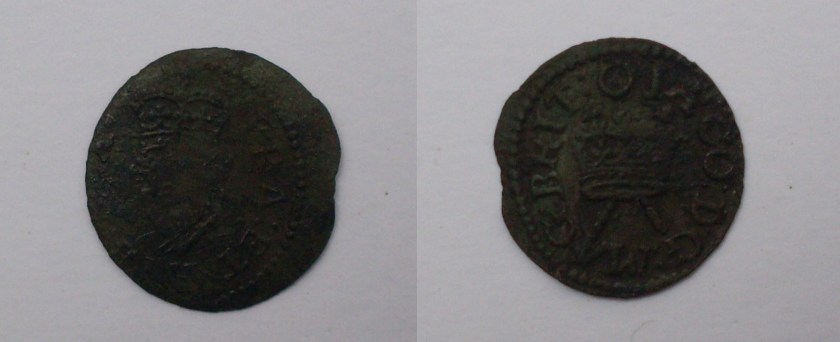
This month, I am going to talk about a small coin (about 16mm in diameter) from James I of England.  This coin is known as a ‘Lennox’ farthing, taking it’s namesake from the man who minted them.  Originally the patent to strike these coins was given to Lord Harrington by James I in 1613, due to their being an extreme shortage of small change in the country at the time (a problem which would persist until the late 18th century).  Harrington died the following year in 1614, followed shortly by his son.  The patent went to his wife who either sold it or gave it to Ludovic Stewart 2nd Duke of Lennox on June 28th 1614.

Ludovic would go on to mint five different variations of this coin.  With only one of these actually being authorised to be circulated in Ireland.  Despite a harp featuring prominently on the reverse of the coin, it was not until the fifth variation when it was allowed in Ireland.  This fifth variation is markedly different from the others, as the flan was more oval shaped than round.

The coin shown in the picture above is the third variation minted sometime between 1622-24.  This can be identified by the privy mark shown at 12 o’clock on the obverse side of the coin (above the crown and sceptres).  The privy mark shown is called an ‘annulet’ (represented by a full circle), and with this third variation a total of 22 different privy marks were used.  All in an attempt to stop forgeries.

The Duke of Lennox would die in 1624, a year before James I.  The patent to strike the coin would pass on to his widow Frances Duchess of Richmond.  The patent would be reaffirmed by James’ son Charles I, and the coins themselves would later be known as ‘Richmond’ farthings.

Collection Update Jun ’18

SDC12745

This month I have acquired two coins from the Dutch East Indies, what is now known as Indonesia.  Both coins are relatively small, about the same size as a 10c euro piece, or a British 20p coin.  Both are relatively well worn, and thus are thin, about 1mm in thickness.  Both are valued at 1 duit, with 160 duits equalling 1 gulden.

The coins themselves date from the late 18th and early 19th centuries.  The one on the left being struck and issued by the Dutch East India Company (VoC), as seen by the companies logo on the reverse side (The logo was used in an attempt to stop smuggling in it’s Indonesian colony).  The VoC, first founded in 1602, functioned along the same lines as it’s British contemporary working to capitalise on trade in India and the Far East.  The VoC was influential in the early modern period as it pioneered the rise of corporate-led globalisation.  It became the first corporation to be listed on a formal stock exchange, and at it’s peak was the most valuable corporation ever.

The coin was struck in 1791 close to the end of the VoC’s existence as 7 years prior it had taken part in the financially disastrous Fourth Anglo-Dutch war (1780-84).  Which would eventually cause for it to be part nationalised 5 years later in 1796, and eventually completely nationalised by 1799.

SDC12746

After it was nationalised all VoC territories were taken over by the Dutch government, and all it’s assets seized.  This can be seen in the following coin on the right which was issued for the region in 1807.  The Latinised form of the name Batavia is the colonial name of what is now central Jakarta.  Indonesia declared it’s independence from colonial rule after the Japanese surrender in WWII.  However, the Dutch government refused to relinquish control and an armed and diplomatic struggle broke out.  This would last until December 1949, when the Dutch finally recognised Indonesian independence due to international pressure.  The last part of Dutch owned territory in the area would not be gained by Indonesia until 1962 when the province of Netherlands New Guinea was handed over to them following the New York Agreement.