Collection Update Feb ’18

So after the last few months of exploring the coins of Asia, we return westwards to more familiar grounds and explore some coins from Italy.  The coins I have acquired date from the early 19th century during the tumultuous phase when Italy underwent several social and political revolutions which culminated in the unification of the disparate Italian states into the Kingdom of Italy in 1871, when Rome was made the capital of the new country.

imgonline-com-ua-twotoone-YMF3bM9Q3iE

Going from left to right in the picture there is a 6 Tornesi piece (1801) from the Kingdom of Naples (a much clearer picture can be found here).  In the middle is a 5 Quattrini (1826) from the Grand Duchy of Tuscany.  Finally on the far right, we have a 1 Soldo (1866) from the Papal States.

Since the fall of Rome, the Italian peninsula was divided amongst a lot of independent states which despite their close geographic position, it is often debated whether they really shared a similar culture.  Thus there was no real calls for unification.  That however changed when Napoleon invaded Italy and created the Kingdom of Italy in the North.  This quickly reverted back in 1815 after the Congress of Vienna when Napoleon was defeated.  Overall,  Italy could be split into five geographical areas.  The ultra-conservative Kingdom of Naples in the South, the theocratic Papal states in the centre.  The Austrian Empire controlled much of the North-East, and exerted control over the remaining central states of Tuscany, Parma and Modena, whilst in the North West was the only truely independent state of Sardinia, also known as Piedmont.

In 1848, there were a series of revolutions across Europe.  In Italy, revolutionaries in Milan and Venice rose up against the Austrians, Sicilians fought for independence from Naples, and in Rome they declared a Republic.  The Roman Republic was led by Giuseppe Mazzini who had founded a revolutionary group called the Young Italians and had been launching insurrections for years.

Unfortunately, in a short time the rebellions had been crushed.  Austrian’s defeated the uprisings, Neapolitans crushed the Sicilians, and French troops were sent to Rome to reinstate the Pope (they would remain in the city for some time).  This period was known as the First Italian war for Independence, and it ultimately failed.  However, it allowed the King of Sardinia, Victor Emmanuel II to position himself to lead the unification movement.

To try and gain powerful allies, in the 1850’s, he sent troops to the Crimea to fight alongside the British and the French against the Russians.  Eventually Napoleon III of France came to their aid for two reasons.  First to gain prestige and hopefully weaken the Austrian Empire, and second, in 1858 he survived an assassination attempt by an Italian revolutionary, and by allying with the Kingdom of Sardinia, hoped to curb this sort of activity.  Piedmont ceded the regions of Nice and Savoy to France, and the alliance was cemented.  They both attacked Austria in April 1858, starting the Second War of Italian Independence.  They were victorious against the Austrians, and gained further help from the central states of Tuscany, Parma and Modena who had subsequently ousted their pro-Austrian leaders.  Piedmont annexed Lombardy, and the central states that helped in the war voted to join the Kingdom.

Shortly after this victory, Guiseppe Garibaldi (a famed revolutionary who had fought in Europe and South America) was persuaded by other revolutionaries to launch the invasion Sicily.  He managed to gather a thousand volunteers, and limited support from the British.  In the 1860’s he sailed for Sicily and slowly fought his way North.  He entered Naples to much celebration and hoped to push on further to Rome.  He was further pursuaded by Victor Emmanuel to stop, because French troops were still stationed in the city.  So Garibaldi handed over his southern conquests to Victor Emmanuel, and the Kingdom of Italy was proclaimed in 1861 (minus the cities of Venice and Rome).  Italy would gain Venice in 1866 when it was handed over to France to keep them neutral during the brief war Austria fought against Germany during Bismarck’s attempts to make Germany the greater German power.  France quickly turned the city over to Italy.

Italy would not gain the city of Rome until 1870.  During this year Germany invaded France kick-starting the Franco-Prussian war.  Germany’s speedy gains in the war forced the French to withdraw the troops they had stationed in Rome, allowing the Italians to simply march in.  In 1871, Rome was declared the capital of the new Kingdom of Italy, and the unification of the country was complete.  Although joined together politically; culturally and economically, the new kingdom had many problems to overcome.


Collection Update Jan ’18

This month I am presenting the last installment of my Asia focus in regards to additions to my collection.  It is safe to say that no foray into Asia would be complete without at least touching upon China.  It dominates the region, and would be extremely hard not to at least acquire several coins from it’s extremely long history.  I have also attained another Japanese copper coin (2 Sen, Meiji Era), as well as another silver Indian coin (1 Jital, 1210-1235) from the Dehli Sultanate.

imgonline-com-ua-twotoone-ZmFusHpunV

I will start off with the rather worn and virdigrised coins on the piece of card.  Both are clearly Chinese, and the one on the left dates from the year 7-14AD.  It is a 1 Wu Shi coin from the ‘Emperor’ Wang Mang.  I use the term emperor in quotes as Wang Mang was a court official during the Han dynasty who overthrew the Emperor of the Liu family and started the new Xin dynasty (which means ‘renewed’ in Chinese) under his control.  Wang Mang was killed when the capital Chang’an (called Xi’an today) was attacked by forces loyal to the previous Han dynasty in 23AD.  The Han dynasty was restored a few years later in 25AD and would continue to rule China until the start of the Three Kingdoms period in 220AD.

The coin on the right dates from 1094-98AD, and is a 1 cash coin from the Emperor Zhe Zong of the Song dynasty.  Not much happened during Zhe Zong’s reign.  He inherited the throne at the age of nine, and was under control of his grandmother until her death in 1093.  He attempted reforms to gain further control on the empire, but due to political infighting amongst his courtiers, many of the reforms were not fully implemented.  This would eventually lead to the collapse of the Song dynasty in the 12th century.  Zhe Zong himself would die at the age of 24 in 1100.

The final two Chinese coins date from the early 20th century when China underwent massive political change and upheval.  Following the turn of the 20th century, China was in the grips of the Boxer Rebellion (1899-1901), a movement which was anti-foreign, anti-colonial, and anti-Christian.  A pro-nationalist movement which had risen up in response to meddling from foreign powers in Chinese affairs, and aggressive Christian missionaries infiltrating all aspects of Chinese life.  Chinese government officials were split on how to deal with the movement as some held sympathies due to harsh demands and exploitation inflicted by the Western Colonial powers during the previous decades.  The attitude of the Empress changed in favour of the Boxers in 1900, when international intervention was beaten back at the Battle of the Taku Forts. Eight different foreign powers sent troops to China to deal with the rebellion, and the now hostile Qing government. In 1901 the rebellion was quelled and ultimately the ruling dynasty’s control of the country.  With defeat and the apparent weakness of the ruling Qing dynasty(not just in the Boxer Rebellion, but the previous Sino-Japanese war), many military officers, students and court officials advocated a change of government to that of a Republic.  The Wuchang uprising sprung up in 1911.  Several months later, other provinces in China followed suit after receiving appeals from rebel forces, and by March 1912 the Empress of the Qing dynasty abdicated, leaving China to become a Republic.

Reflections and Collection update December ’17

So being the final blog entry of 2017, it gives one a chance to reflect on what I, as a collector and enthusiast have achieved over the last twelve months.  This year I have acquired many different types of coins, with an aim of finding new and unusual pieces for my collection.  This has caused me to start focusing on coins beyond the 20th century, or from countries which as a British person sound far-flung and exotic.  The number of coins in my collection dating from before the turn of the 20th century has significantly increased.  I feel I have attained more coins from the late 18th and early 19th centuries than I have done in the last 20 years.

This pursuit of acquiring older and older coins has yielded some fruit, and I have attained some coins dating back significantly further.  With last months post about the coins from India being a prime example.

So apart from diversifying my collection, what have I actually learnt?  I would say the one thing which comes to mind instantly is the blog entry on British token coinage I did back in the summer.  My studies at university rarely ventured beyond the early medieval period, so knowledge of numismatics beyond that and the 20th century are rudimentary at best.  Finding that Britain thought minting low value coinage as a stain on it’s integrity was novel in of itself.  Pursuing this, led me to finally acquire a Cartwheel Penny, something I have mildly wanted since first seeing them in the British Museum many years ago.  Through discovering this new type of token coinage, my own interest in alternative monetary systems has increased.  As understanding the cultural significance of money has always been a keen personal project.  As evidenced by a post I dedicated to Notgeld towards the start of this year.  Hopefully in 2018, I will be able to continue to acquire older and older pieces, but also discover more token coinage and other alternatives people have used to facilitate trade.

Speaking of acquiring things.  This month I have continued with the theme of pursuing pieces from Asia.  This time from Japan:

imgonline-com-ua-twotoone-scZZ1JlYpRI8rR6

From the picture above we can see a cast lead-bronze Japanese 100 Mon piece.  Dating from the late Edo and early Meiji era, it was cast some time between 1835 and 1870.  Most pieces were cast in either Tokyo, Osaka or Fukagawa, but there is evidence more provincial mints also produced samples.  It features on the rim, on the long oval side, two cherry blossom stamps.  In line with the central square hole.
Japan during this period went from a long period of peace and prosperity in the long running Edo period (1600-1858), during which it was ruled by the Tokugawa shogunate which enforced a policy of isolationism.  This seclusion would later be ended, and Japan opened up to the rest of the world after the American Perry expedition in 1854-3.  It was through the Meiji period (1868-1912) that Japan would receive plenty of Western influences and would begin to industrialise.  With power transferred back to the Emperor after the fall of the Shogunate in 1868, Japan was free to expand it’s influence and it’s Empire.

Collection update November ’17

This time I have gotten some new coins with a different flavour for a change.  As it is nice to step outside the bounds of Europe and N. America every so often!

SDC12468

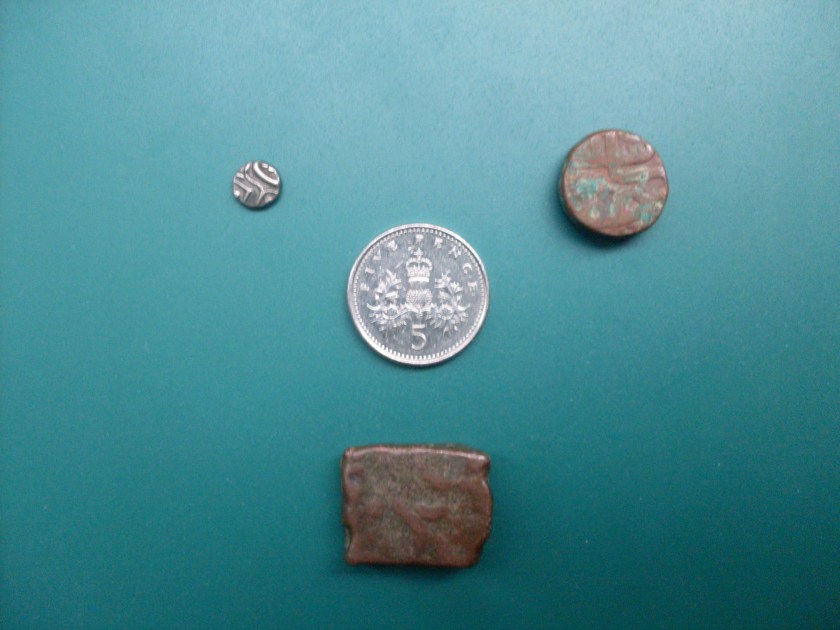
All these coins originate from India (except the 5p of course haha) and are especially small in comparison to any other coin I have in my collection.  They have a broad range of dates during India’s very long history.  Dating from before colonial activity to British rule.

The first coin is a small silver 1 Chakram piece (top left) dating from 1860-1901.  This is by far the smallest coin I have ever held in my hands, and now keep it in a small bag in case I ever drop it (which I have done and spent a furtive 20 minutes searching for it again).  It hails from the Travancore region of India located at the very southern tip of the sub-continent.  During the period of this coins minting, the kingdom of Travancore was under direct British rule.  Travancore would exist as a kingdom until 1949 when it was merged with the kingdom of Cochin. It would later form a part of the state of Kerala in 1956, with the position of king being replaced by govenor (known as a Rajpramukh) being appointed by the president of the newly formed Indian state.

SDC12469

The next coin is a 1 paisa piece (bottom) from Hyderabad, located in the South central region of India.  It dates from around 1763-1774, the period when the British East India Company was gradually exerting more control in the region creating presidencies and protectorates.  Hyderabad wouldn’t come under the sphere of British influence until 1805 when the Maratha Empire loses in the second Anglo-Maratha war.  Hyderabad itself gained it’s independence from the Mughal empire during the early 18th century when Mir Qamar-ud-Din Sidiqqi broke away from the empire and set up the Asaf Jah dynasty in control of the region.  The ruler (known as the Nizam) would control Hyderabad until 1948 when he was deposed by the new Indian army in operation Polo to prevent a potentially large hostile state remaining in the middle of the newly formed country.  The coin itself is rather worn, but a more detailed picture can be found here.

Finally, the last coin (top right) is a 1/2 Tonga from the Gujarat region of India, located in the far west of the country.  It dates from 1512-1526.  A period before any western colonial powers had an influence in the country.  Much of northern India during this period was either in control or influenced by outisde muslim forces.  Gujarat was no exception, and was attacked in the late 12th century, by Islamic forces from Eastern Iran.  The invasion failed, but Muslim influences were transmitted peacefully due to close proximity of her neighbours.  Gujarat would maintain close ties with Egypt, a powerful member of the Muslim world in the middle to late medieval period, which would later evolve to close ties with the Ottomans.  Most notably in the form of working together to prevent Portuguese naval expansion in the Red Sea area.  Gujarat would remain independent until it was conquered by the Mughal empire in 1572.  This however would not diminish the region, as the port city of Surat would continue to flourish being the only major westward facing Indian port.  This would cause the city to becoming a major trading hub on par with that of Beijing or Venice, eventually gaining the title of Bab al-Makkah (gate of Mecca).

Collection update October ’17

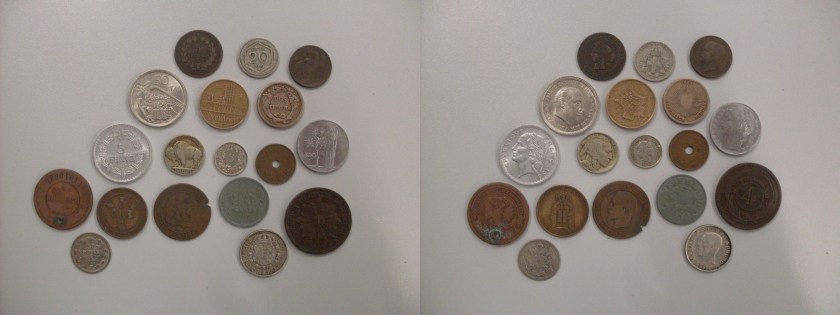
My acquisitions this month hail mainly from Europe and the Americas.  There is also a strong theme of colonialism and empire as many of the coins I have gotten date from the 19th and early 20th centuries.

imgonline-com-ua-twotoone-wibPS52IzBkPlr

Several of the coins were in very good condition, like the Uruguayan 4 Centesimos, and the Swedish krona in the bottom right corner of the pictures.  I was also pleased with silver Russian coin on the bottom left as it is the first non-copper Imperial Russian coin I now own.  However, a couple of the coins in the next picture are what I wish to focus on this month:

imgonline-com-ua-twotoone-SlSlq9mi3COZzz0U

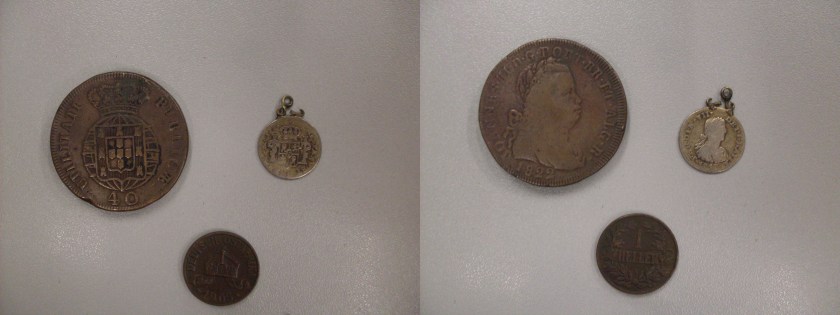
Starting from the top left we have a Portuguese 40 reis, a Mexican 1/2 real, and a German East African heller.  The Portuguese coin dates from 1822, and is a significant date in the history of Portugal.  During the previous year (1821) the current king, John VI, had previously returned from exile in Brazil due to the Napoleonic Wars and subsequent revolt and revolution.  He was invited back to Portugal to reign as king, but due to a shift in political thinking and demands made during the previous revolution, John was forced to sign a new constitution handing over several key royal perogatives to the newly formed government.  He did, but his wife refused resulting in her being stripped of all royal and political powers.  The following year, Brazil declared herself independent from Portugal, and John’s son Pedro crowned himself emperor of the newly independent empire.  It is said that whilst in exile in Brazil, John showed a hint of prescience and told his son that Brazil would soon become independent and he should declare himself as ruler before another adventurer does.

The Mexican coin also has it’s roots in colonial empire, and also can be linked to another struggle for independence.  The coin dates from 1813 when Mexico was still a colony of Spain.  However, three years prior to the minting of this coin unrest spilled into violence as a revolt led by a priest called Hidalgo rose up against the injustices suffered by the poor of Mexico.  This resulted in protracted fighting and violence between Mexican revolutionaries and the Spanish imperial administration.  In 1811 Hidalgo is captured by the Spanish army and executed, and is succeeded by José María Morelos.  Who in 1813 convened the Congress of Chilpancingo which issued the first formal declaration of independence for Mexico.  Fighting would continue for a further 8 years until on the 27th September 1821 Mexico would gain her independence as a new empire under the name of New Spain.

Finally we have the German East African Heller.  There is nothing special in regards to this coin, but I wanted to include it as it is the only coin from Africa I received in this small collection.  It also fits the over-arching theme of colonialism and imperial powers this blog post has decided to explore.  Sadly, this coin does not have ties to any independence movement.  In 1909, German East Africa comprised of Burundi, Rwanda and parts of mainland Tanzania.  These regions under German control suffered much like the rest of Africa under the colonial powers, with harsh regimes and indifference to the native populations.  Several revolts were put down during the German administration with the last in 1907. Control of the colony was sunsequently split between the British and Belgians after Germany’s loss in WWI.  The regions themselves would not gain independence from imperial administration until several decades after WWII.

Collection update September ’17

imgonline-com-ua-twotoone-br86NzvJvak4dhB

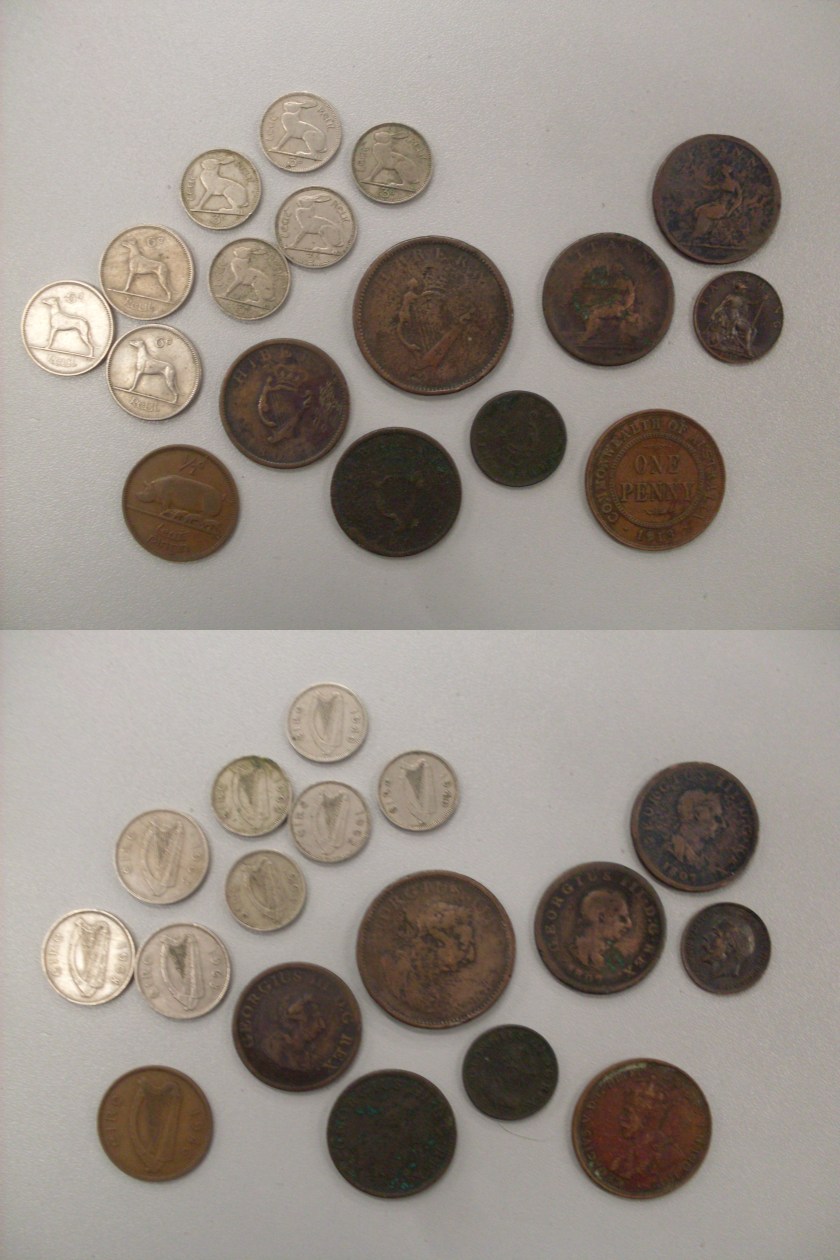
This month I got a selection of British and Irish coins, many of which I have already shown in my collection update blog posts before.  From the pictures above you can see the full range of Hibernia coins minted for Ireland during British rule, as well as a selection of coins minted for Ireland after they achieved independence in the 1920’s.  Most Irish coins still retain the harp, which is a symbol of the country itself, and is commonly featured on the country’s coat of arms.  An icon which has now been translated onto the Euro coins issued by the country.  As well as the British and Irish coins, I also acquired a coin from Australia dated from 1913.

Although George V is shown on the obverse of the coin, Australia by this point in time had become a fully independent country from Britain after the confederation bill was passed by the UK parliament in 1901.  Upon it’s independence, and it’s formation into a unified country it adopted the name Commonwealth of Australia, which can be seen on the reverse.  Despite gaining independence from Britain, Australia still retained the British monarch as it’s head of state, which is still prominently featured on it’s money today.  Similar to Canada, and other former colonial possessions.

Finally, another coin I received was a British penny dating from 1797.  From the reign of George III.

imgonline-com-ua-twotoone-LIpkAa1Cm6

Sadly, the coin itself is in bad condition, and much of detail has been lost.  However, the profile of George and Britannia can be made out.  One thing which, although not clearly seen in the pictures, is that the legends and date which decorate the edge are still clear.  This coin does need a special mention as it is the first modern British penny minted.  Prior to this, there was no official mass produced penny by the government except the silver penny which had been discontinued years beforehand and was the mainstay of British coinage for much of the previous eight centuries.  Due to it’s size and distinctive shape, it is commonly referred to as a ‘Cartwheel’ penny due to it’s uncanny resemblance to a cartwheel.

Collection update August ’17

SDC12389

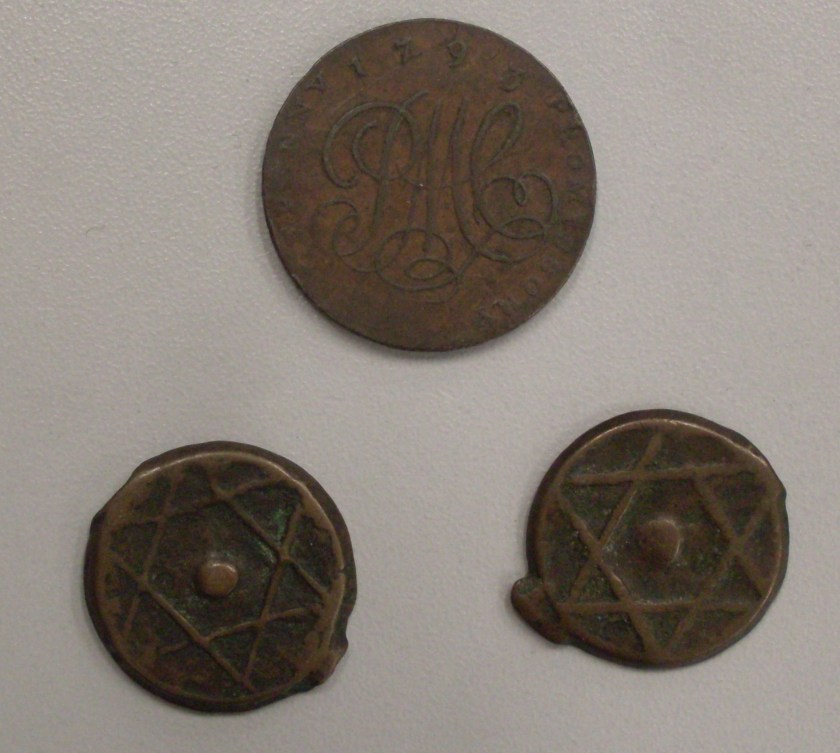
This month’s additions are a pair of bronze coins from Morocco and yet again another token.  I feel like I am getting more tokens these days than I am actual coins!  However, this token is a window into local Welsh history particular to Anglesey.

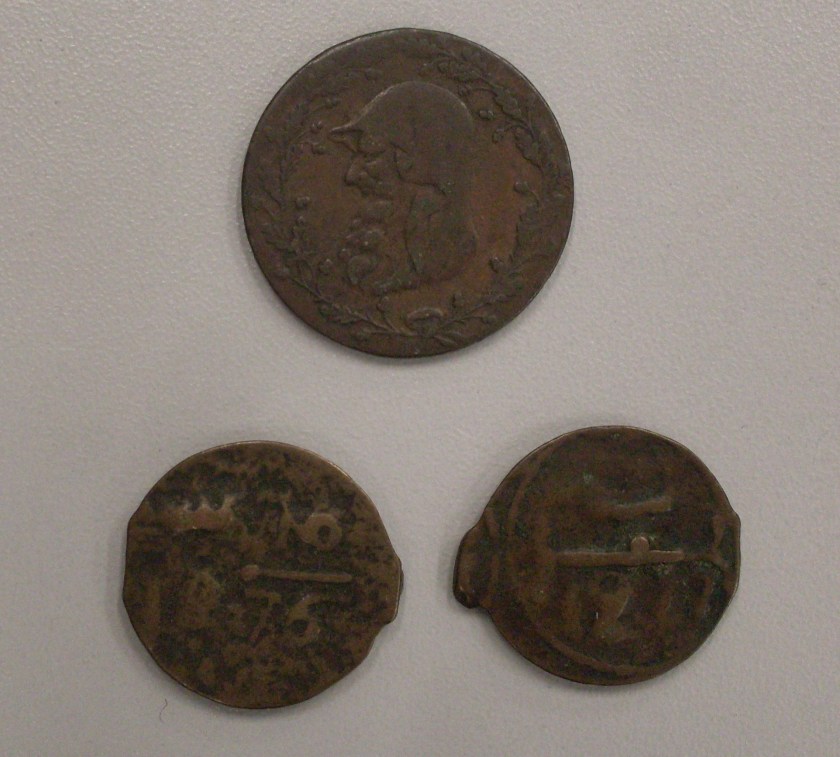
Now the story of this token references back to some of my previous blog posts, in particular, that during the late 18th century it was the practice of the British Royal Mint not to produce coinage of low numeric value as it was seen as to cheapen the name of currency.  This produced a lot of problems for the lower classes whose daily lives revolved around transactions involving small denomination coins.  As we can see, one of the outcomes was the evasion money I mentioned last month.  Another type of coinage which appeared was coins being minted by businesses and companies.  The token I acquired this month is known as the Anglesey Penny, or as it is more well known, the Druid Head Penny.  These coins were produced by the Parys Mountain Copper works to help facilitate the payment of it’s workers at it’s site in Amlwch, Anglesey.  This can be clearly seen by the PWC monogram on the reverse of the coin,  and although the picture is faded due to wear and time, a legend around the monogram promises to pay the bearer ‘one penny’ by the company itself.  The coins were first produced in 1787 and continued on until 1821 when it was made illegal to produce them.  During this time frame the idea became popular and a half-penny was minted as well, with production of these half-pennies starting in 1788 a year after the penny itself was introduced.  So why the druid motif?  This harkens back to ancient Anglesey history where the island was the spiritual home of the druidic order in Britain.  It therefore was the main focal point for the ancient Celtic religion until the druids were exterminated by the Romans in 77AD, which resultantly brought the celtic tribes under their control.

SDC12390

The other two coins which hail from Morocco are 2 bronze cast coins with the denomination of 2 Falus.  The dates are faded and worn and hard to discern, but both date from around 1275-1277 in the Arabic calendar (1858-1860).  At this time Morocco was ruled by Sultan Abd al-Rahman, who would die in 1859.  Morocco would continue to use cast bronze coins until machine milled coinage was introduced in 1882.  Apart from the cast bronze coins, Morocco also used silver and gold hammered coins for larger denominations.  Uniqely, there was no fixed exchange rate between the different denominations of coins Morocco produced, nor were the weights of the individual coins regulated.  Thus, it would be safe to assume that after haggling the price with the seller, you can further spend more happy hours haggling about the exchange rate.

Collection Update July ’17

This month’s additions to my collection is a small handfull of British copper coinage, and a single silver coin from the reign of Charles II.

Much of the earlier coins are severely worn, with the most prominent of the copper coins seeing less wear dating from 1901.  Much of the coins are copper pennies with various monarchs represented.  The earliest date is from the reign of George II, and although one of the coins exhibits a somewhat clear view of his bust on the obverse, much of the reverse showing Britannia is severely worn making it very difficult to date.

The small group of three coins in the bottome centre of the pictures however are the most interesting.  Shown here is an Irish half-penny, the exact same design as the penny shown in my collection update of last month.  It unfortunately shows the same amount of wear as it’s counterpart, although the bust of George III is more defined.

The silver coin is from the reign of Charles II, and I got it as part of this group in a bulk purchase.  It hasn’t weathered the years well, as it is slightly bent, with a hole punched through it.  It dates from 1679, 19 years after the restoration of the monarchy in the UK.  Charles’ father, Charles I was executed (and the only English monarch to have been so) by parliament after losing the Civil War to forces led by Oliver Cromwell.  Cromwell ruled the country in the role as Lord Protector until his death.  This is the only time when England has not been a monarchy, but a Commonwealth.

When Cromwell died in 1659, his son Richard was not well liked by the newly formed army, and was seen in general as a man incapable of continuing his father’s policies.  After a small coup enacted by the army, a new parliament was installed.  After much deliberation and politicking, Charles II issued the Declaration of Breda which acknowledged his acceptance of the conditions proposed to him on accepting the English crown.  The monarchy was restored in May 1660, and Charles II was crowned in April of the following year.

Finally, the only other coin of note is the modern 2p coin.  It is significant because it dates from 1971, the year that the UK decimalised it’s currency, ending the old system of pounds, shillings, and pence.  A system which is often ascribed to being the longest running monetary system globally, dating back to the Roman occupation of the British Isles.  This 2p coin however, is also of note, as instead of showing the later inscription of the value in letters above the number on the reverse, it instead uses the phrase ‘New Pence’.  A feature on the coin until 1982.  Also of note, there was a mistake in the minting of 2p coins in 1983, and some bearing the old legend of New Pence has become somewhat rare.  So remember to check your change, you may have a nice night out in the form of a copper coin!

Collection update June ’17

SDC12365

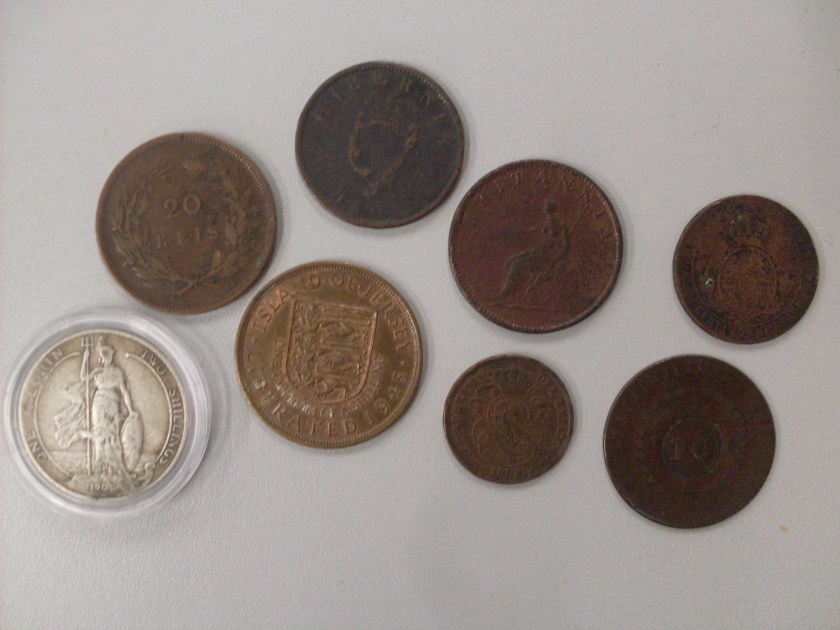
This month I managed to acquire a small smattering of 19th and early 20th century copper coins, with one silver 1904 florin.  The florin itself is interesting due to the fact it is the first design change of how Britannia was depicted on the coinage of Britain.  The usual design choice is with Britannia seated facing left, with her shield and trident by her side.  A image which can easily trace it’s roots back to Roman provincial strikes during their ~300 year occupation (The Royal Mint has a small page detailing more information about Britannia and the Romans.).  On the Florin of Edward VII we can clearly see she is standing facing right, with her customary trident and shield in hand.  This design was used until 1911 when it was changed to a pattern of crossed sceptres and shields depicting the coat of arms of the four constituant countries of the UK.

Keeping within the UK for a moment more we also have a bronze coin from the island of Jersey dated 1945, commemorating the liberation of the island from occupying German forces at the end of WWII.  Along with Guernsey and Alderney, the Channel Islands were the only part of the British Isles to be occupied by German forces during the war.  They were held from June 1940 till their peaceful liberation in May 1945.

SDC12366

To the top centre of the pictures there is a Hibernian penny dated 1805.  Unfortunately, the coin is badly worn, and the inscription, especially the portrait, of George III on the obverse is barely visible.  Hibernian coins were minted for the sole use in Ireland, and were minted after a 20 year gap due to the Napoleonic wars and the American War of Independence.  Minted in Soho, these coins were the first official issue of Irish coins in a base metal.  Most official coins being minted in precious metals such as silver.  This therefore caused a shortage of change (which was not just endemic to Ireland, but the UK as a whole at the time) leading to many ‘tokens’ being minted by locals throughout the country to fit this need.  These tokens were known as Evasion Tokens, and will be the topic of my next blog entry.

Finally, the last coin worth talking about, is the Brazillian 20 reis coin which has been counterstamped in the bottom right corner of the pictures.  Even though it is severely worn, the coin dates from the mid-1830’s when the Empire of Brazil was suffering from a series of revolts, uprisings and civil unrest.  Brazil at this time was under the control of Pedro II, the son of Pedro I who returned to Portugal to install his daughter on the throne.  Brazil was therefore ruled by a weak regency council as Pedro II was underageat the time.  The unrest began due to several wars with neighbours, but the straw which broke the camels back in regards to the currency could either have been the Cabanagem or the Malê Revolt.  Regardless, the currency was devalued in an attempt to save the country’s finances, and to save costs by not reissuing a new currency, the government simply cut the value of the coins in half.  So a 20 reis coin became a 10, and a 40 reis coin became a 20 and so on.  The new value of the coin was the counterstamp clearly seen in the middle of the reverse over the original value.  I do own several Brazillian coins with these counterstamps, but there are surviving types of this coin which do not bear the counterstamp, unfortunately I have only had the privilege of seeing them in pictures only.

Collection update May ’17

This month I will be talking about two small coins which I got as part of a small group of silver coins mainly from Denmark.  The Danish coins themselves date from the early 20th century, and like most Scandinavian coins of that era, their design, in my own personal opinion are something to be desired.  Generally sporting the value of the coin itself whilst displaying the monogram of the current monarch.  A bit lacklustre.  The second coin I want to talk about can easily fit into this category, as the design on the reverse is nothing to write home about, but the bust of the monarch is rather interesting to say the least.  However, I will move on to the first coin, as it has a bit more history attached to it.

imgonline-com-ua-twotoone-jkFhueRz2vhIj

Now above is a small silver coin from the city of Hamburg dated 1738.  It is about 17mm in diameter and about 1mm thick.  On the obverse we see the three towered castle which is the coat of arms of the city, whilst on the reverse is the date and value between some branches.  Sadly, sometime during it’s life the coin has been pierced to be worn as jewellery, thankfully it hasn’t marred much of the designs on both sides of the coin.  Even if it does leave a large ugly hole staring glaringly at you.
Hamburg itself is in a unique position within Germany, occupying an area in the north of Germany at the southern point of the Jutland peninsular. The full name of the city is the ‘Free and Hanseatic City of Hamburg’, tipping its hat to it’s medieval past and links to the Hanseatic trade league that it was a member of.  For much of Hamburgs existance it was a free city within the Holy Roman Empire, and later German Empire, being a state in it’s own right.  During the middle ages, Hamburg was one of the improtant ports within Europe due to it’s location near the North and Baltic seas, as well as being on the confluence of the rivers Elbe, Alster and Bille.  This was further strengthed by it’s status as a free city.  It was not, in fact, until after the Second World War that Hamburg lost it’s total independence from Germany itself as it was subsumed into the administration of Western Germany during British Occupation in 1949.  Where to this day it has grown to be the second largest city in Germany.

The second coin I mentioned is a silver threepence from the UK from 1819.  Now as I mentioned previously, the design of the coin itself is rather dull, but really I want to talk about the bust of George III displayed.

SDC12314

Now although the coin itself is very worn, and suffering from deep scratches on the face, a clear outline of the bust can be seen.  This bust design is known to collectors as the ‘bull-headed George’.  This was due to the engraver at the time, the Italian Benedetto Pistrucci, being unable to engrave a proper portrait from life due to George being very much insane. This portrait was thus put into use for several years between 1816-1820, and was met with much public hostility from all sectors of society.  One high ranking official in the Houses of Parliament has even been noted to have said ‘send the lot to the provinces so no-one has to see them’.  By this he meant the anywhere that wasn’t London or the south of England.  A view which is still often in use today.  Eventually the design was withdrawn from use, and the mint reverted back to the older ‘Young head’ design of the late 18th century, much to many peoples relief.  George was succeeded by his son George IV in 1820.